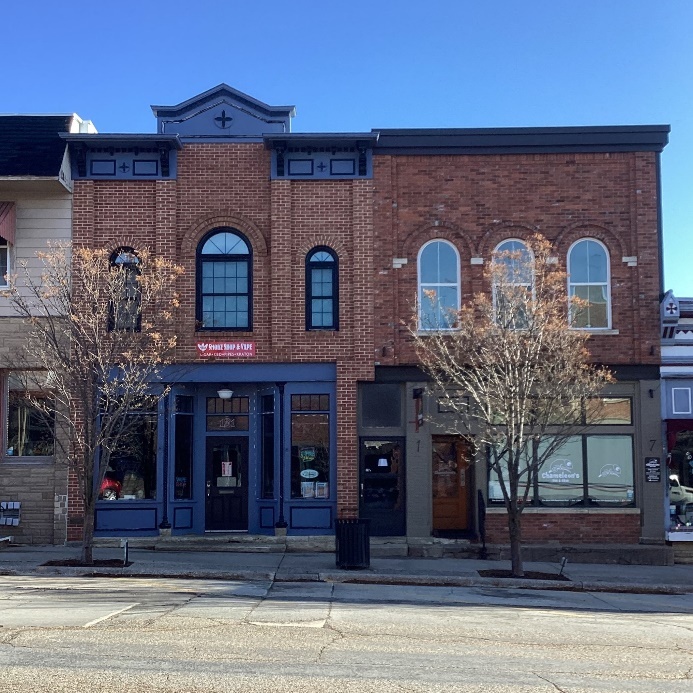
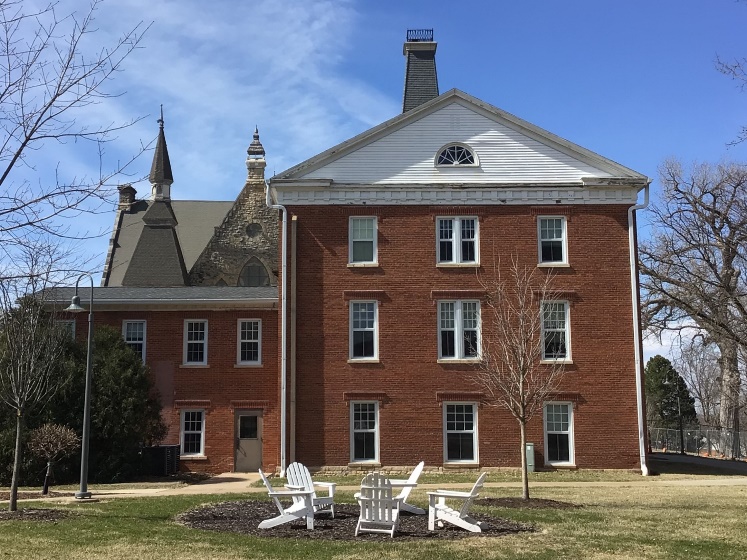
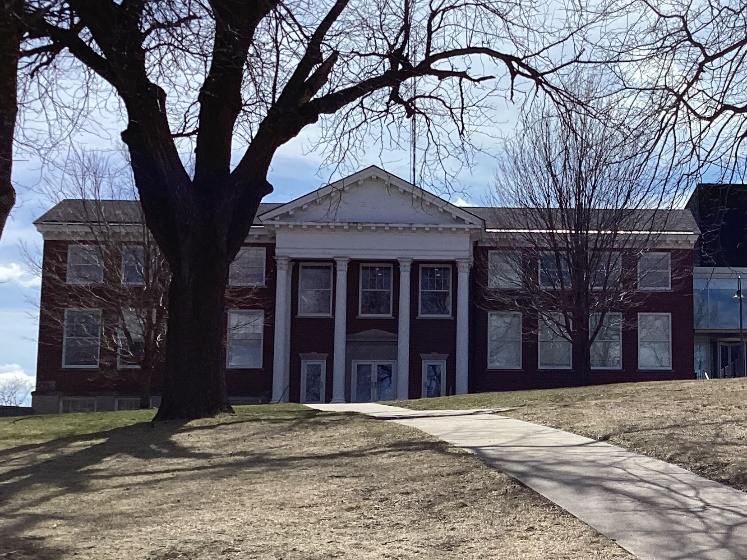
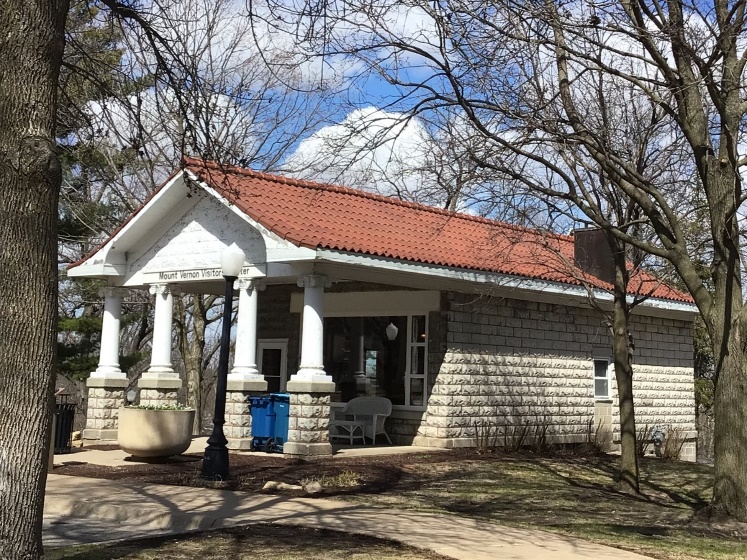
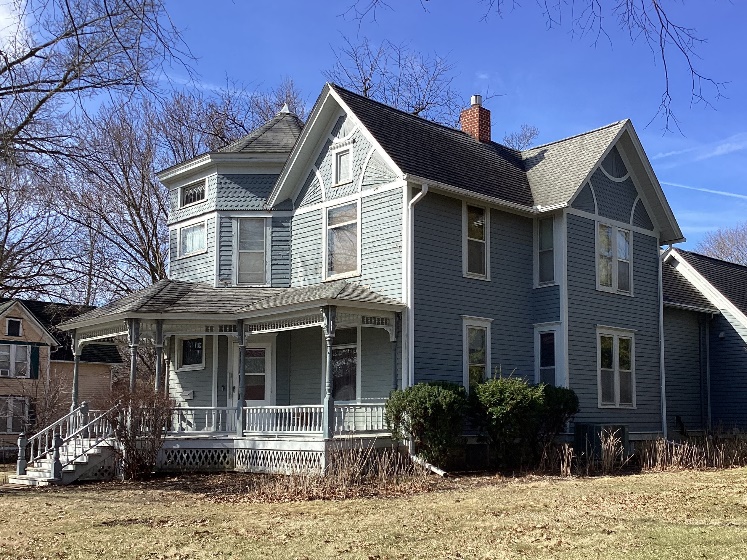
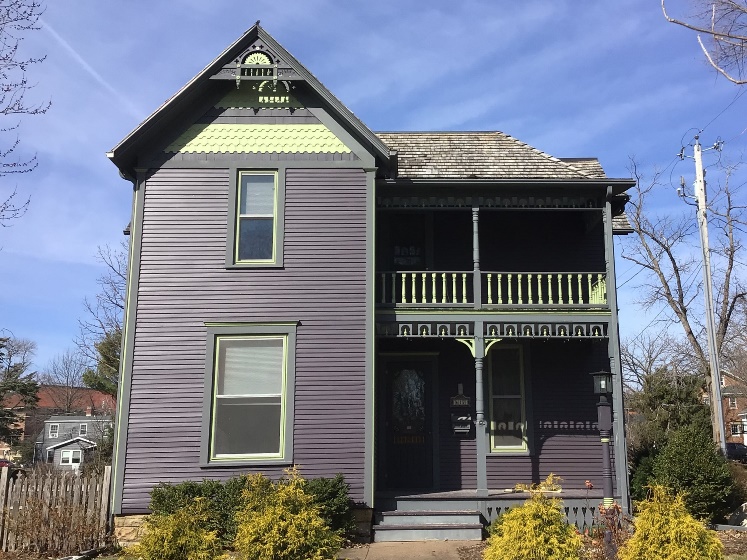
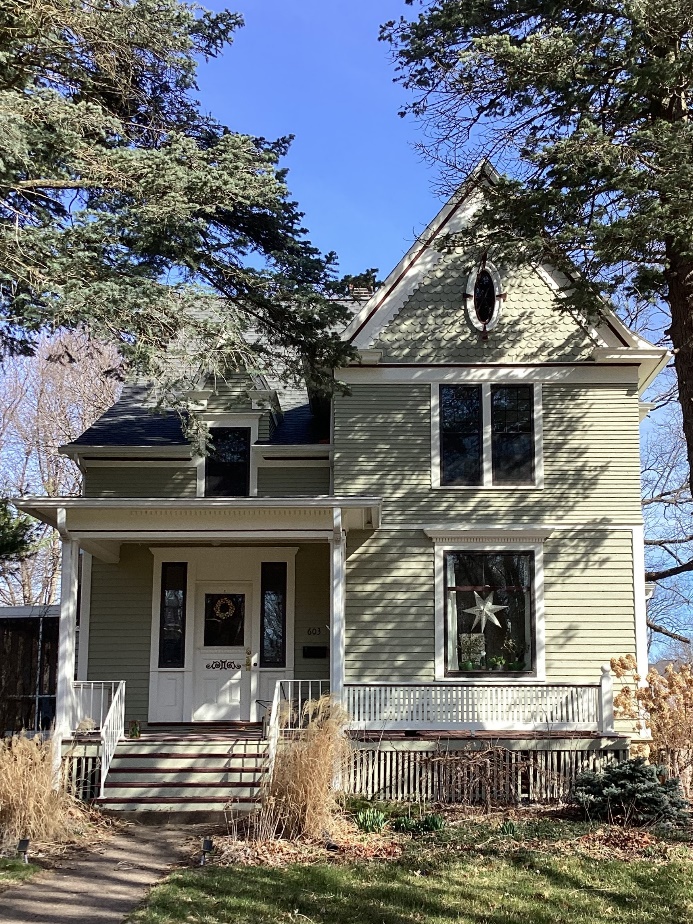
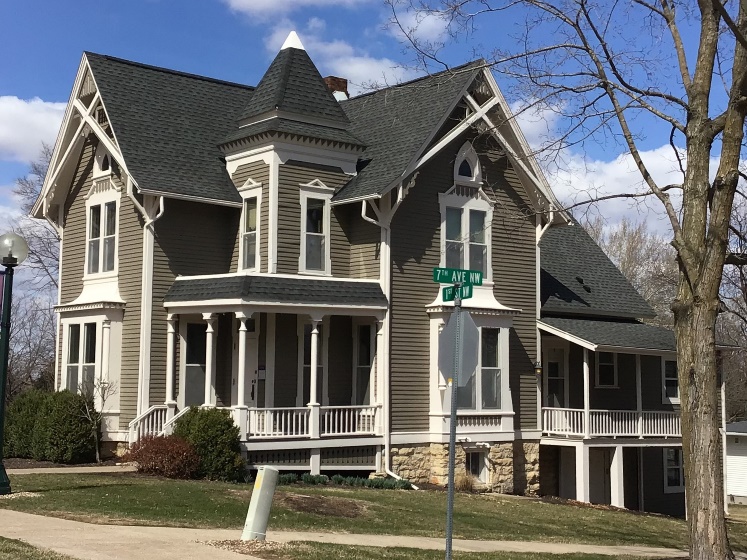
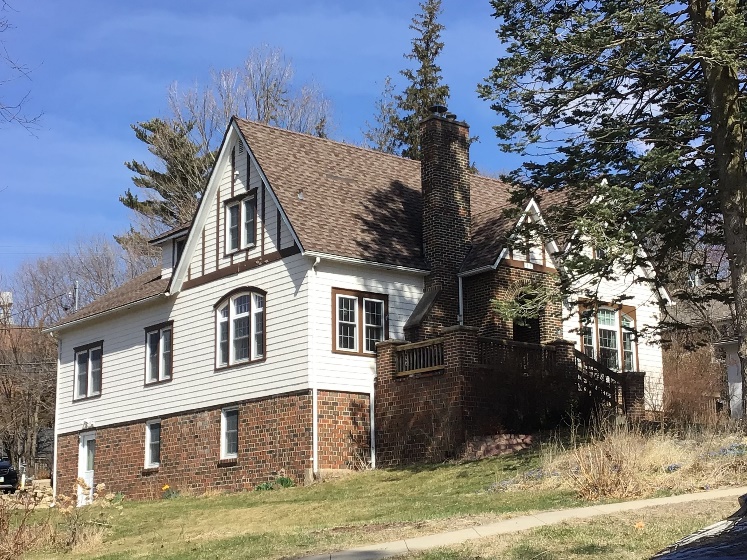
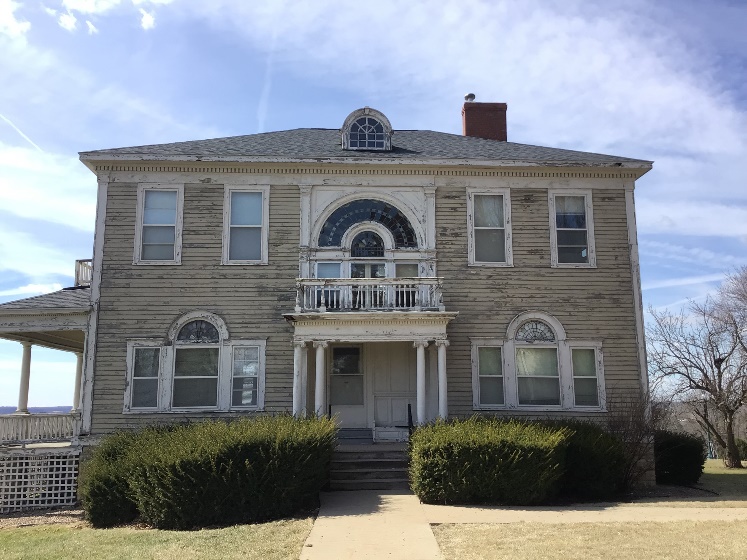
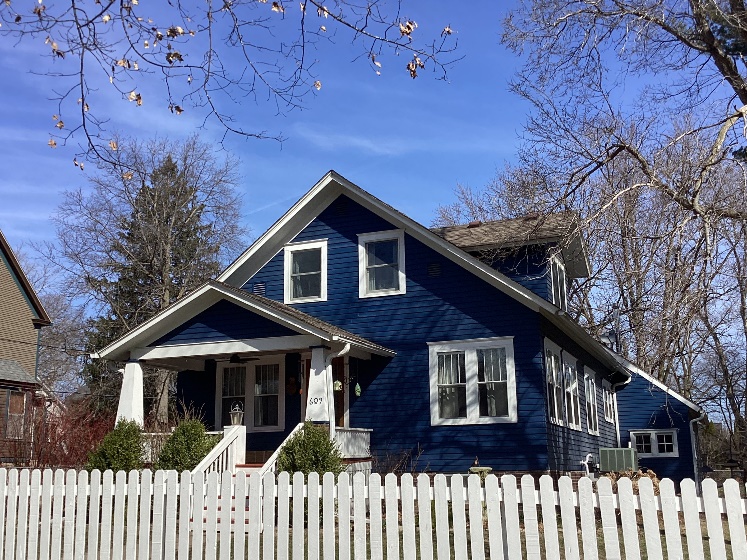
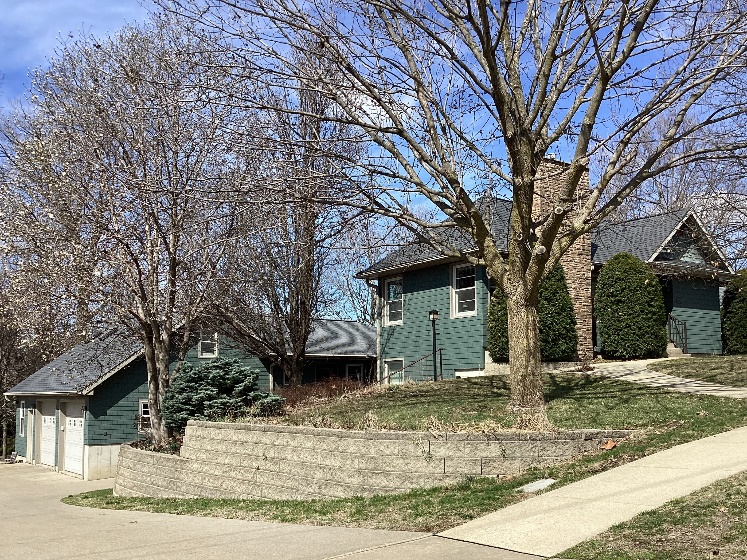
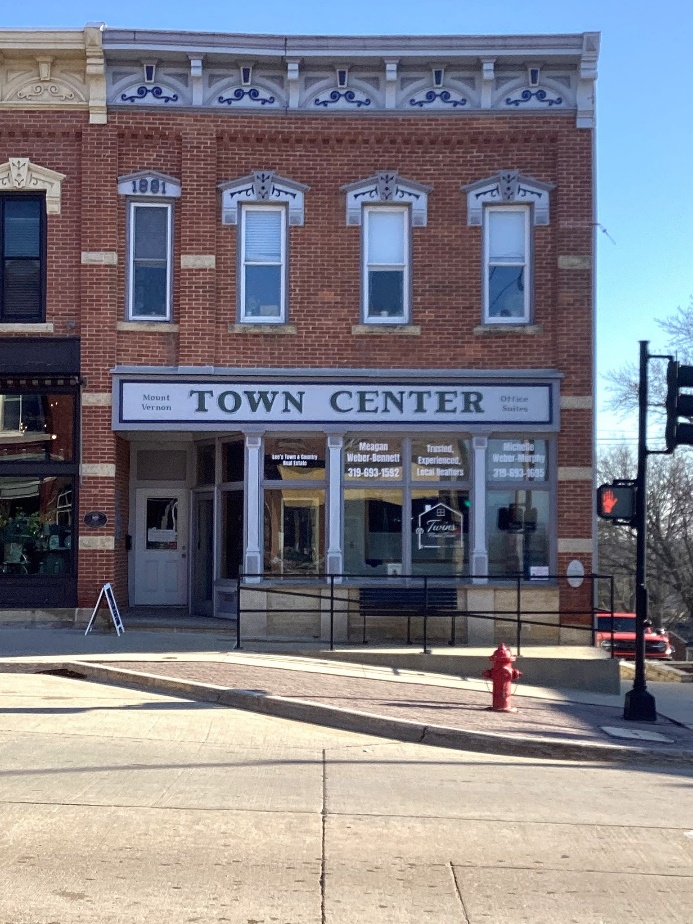
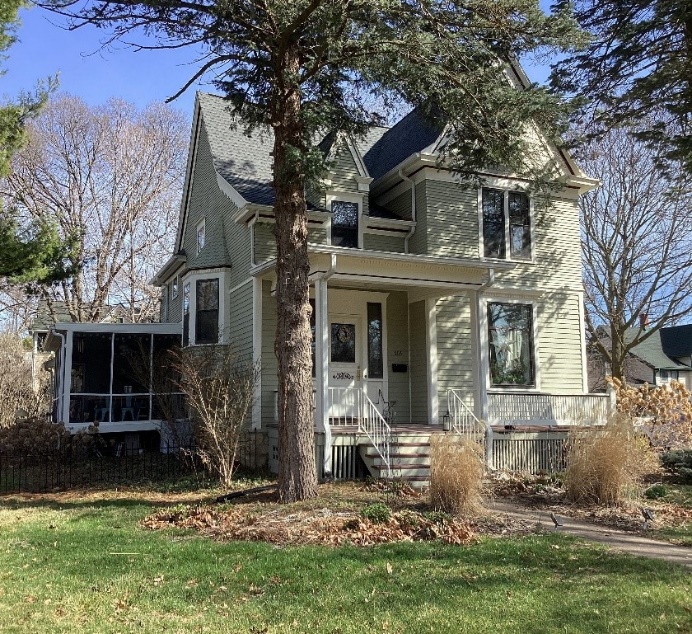
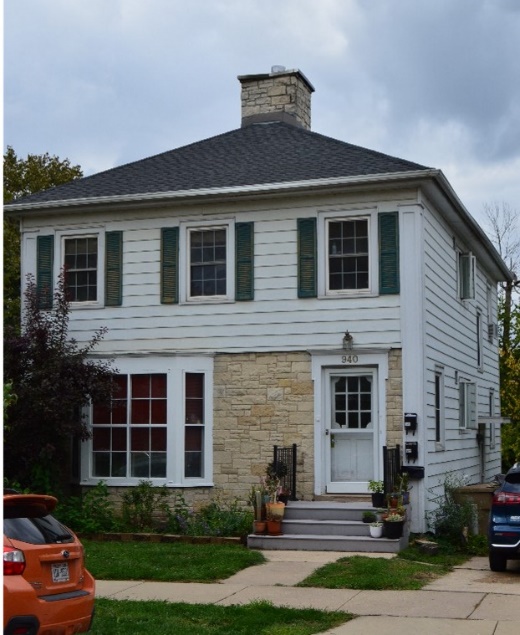
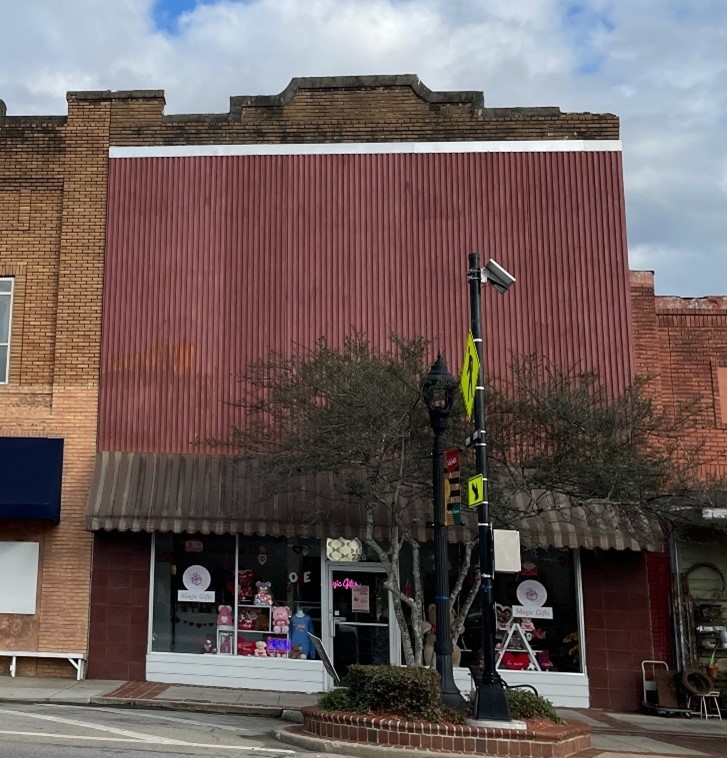
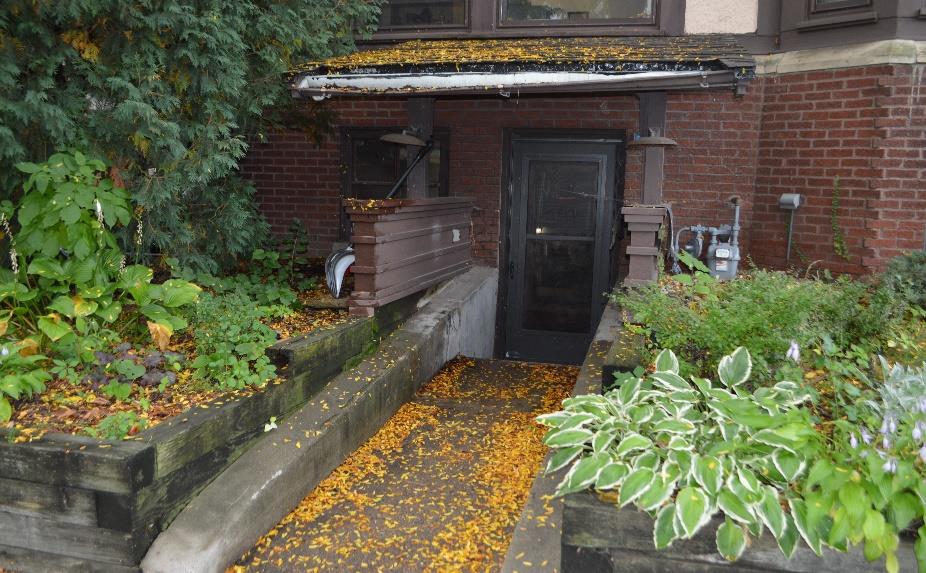
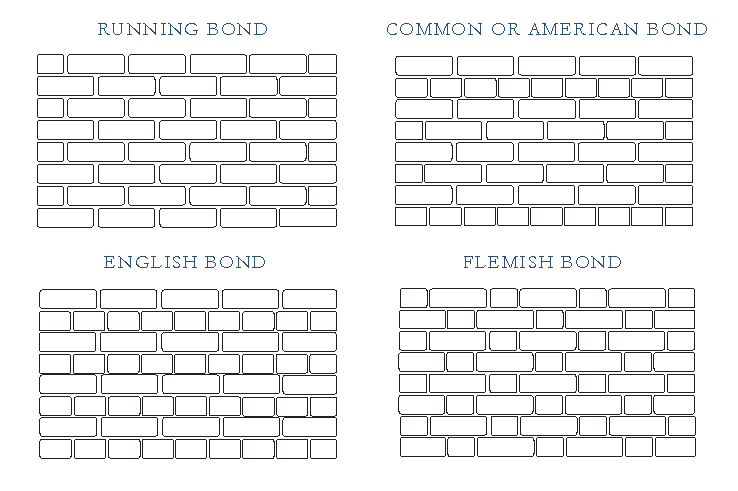
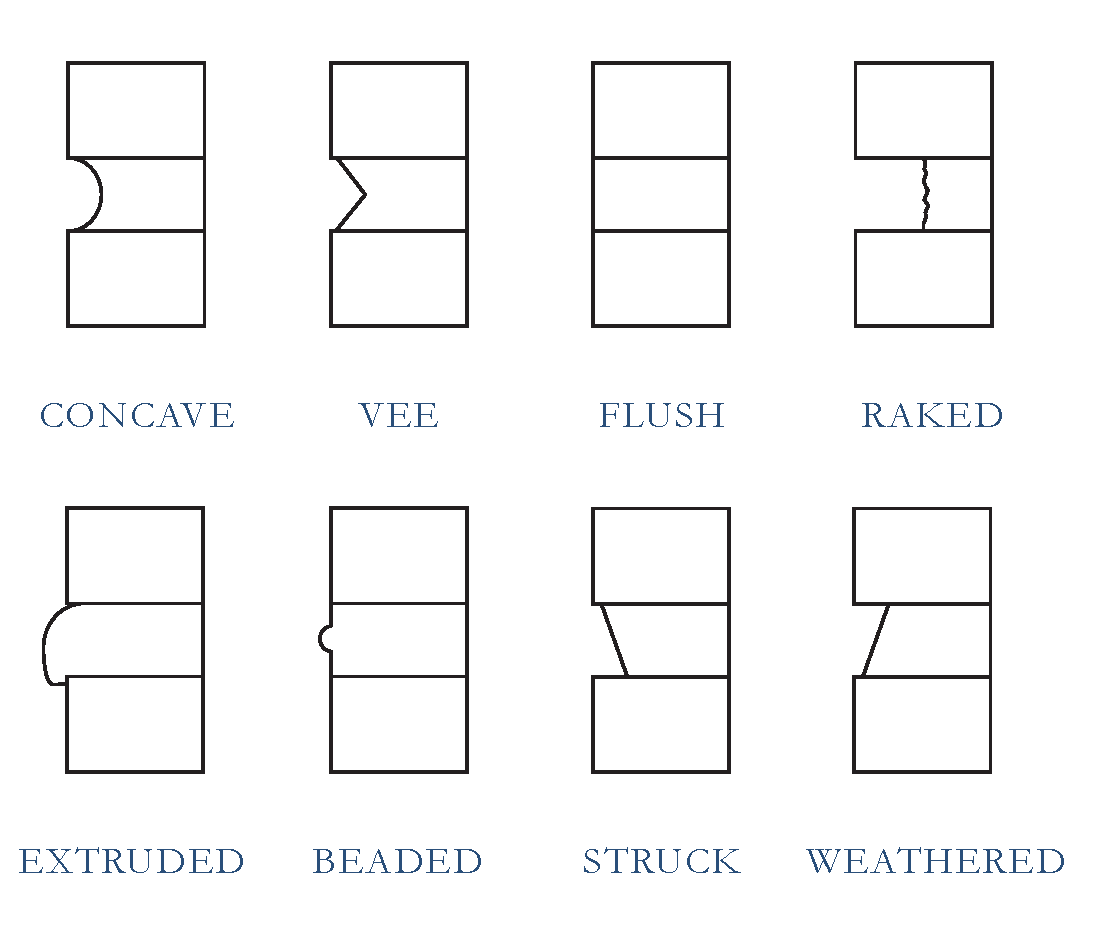
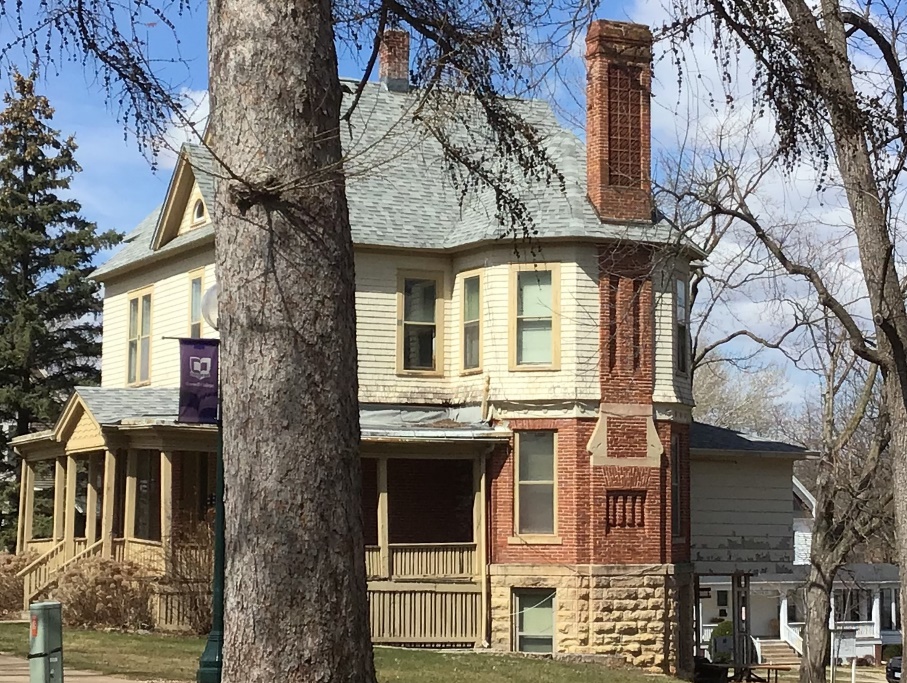
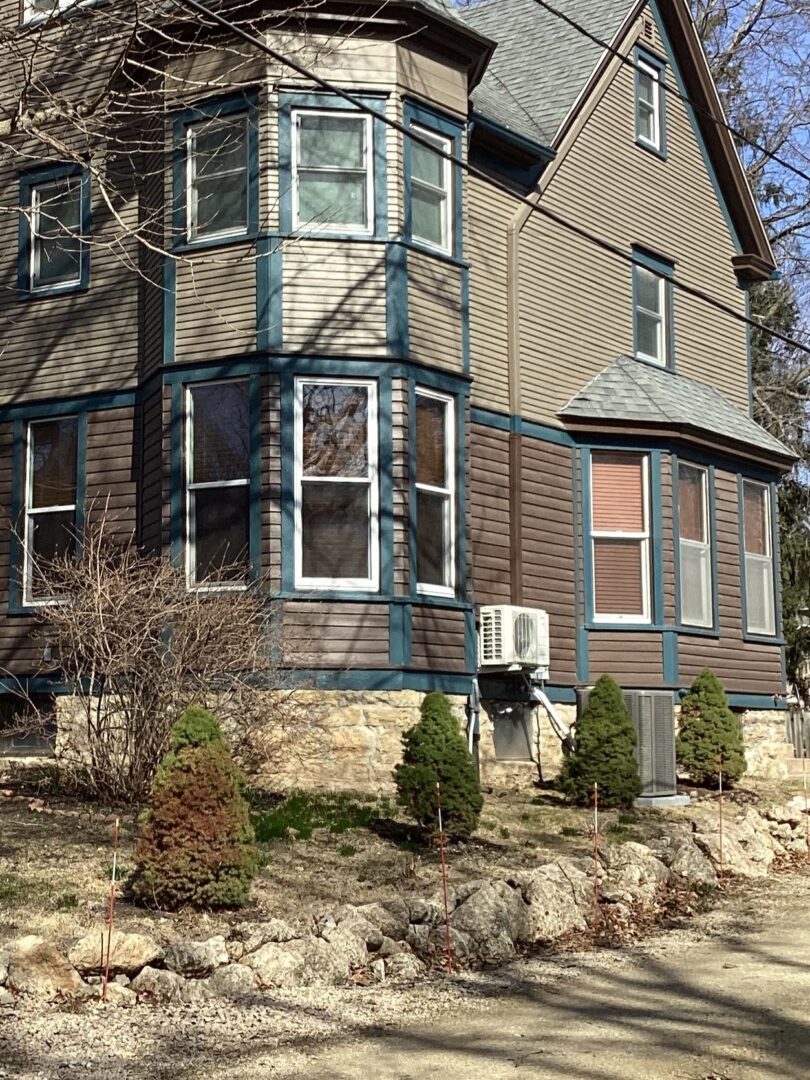
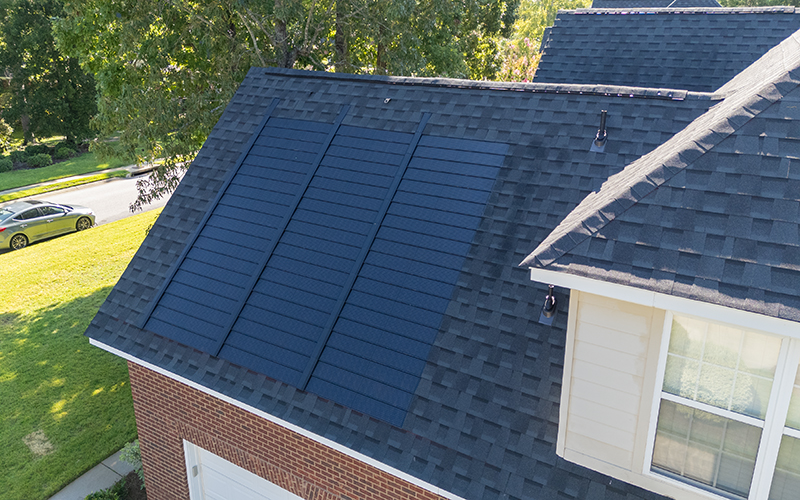
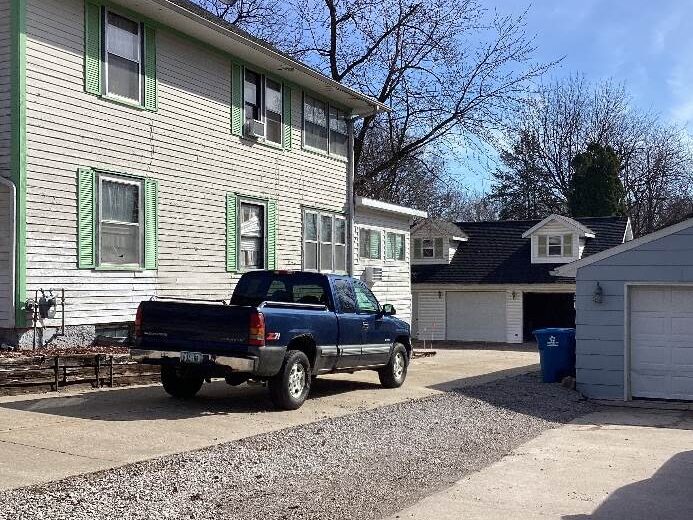
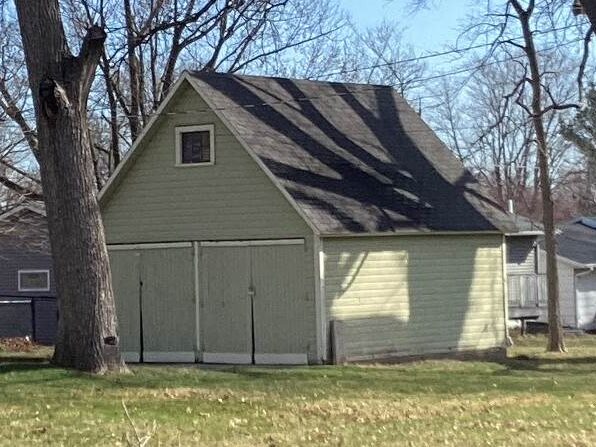
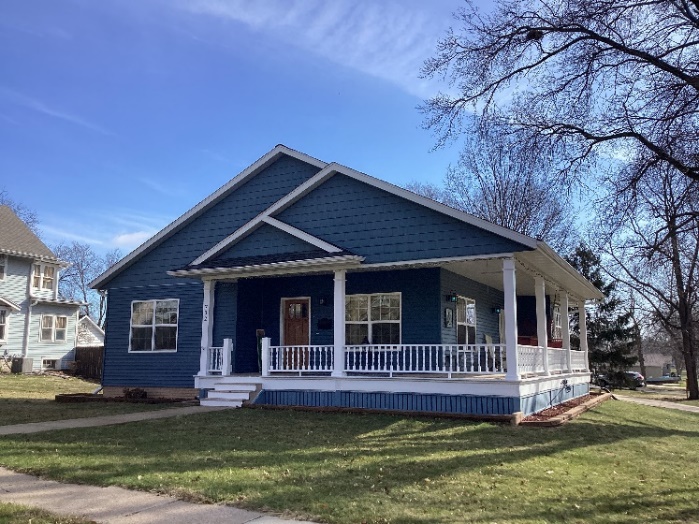
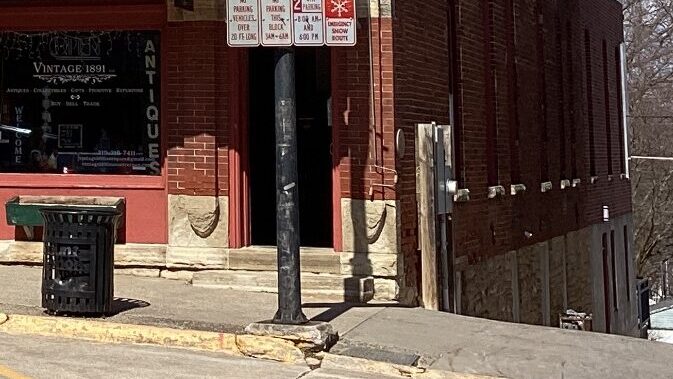
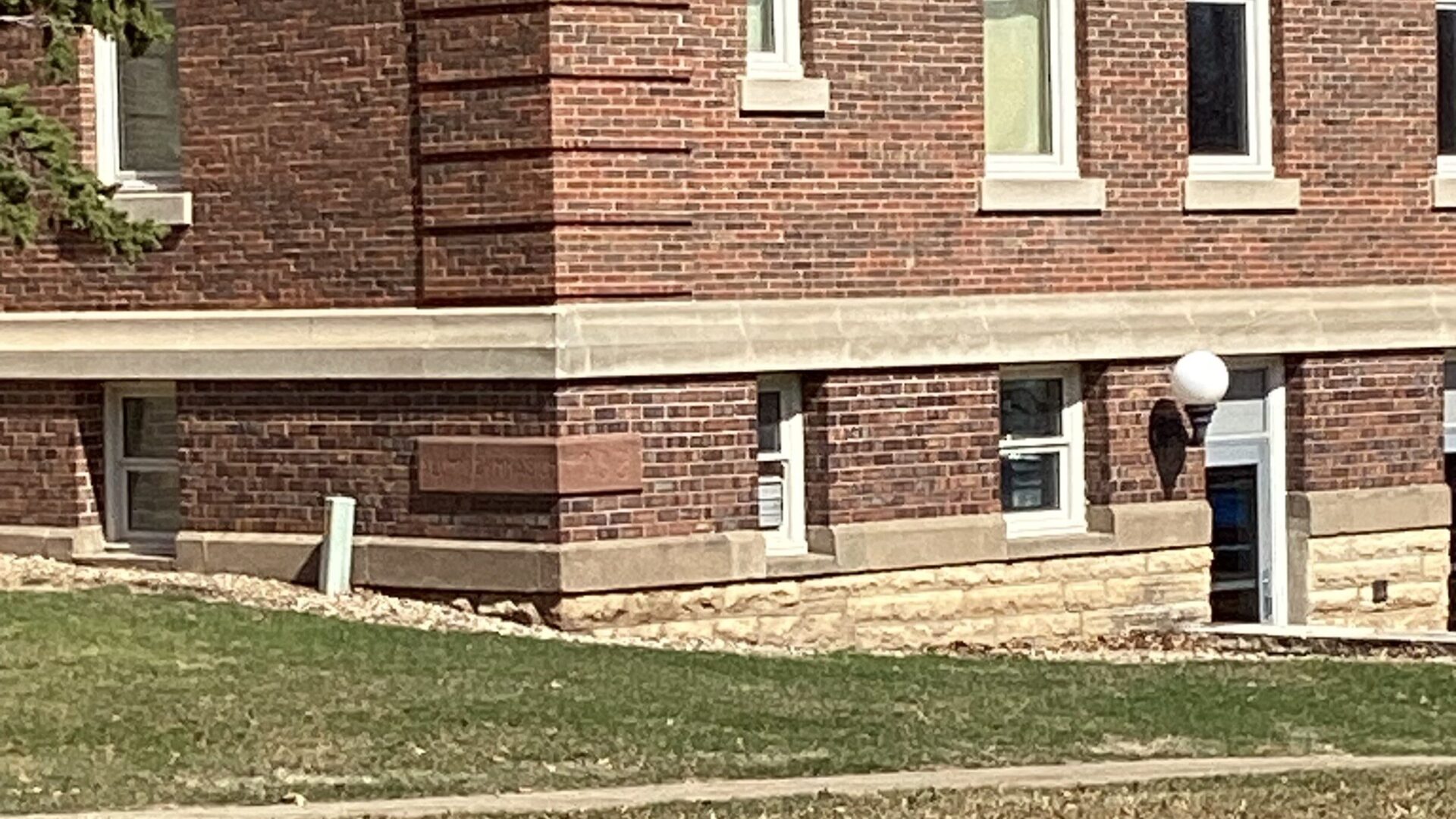
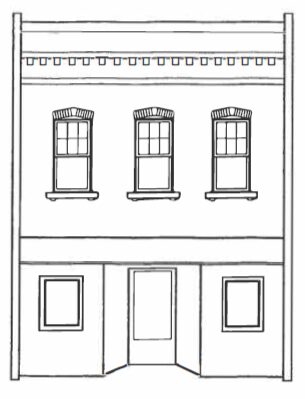
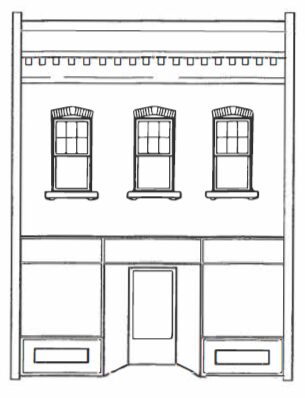
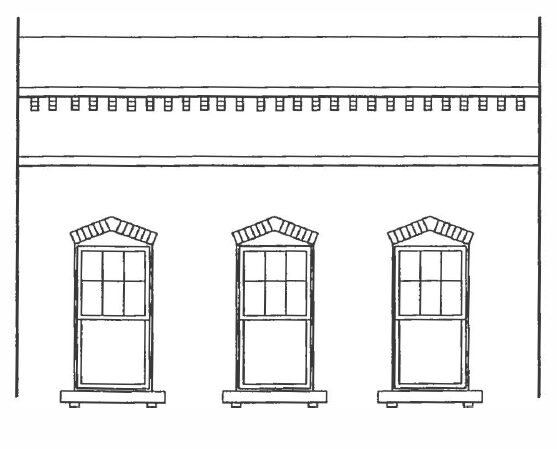
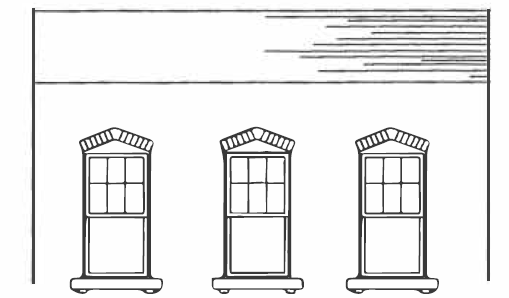
The Mount Vernon Historic Preservation Commission (MVHPC) determines whether exterior modifications in our 3 Historic Districts will enhance, maintain, or detract from the building’s historic appearance.
The Historic Preservation Design Guidelines are the basis of these determinations.
Below is an attempt at adapting that information so it can be viewed on any device. There will be minor visual and formatting differences from the PDF, but the content is the same.
City of Mount Vernon, Iowa – Historic Preservation Design Guidelines
Rehabilitation and Preservation for Residential, Commercial, and Institutional Properties
This document has been prepared for the City of Mount Vernon with the primary assistance of the Mount Vernon Historic Preservation Commission.
Acknowledgements
This updated set of guidelines was inspired by the original work and graphics illustrated in the “City of Mount Vernon: Design Guidelines Booklet” created by J. Edward Sauter, Richard Thomas, Kristin Fairley, and Julie Etheredge.
The purpose of design guidelines and best practices for historic residential, commercial, and institutional buildings is to promote the preservation of the significant features of a historic district by ensuring that alterations, additions, and new construction are compatible with their historic surroundings. These guidelines are intended to provide a clear framework for Mount Vernon property owners to make sure that changes to the exterior of historic properties within each of its three historic districts are made appropriately and consistently. This ensures that changes to individual properties do not negatively impact surrounding properties or the overall character of the district. Maintaining a neighborhood’s historic character has social, economic, and environmental benefits beyond achieving a particular aesthetic appearance. Design guidelines can improve the quality of growth and development, protect the value of public and private investment, preserve the integrity of a historic area by discouraging the construction of buildings that are inappropriate, discourage inappropriate alterations of historic properties, provide an objective basis for the decisions made by a design review board, serve as a tool for architects and their clients in making preliminary design decisions, and increase public awareness of design issues and options.
Mount Vernon retains significant historic materials in its built environment. There are three historic districts within the city, the Ash Park District, the Mount Vernon Commercial District, and the Cornell College District, that are representative of Mount Vernon’s rich history and the people who have been a part of its development. In order to enrich the lives of its residents today and enhance its legacy for the next century, the City of Mount Vernon has put into effect design guidelines for projects that have the potential to impact historic resources.
These guidelines cannot limit growth or regulate where growth takes place. They cannot control how space inside a building is used, cannot guarantee that all new construction will be compatible with a historic setting, and cannot guarantee high quality construction. Property owners need to be aware that the proper care of a historic building will take time, money, and often the assistance of qualified craft persons. If properly cared for and maintained, a historic home can last for hundreds of years—a lasting legacy for generations to come. The historic buildings of Mount Vernon make this community special and attract people to live and visit.
The Mount Vernon Code of Ordinances defines a historic district as:
“[A]n area which contains a significant portion of buildings, structures, sites or other improvements which, considered as a whole, possess integrity of location, design, setting, materials, workmanship, feeling and association, and which area as a whole:
Embodies the distinctive characteristics of a type, period or method of construction, or represents the work of a master, or possesses high artistic values, or represents significant and distinguishable entity whose components may lack individual distinction; or
Is associated with events that have made significant contributions to the broad patterns of our local, state or national history; or
Possesses a coherent and distinctive visual character or integrity based upon similarity of scale, design, color, setting, workmanship, materials or combinations thereof which is deemed to add significantly to the value and attractiveness of properties within such area; or
Is associated with the lives of persons significant in our past; or
Has yielded, or may be likely to yield, information important in prehistory or history.”
Historic properties included in a historic district must go through the review of the City of Mount Vernon and the Mount Vernon Historic Preservation Commission (MVHPC) to confirm their significance. A district’s significance will be derived from elements like architectural style, historic function, material type and general location of contributing resources. Once the significant features of a historic district are identified, it is up to the City of Mount Vernon and the Historic Preservation Commission to preserve and protect the features by way of reviewing proposed projects.
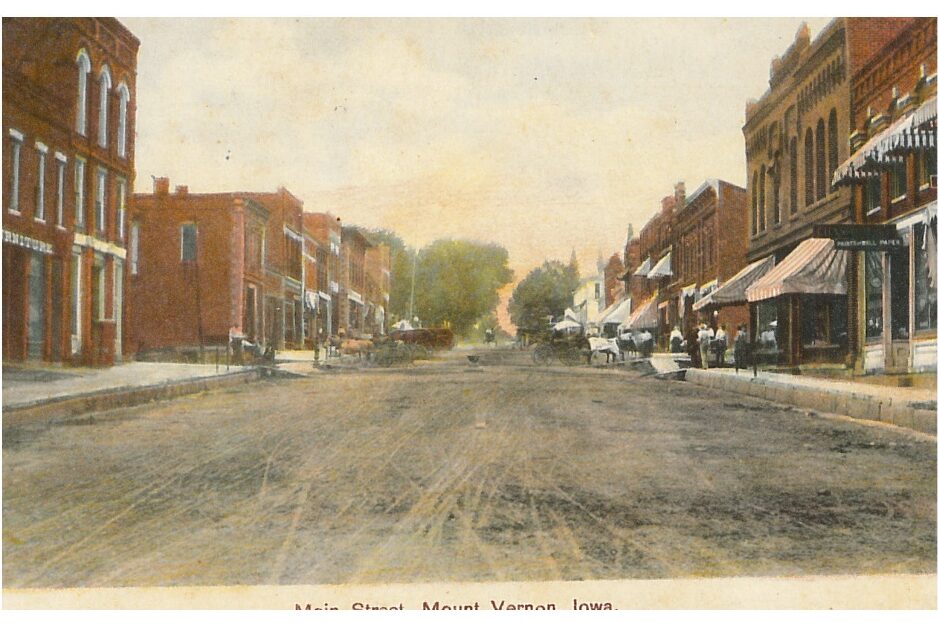
Figure 1: Postcard featuring Mount Vernon’s Main Street. (Photo Courtesy of the Mount Vernon Historic Preservation Commission).
1.2. Benefits of Historic Preservation
The preservation of historic buildings provides many benefits for the communities in which they are located, including a number of social, economic, and environmental advantages.
Historic properties are established resources constructed using workmanship and materials which are often superior to that of new construction, including old growth lumber and artisanal techniques. As such, they typically have a longer lifespan – over 100 years on average – as compared to new construction, which has a typical useful life of 30-40 years. Existing historic buildings are tied into existent public infrastructure including roads and sewers. The rehabilitation of existing structures often compares very favorably to new construction for this reason, particularly where demolition of an existing building would be required.
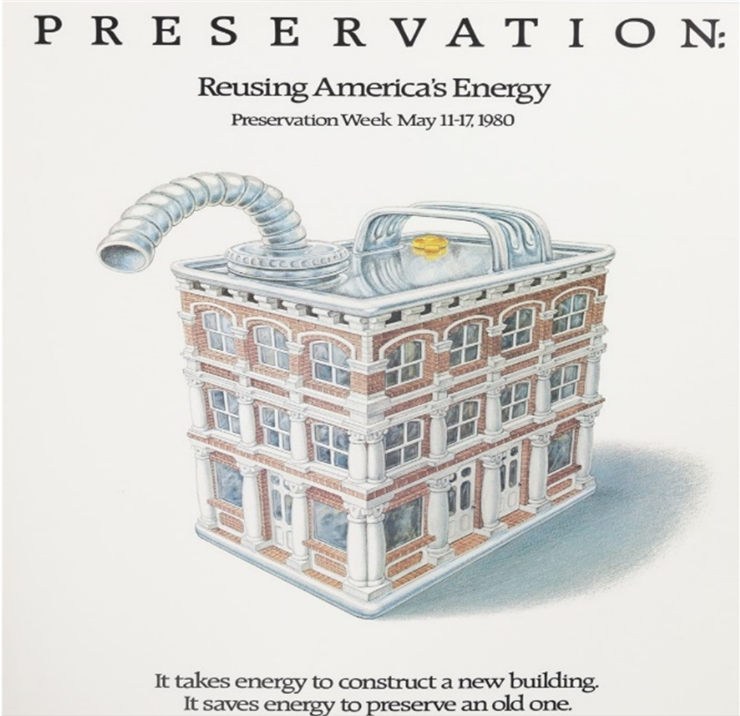
Historic preservation is inherently sustainable. Waste materials from demolition and construction projects comprise approximately 25% of the waste in our nation’s landfills. Historic buildings contain “embodied energy,” which is the energy associated with extracting, processing, manufacturing, transporting, and assembling building materials. Demolishing a historic building that could otherwise be utilized for a productive purpose wastes a significant amount of energy which had been in use for decades, while replacing it with new construction, often utilizing inferior materials, wastes even more.
Not only is the demolition of usable structures wasteful, but many historic resources feature unique energy saving features which can contribute to overall sustainability. When necessary, existing historic buildings can also be retrofitted to increase energy efficiency.
Historic preservation can also help fuel the local economy by providing more local jobs as compared to new construction, as a larger percentage of the project cost for a rehabilitation project is for labor. Due to the widespread and common use of prefabrication in new construction, these projects often effectively outsource work from beyond the local economy.
Beyond the social, economic, and environmental reasons to support and promote preservation, financial incentives exist that benefit residents and property owners.
State legislated tax exemptions for residential rehabilitations are available for use. In addition, Federal law provides a 20% income tax credit for the rehabilitation of historic, income-producing buildings. To qualify for both state and federal credits, a property must be a certified historic structure—that is, listed on or eligible for the National Register of Historic Places or considered contributing to a listed historic district. The rehabilitation work must be substantial and must meet the Secretary of the Interior’s Standards for Rehabilitation.
Historic property owners or occupants are also encouraged to search for alternative funding for rehabilitation or renovations on the property. Some incentives include the Federal Rehabilitation Investment Tax Credit, the Iowa State Historic Preservation and Cultural and Entertainment District Tax Credit, and the County Historic Property Tax Exemption Program.
Figure 2: Historic preservation minimizes embodied energy by reusing existing buildings. (Source: National Trust for Historic Preservation, 1980).
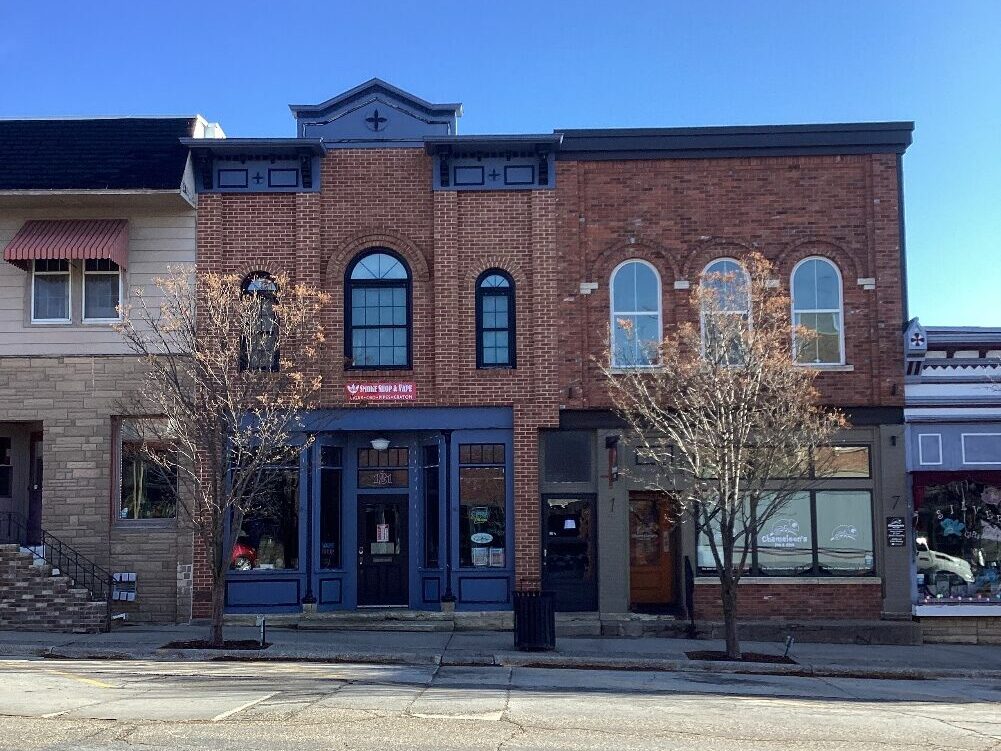
Figure 3: The revitalization of historic downtown buildings can act as a major draw for entertainment and activity.
1.3. How to Use this Document
The following document provides design criteria for changes to residential, commercial, and institutional buildings located within the three historic districts. These design guidelines are meant to provide a reference point for building owners, architects, designers, and other interested parties when planning exterior alterations to properties within the district, and to provide clear examples of what types of changes are appropriate to the district’s historic character. These guidelines are based on the guidance outlined by the Secretary of the Interior’s Standards for Rehabilitation, a set of overarching guidelines developed by the National Park Service which set forth standards of treatment when rehabilitating or altering historic properties. This document provides guidance on maintaining, repairing, and, when necessary, replacing historic features on residential, commercial, and institutional properties within the historic districts.
New construction and alterations to existing buildings within the historic districts, as well as the installation of new signs or streetscape elements, must be approved by the Mount Vernon Historic Preservation Commission (MVHPC) before the project begins. Background information on the history and character of Mount Vernon and its historic districts is provided in Chapter 2. Chapter 3 provides an overview of the process and requirements. An architectural style guide, which is helpful in identifying appropriate characteristics for particular building styles, is provided in Chapter 4. An overview of design principles is also provided in Chapter 4.
Universal Guidelines for all types of projects regarding properties in the three historic districts are provided in Chapter 5. Guidelines concerning residential properties are provided in Chapter 6, while guidelines for commercial and institutional properties are provided in Chapter 7. These two chapters include guidelines for alterations to existing historic buildings and new construction within the historic districts based on their property types. Guidance for demolition, relocation, or replacement of structures and buildings in historic districts is found in Chapter 8.
Visuals like images and diagrams are included in each chapter to provide examples of solutions. These solutions will be sorted by their level of appropriateness: Best Practices, May be Appropriate, and Not Appropriate.
Chapter 2. Historic Preservation in Mount Vernon
2.1. A Brief History of Mount Vernon
Mount Vernon has historic structures that date from the 1840’s to the present. The principle historical themes that best help trace its past are related to the revolutions in transportation.
By 1842 the Military Road (Highway 1) was marked from the territorial capital (Iowa City) to Dubuque. Lyman Dillon was paid by Congress to mark a trail that could be used by federal troops stationed at Ft. Snelling (St. Paul) to protect the legislature meeting in Iowa City. The quickest way for the troops to move was via the Mississippi to Dubuque and then overland to Iowa City. Dubuque was also the largest town in the Iowa Territory. The trail was essentially a furrow plowed with a team of oxen. For whatever reason, Dillion chose to mark his trail over the hill. The top of the hill was a good place to stop and water the horses after a hard pull. The town became an early service center for travelers and farmers settling around the hill. The early businesses were related to wagons, horses, and travel accommodations.
The small but growing number of settlers along the hilltop platted the town in 1847. It was one block on either side of First Street, one block east and two blocks west of the Military Road. The town would not incorporate until 1868. One feature of this early period is the large number of home-made brick buildings constructed as residences, stores, churches, and schools. Local deposits of clay and sand together with several talented masons gave the town a distinctive architectural character. There are several remaining brick stores from the 1850’s as well as two Cornell College buildings and a number of homes. The first wooden homes and stores were quickly replaced with brick structures.
In 1858 the railroad arrived but the major economic impact would wait until after the Civil War when bridges were constructed across the Mississippi and Missouri rivers. By the time the railroad arrived, the town was well established, and Cornell College (1853) was showing signs of stability and growth. The railroad and the great logging boom in Wisconsin and Minnesota brought cheap, elegant building materials and as American taste changed to the larger, asymmetrical Victorian homes, Mount Vernon joined the trend.
The railroad also brought students to Cornell from greater distances than the stagecoach or wagon. The town was connected to the larger world with mail order catalogues and builder’s style manuals. There was a greater range of choices in styles and materials. With the exception of Bowman Hall (1885), Cornell did not build residences for students until the 1930’s. Students lived with families in the town. Residents could build a large home and be assured that students would be available to help pay the mortgage.
The town prospered along with agriculture and experienced several building booms between 1890 and 1920. Fires in the central town also reshaped the area with new brick structures.
The automobile and internal combustion engine revolutionized the farms and the towns. The first marked highway across the nation was the Lincoln Highway in 1913. In Linn County it followed the old Tipton to Marion trail which was the first east-west road across the county.
When the Federal Government designed a national highway system and helped to pave roads, that portion of the Lincoln Highway through Mount Vernon became U.S. Highway 30 so the town remained as part of a major transcontinental paved route. Mount Vernon was a service town, and students continued to come to Cornell from increasingly distant places.
Merchants profited from the new travelers. Many of the homes along First Street took in travelers for overnight stays, and some old carriage barns became garages. Homes were built with room for cars under the same roof as the family. The college continued to grow and played an even larger role in the community.
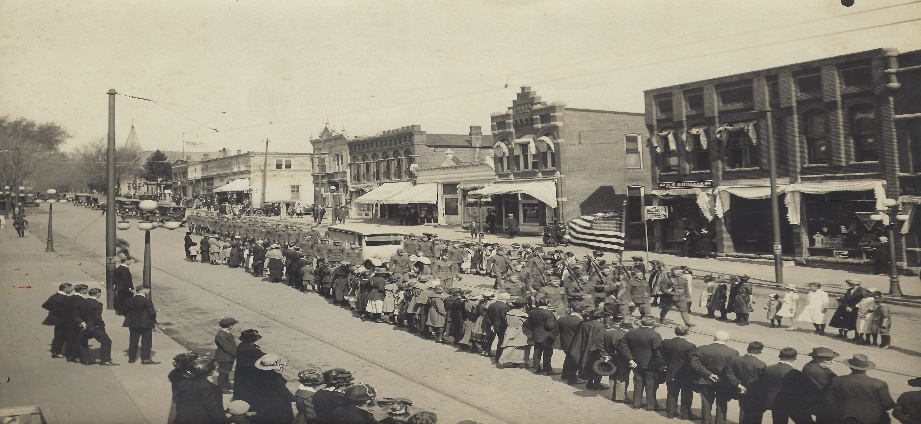
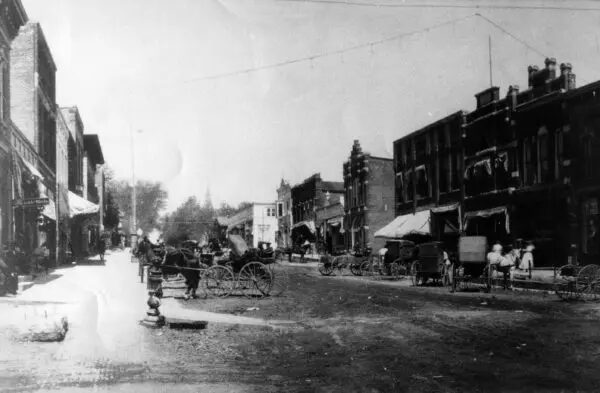
Figure 4: View of downtown Mount Vernon, facing north on 1st St. W, 1921. (Photo Courtesy of the Mount Vernon Historic Preservation Commission).
During World War II many citizens worked in defense plants in Cedar Rapids, and Mount Vernon was drawn more and more into the expanding metropolitan industrial magnet. Commuting has continued to be a way of life for many residents. The Post-War boom brought slow but steady growth to Mount Vernon. New additions to the city reflected the styles and plans of the suburbs around the nation’s major cities. The new highways bypassed small towns and Mount Vernon’s “new 30” cut south of town in the late 1950’s.
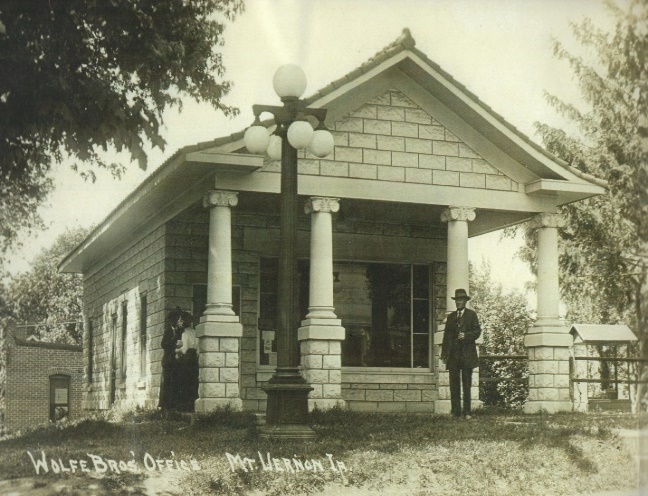
Figure 5: Dr. Wolfe’s Office ca. 1920. This building is now the Mount Vernon Visitors Center. (Photo Courtesy of the Mount Vernon Historic Preservation Commission).
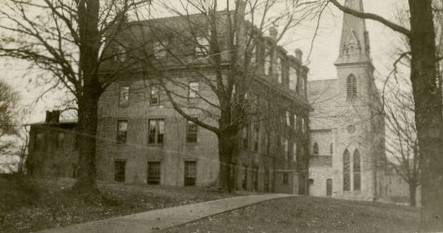
Figure 6: “Old Sem,” was Cornell College’s first building. Pictured here with King Memorial Chapel ca. 1910. (Photo Courtesy of Mount Vernon Iowa History Tours).
Through all these transitions and changes, Mount Vernon has retained structures from the past and worked to make them fit changing lifestyles. The charm and character of the town is largely due to these reminders of the past. Mount Vernon is proud of the fact that it is visually different than other small Iowa towns. Retaining its architectural integrity requires treating its older structures with respect while making them comfortable for our contemporary times.
2.2. Contributing and Non-Contributing Buildings
Boundaries of historic districts contain both contributing and non-contributing resources. Contributing resources include buildings that are of a historic age and retain enough of their original building features (windows, siding, doors, trim, etc.) to “read” as a historic building. Non-contributing buildings generally include non-historic buildings located within the district boundaries. Because non-contributing properties do not have architectural elements which contribute to the historic character of the district, the MVHPC has more flexibility over changes to a non-contributing property when reviewing applications. Non-contributing properties within the local historic districts are still required to submit an exterior work application because alterations to non-contributing properties still have the potential to adversely affect the district as a whole.
2.3. Historic Districts and Properties Listed on the National Register
Ash Park District
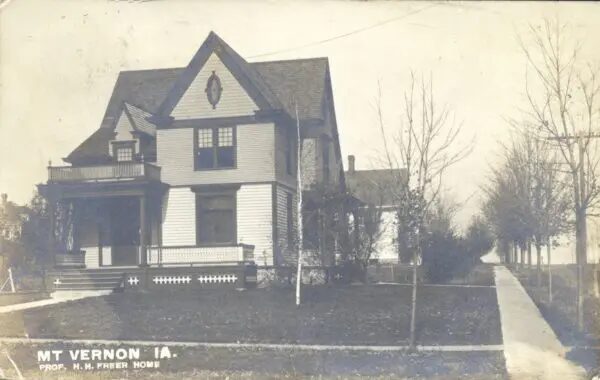
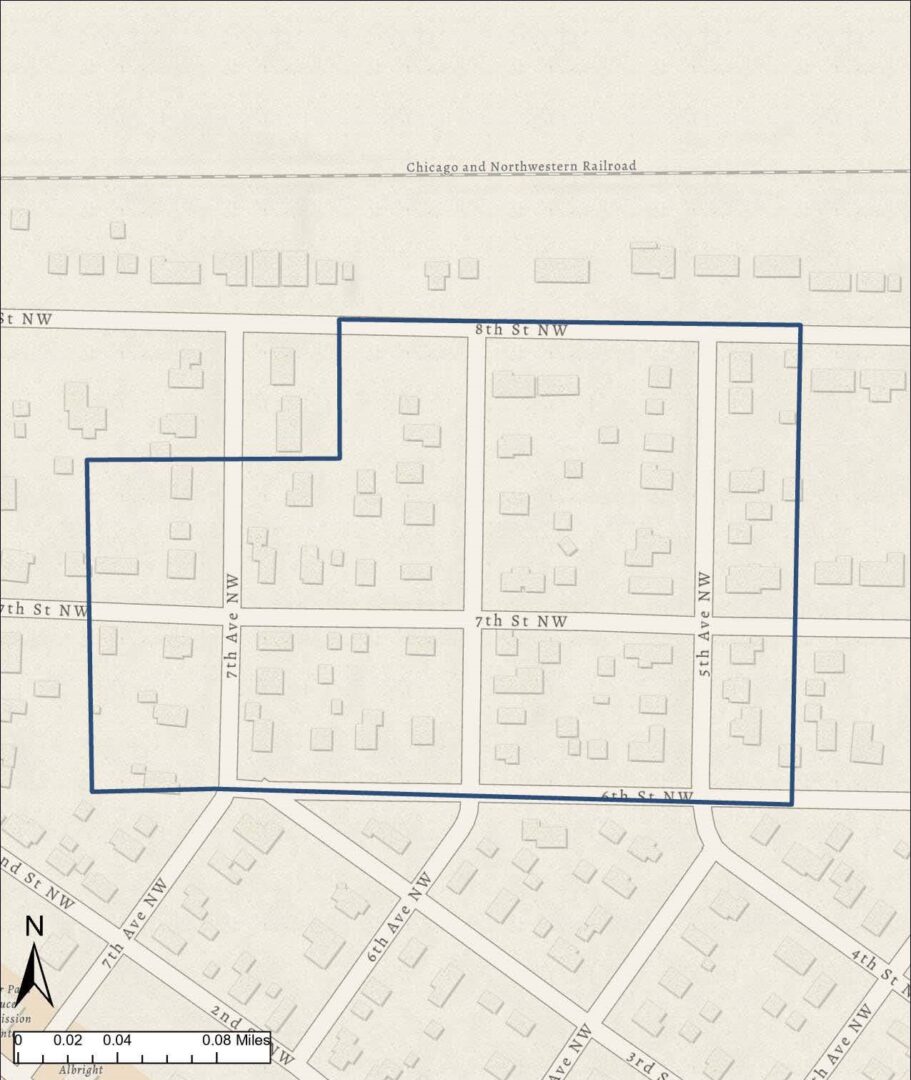
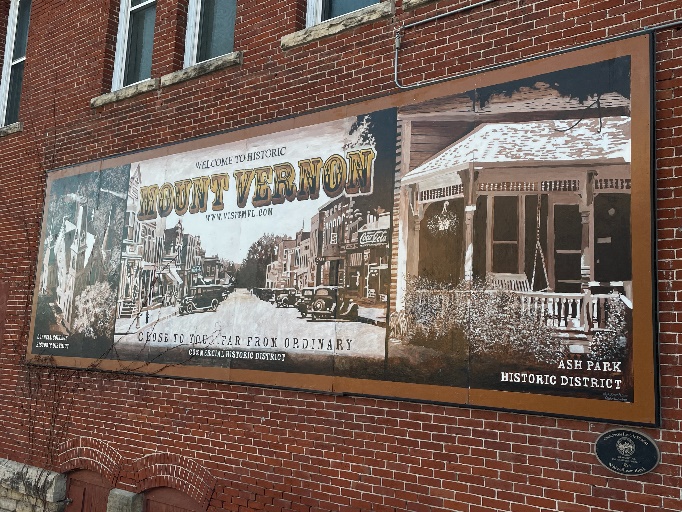
Mount Vernon’s historic residential district is called Ash Park and is located between 6th and 8th Streets NW and 5th and 7th Avenues NW. It was associated with the railroad era around the turn of the 20th century. The streets were aligned with the cardinal directions which now contrast with the older platting of the town, which is aligned with the Old Lincoln Highway and Highway 1. There is a clear break between the old and the new.
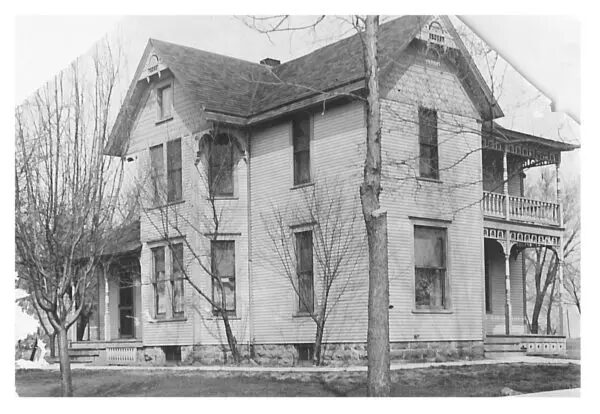
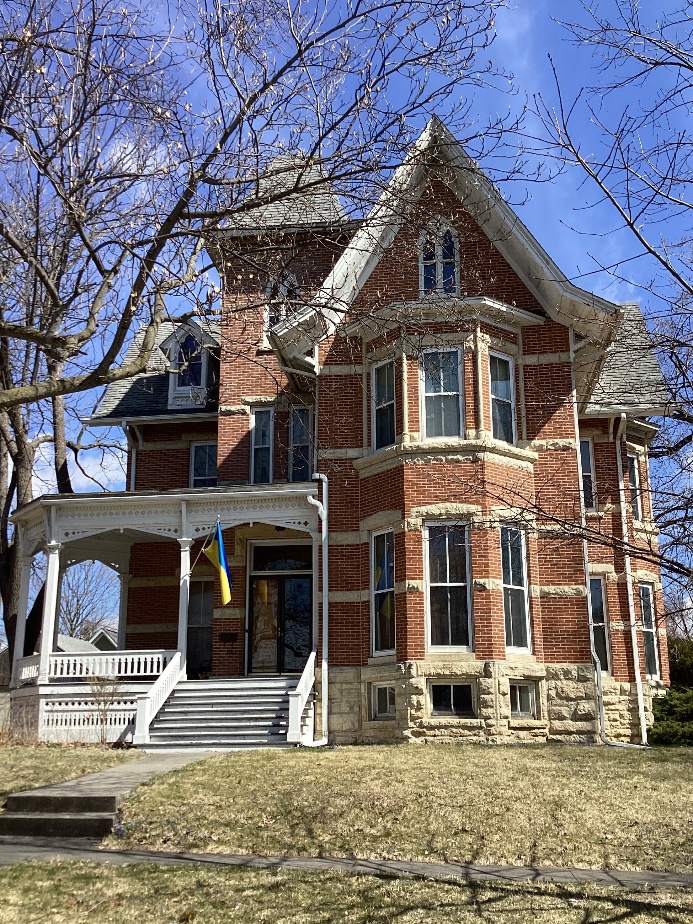
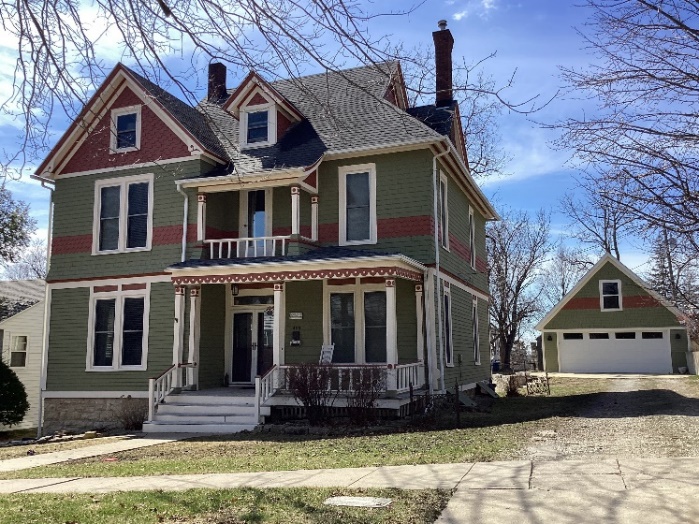
The houses in the district occupy one to three lots and three-fourths of them were built in the first two decades of the 20th century. Common features of homes are stone foundations, two-story wood/weatherboard walls, and asphalt roofs. There are many styles that can be found in this area, including Late Victorian and Late 19th and 20th Century Revivals. Stick Style, Colonial Revival, Queen Anne, and Craftsman styles with dormers and towers, welcoming front porches, and decorative shingle work can also be found there. Because of the conveniences of the railroad, features and motifs were readily available such as turned porch columns, wood shingles, brackets, and pendants. A majority of the houses have gabled roofs and decorative ends with shingle patterns.
Construction in Ash Park district ceased at the end of World War I and at the beginning of the economic depression. There was no new construction until the mid-1950s.
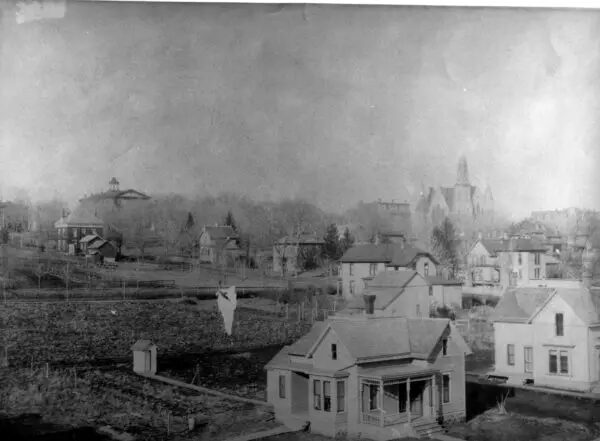
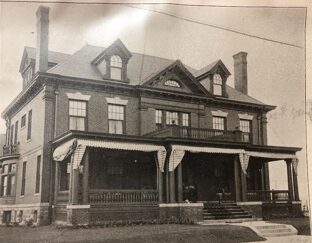
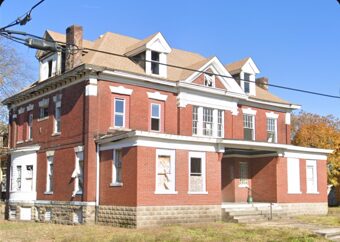
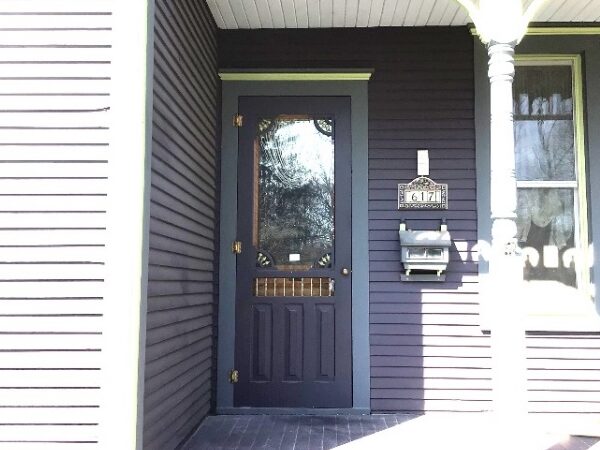
Ash Park, facing south ca. 1898603 6th St. NW, date unknown617 7th Ave. NW, date unknownFigure 7: (Photos Courtesy of the Mount Vernon Historic Preservation Commission).
Ash Park District Map
* This map depicts the approximate boundary lines of the Ash Park historic district.
Mount Vernon Commercial District
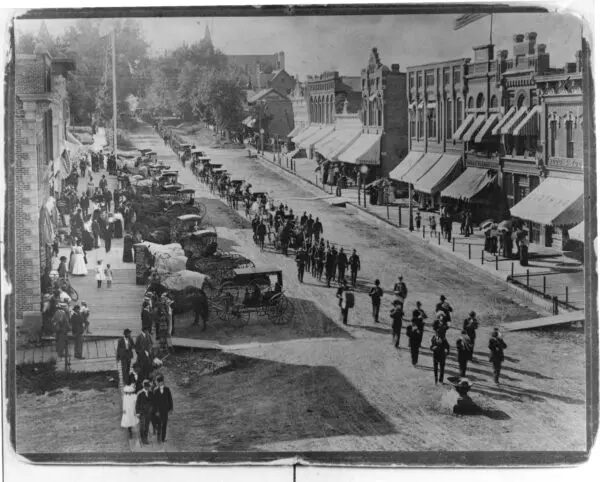
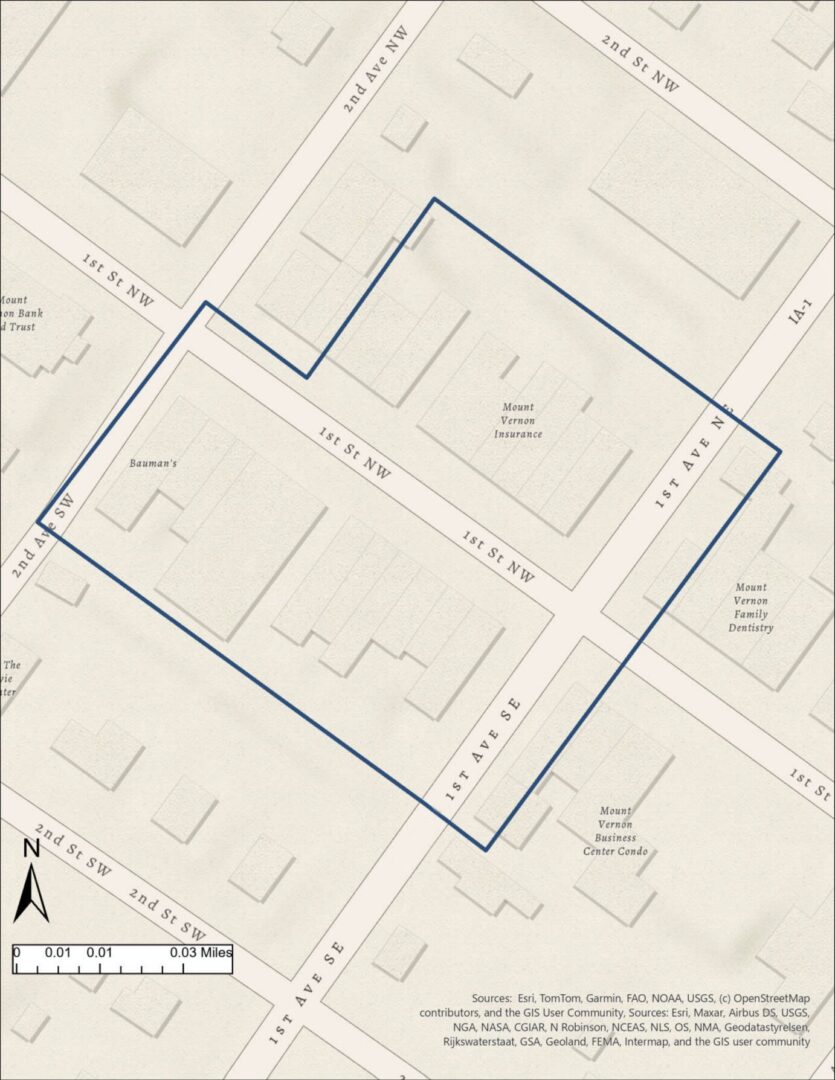
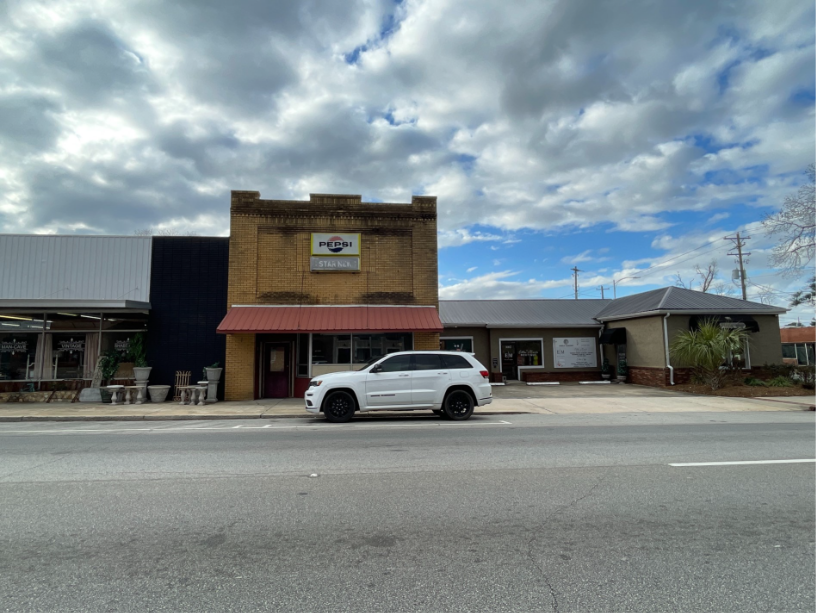
Mount Vernon’s commercial district is concentrated along the north and south sides of 1st Street. The development of 1st Street was the starting point of Mount Vernon’s settlement in the 1840s. The one and a half blocks between 2nd Avenue North and 1st Avenue North run along the Paha, a ridge of silt and clay in the glacial drift from northeast Iowa. Mount Vernon was thus called the “Hill City.”
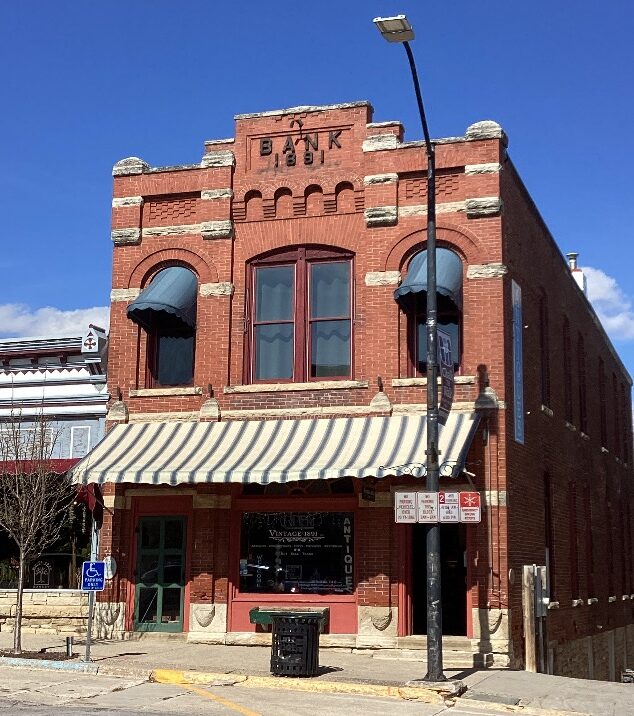
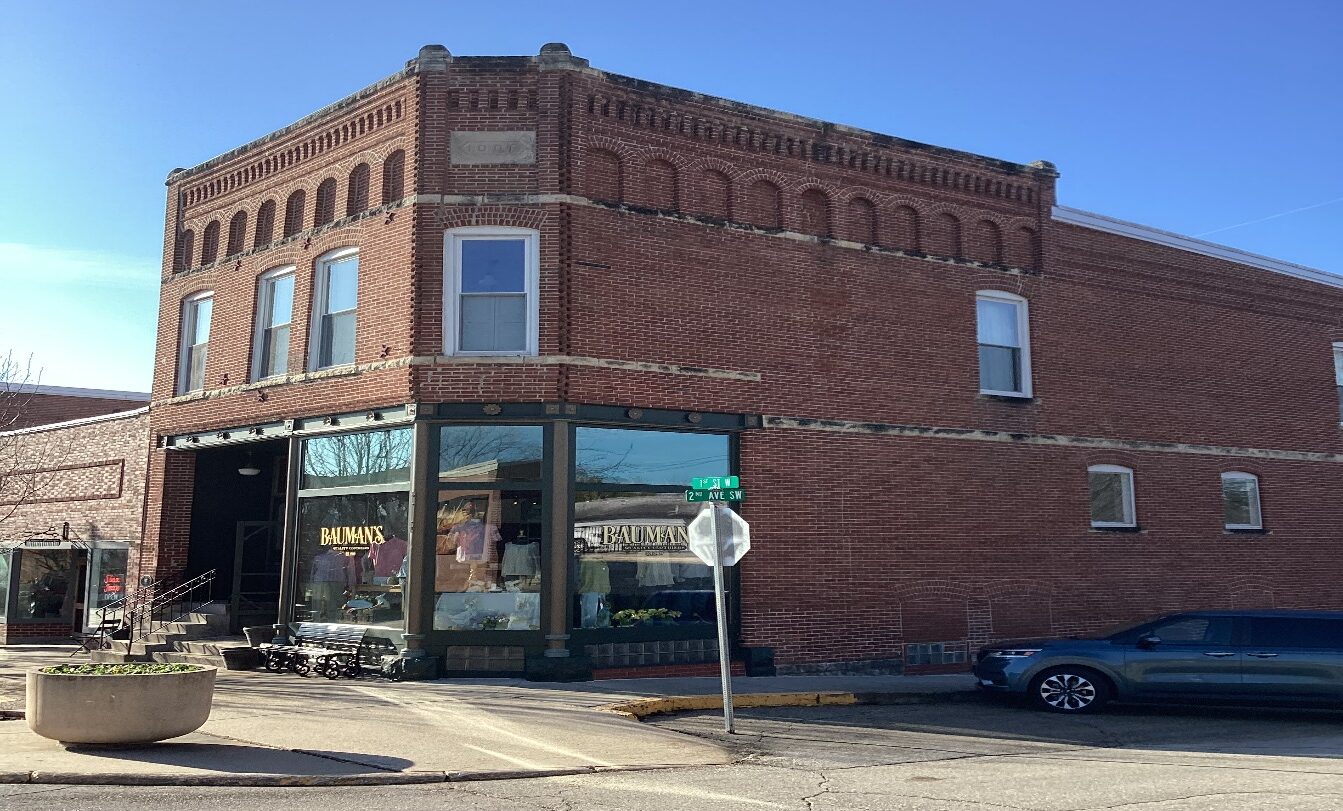
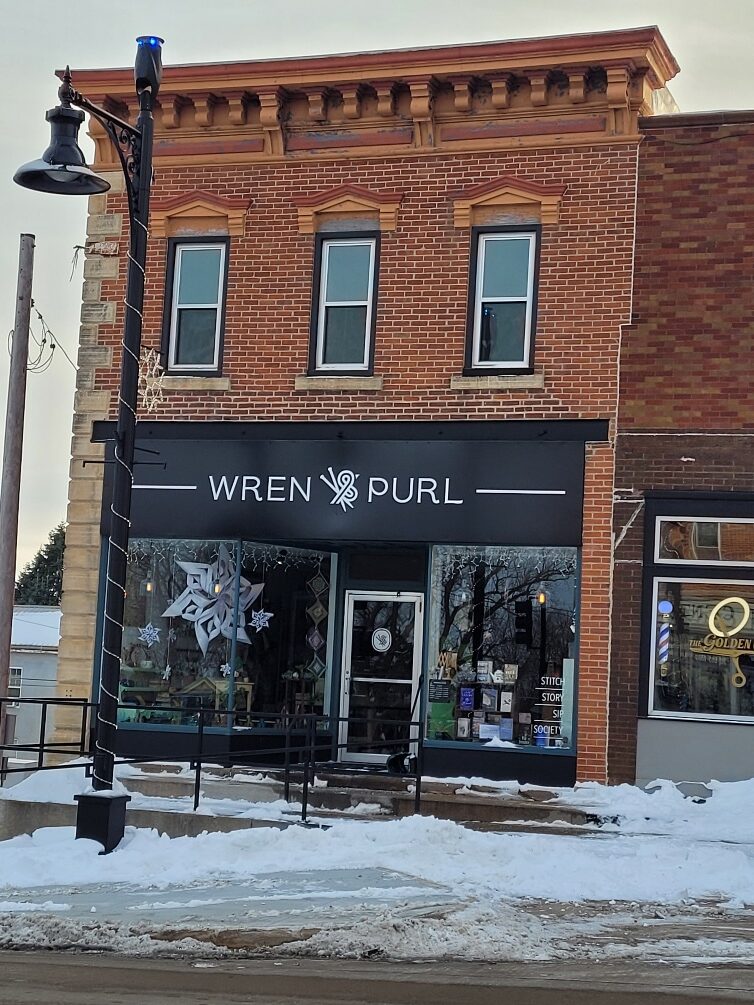
At the peak of the town there are eighteen one or two-storied buildings along the street that date from 1860 to 1904. All but one of them were built before 1904. They all have similar brick facing stone trims that help unify the downtown area. Through later renovations, some buildings have lost their historical aspects, but there still remain some key features found in all of them. The foundations are commonly made of stone, the walls of brick with thin mortar joints, and the roofs of asphalt.
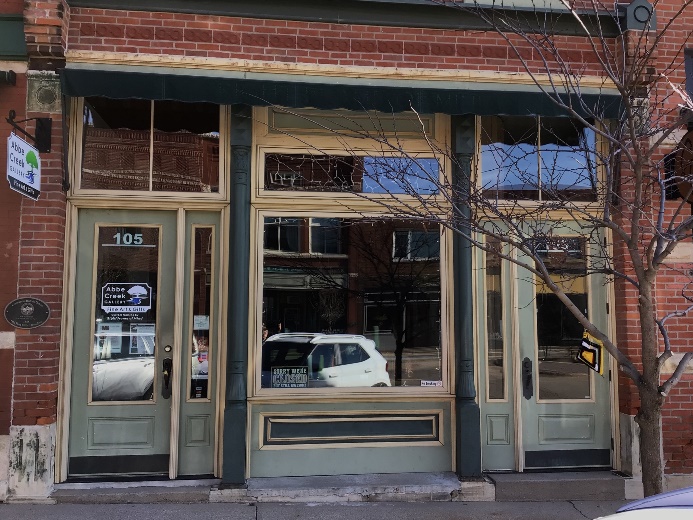
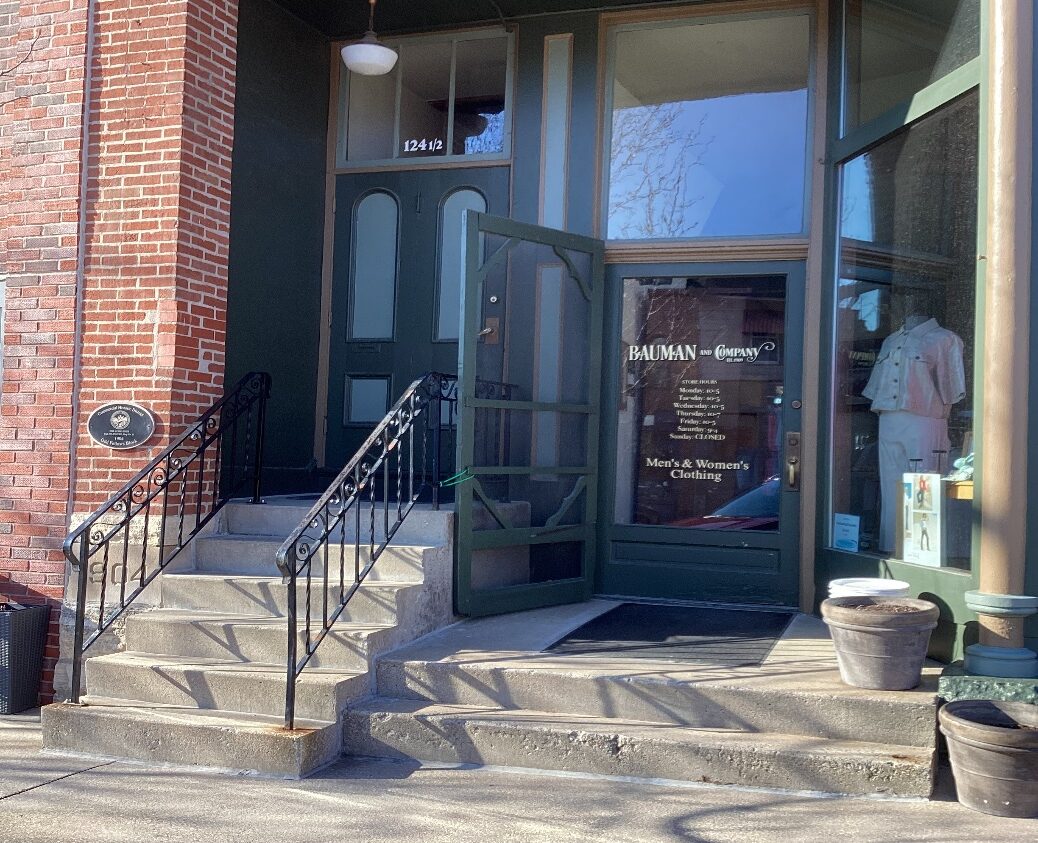
Other features that may have been hidden by construction or remodeling but were present in the early 20th century are unusual patterns of brick. These patterns can still be found in checkerboard panels, corbelling, and brick set at angles. There are rich metal cornices and rough limestone trims which define the buildings. Some of the buildings have recessed entries with double or single doors, chamfered corners, and decorative steel lintel beams. Above the upper story windows are ornamental window hoods, and some windows are round-arched with radiating voussoirs, an example of Romanesque Revival.
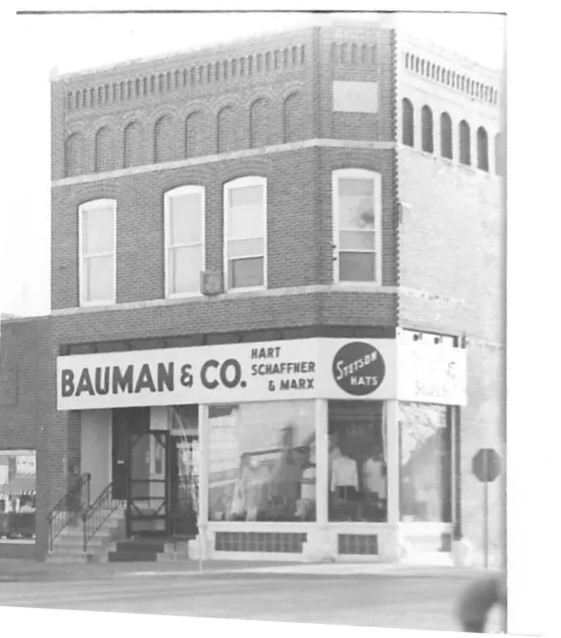
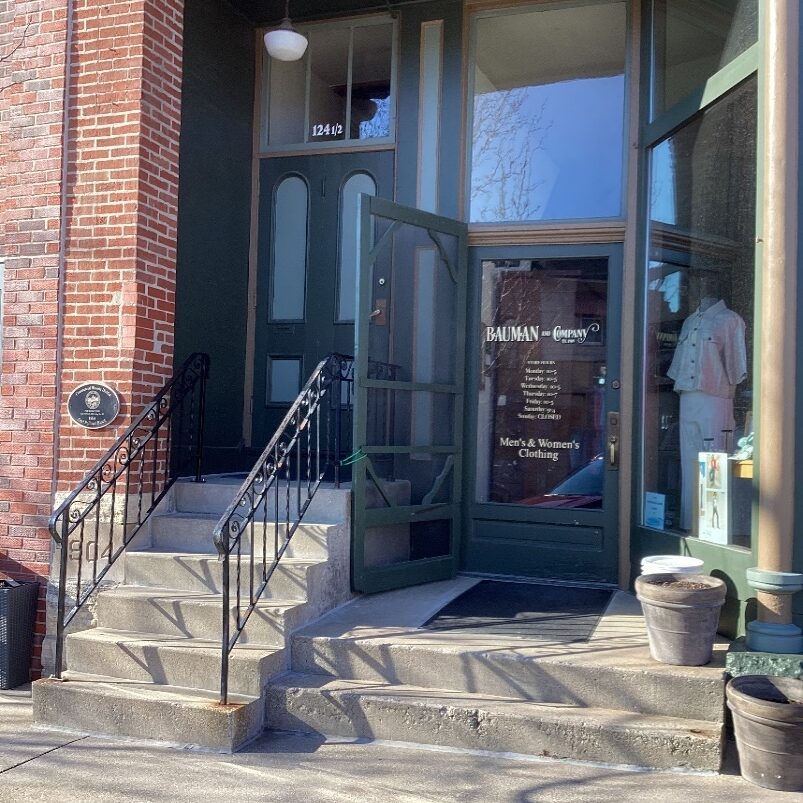
Funeral procession ca. 1900Bauman’s on Main Street, date unknownMain St. looking west, ca. 1885Figure 8: (Photos Courtesy of the Mount Vernon Historic Preservation Commission).
Mount Vernon Commercial District Map
* This map depicts the approximate boundary lines of the Commercial historic district.
Cornell College District
Only six years after Mount Vernon was platted in 1847, the Iowa (Methodist) Conference Male and Female Seminary constructed its first building. In 1885, the institution was renamed Cornell College. During the turn of the century, residential construction developed around the western edge of the campus. While construction slowed during the Depression years in other parts of Mount Vernon, federal assistance programs created local jobs with the construction of the water tower and Cornell College erected several new buildings throughout the 1930s.
The post-war boom prompted further expansion of the College, and several new buildings were constructed particularly by the architectural firms Green and Co. and Harry Weese and Associates throughout the 1950s and 1960s. While Mount Vernon is transitioning into a bedroom community for Cedar Rapids, the Cornell College District illustrates the historic community that was at the foundation of the town and represents its continued role as an anchor to the local economy and as an influence on its cultural life.
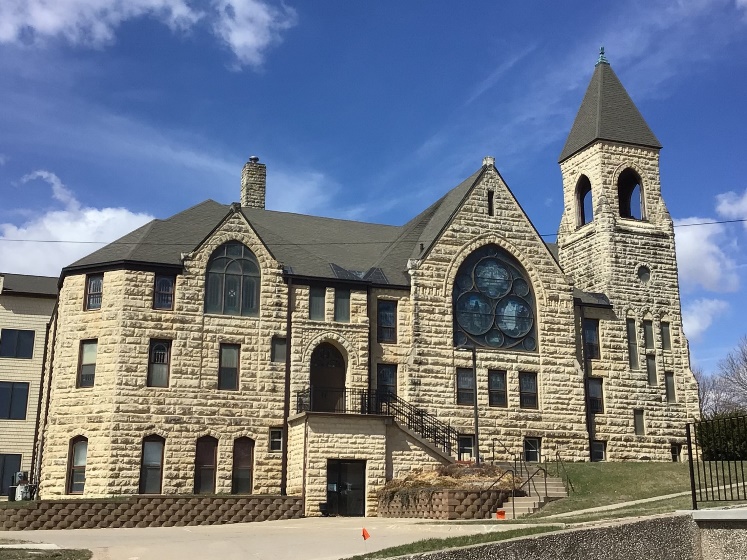
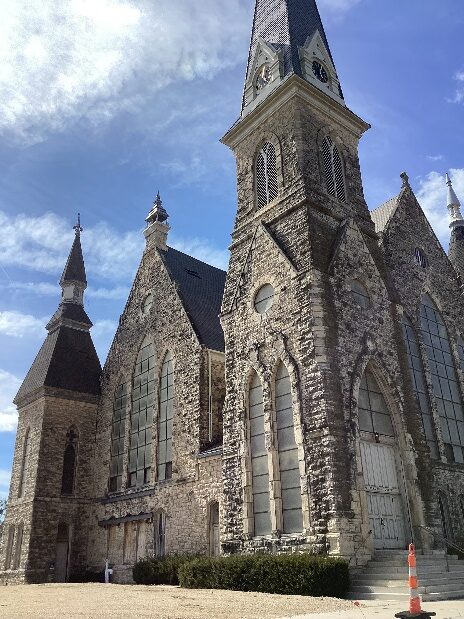
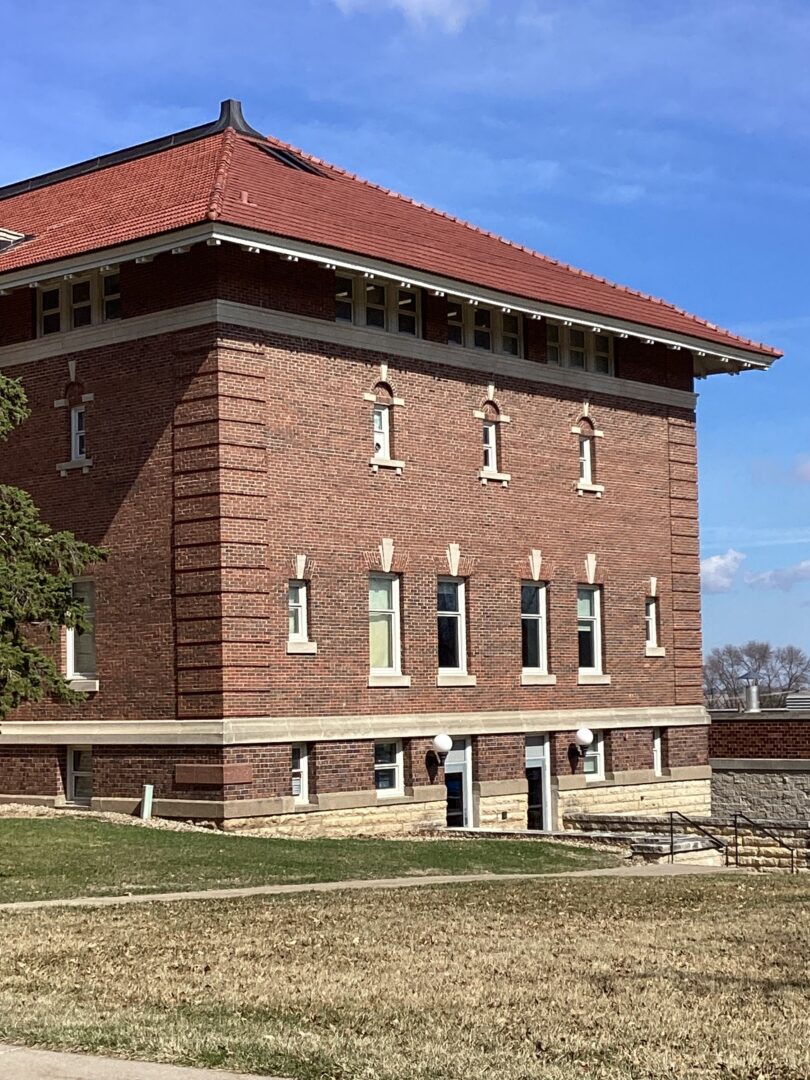
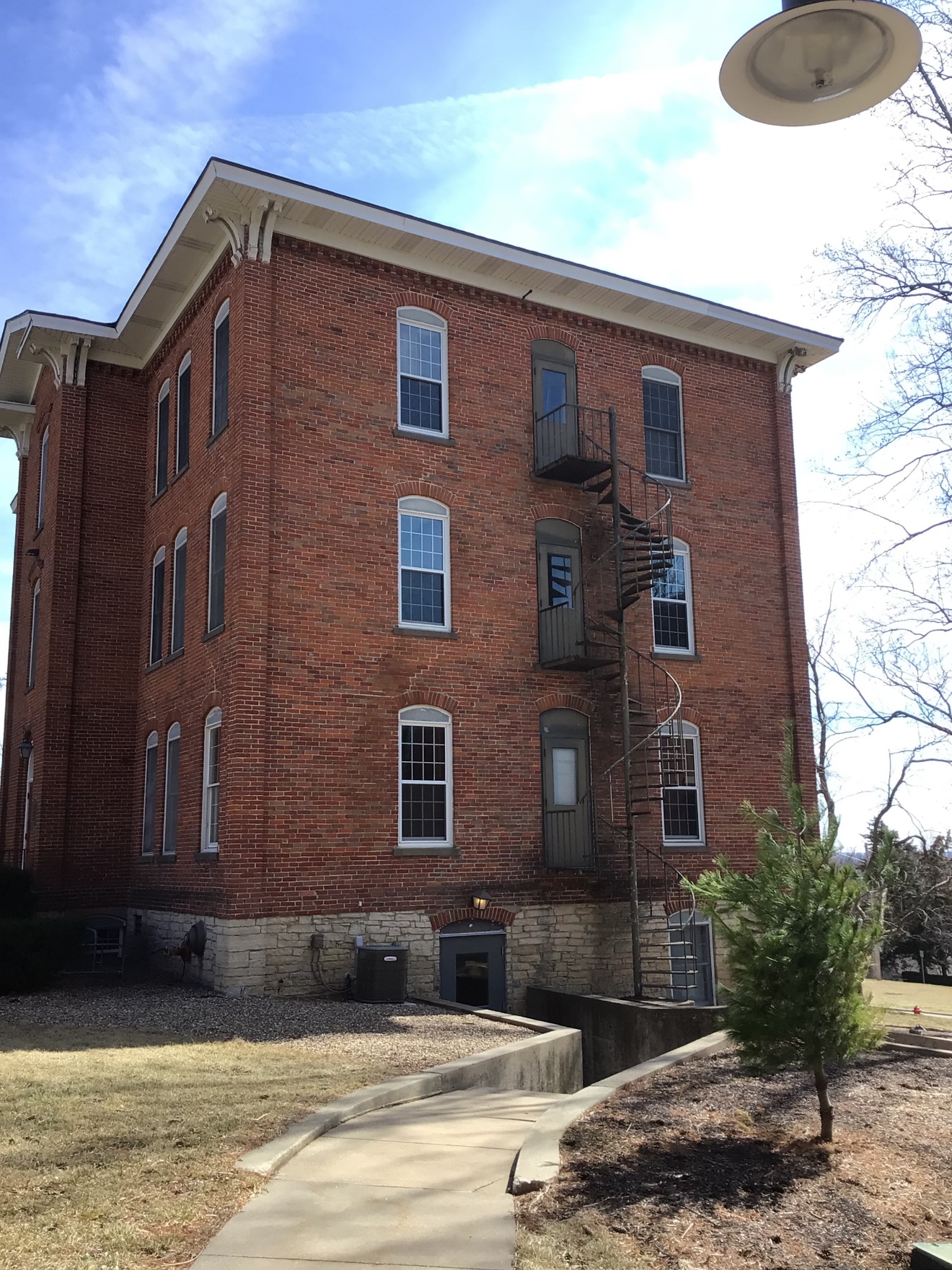
The institutional buildings found within the Cornell College District are primary multi-story buildings used for college purposes, including dormitories, lecture halls, and churches. Classical, Colonial, and Gothic Revival styles are common throughout the district, however other residential styles such as Tudor Revival, Folk Victorian, and Queen Anne are also found withing the residential properties that have been included within the Cornell College District.
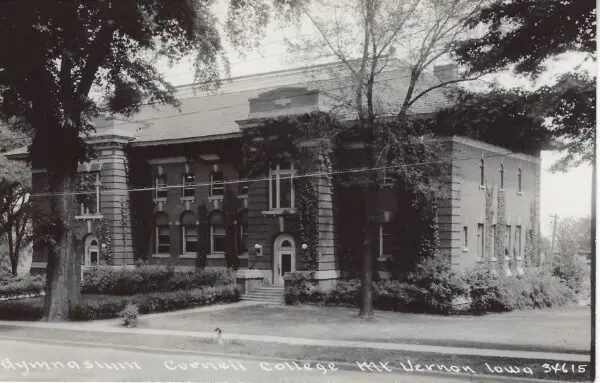
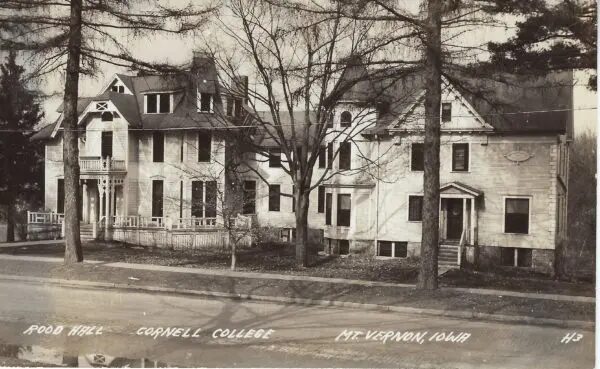
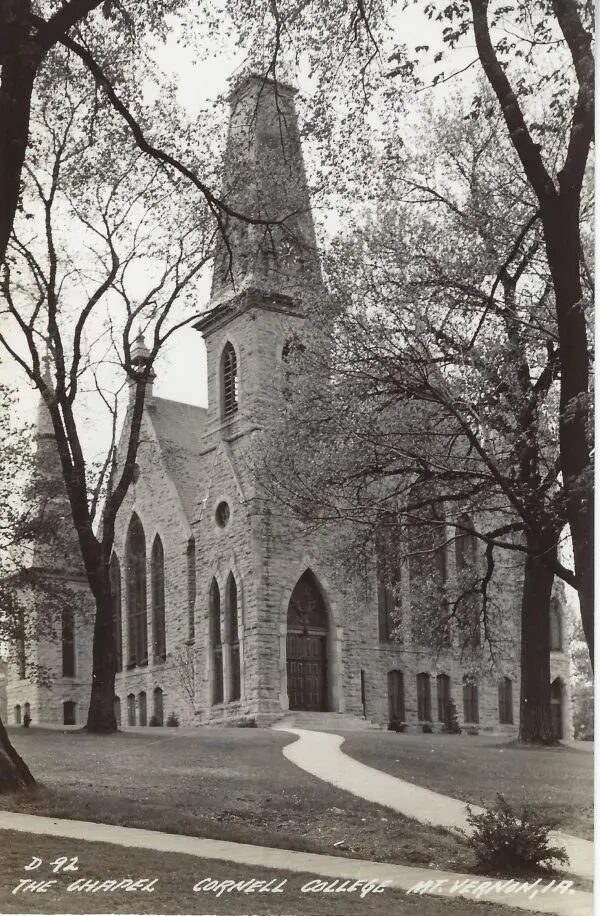
McWethy (formerly the Gymnasium)Rood HallKing Memorial Chapel, Ca. 1943-1944Figure 9: (Photos Courtesy of the Mount Vernon Historic Preservation Commission).
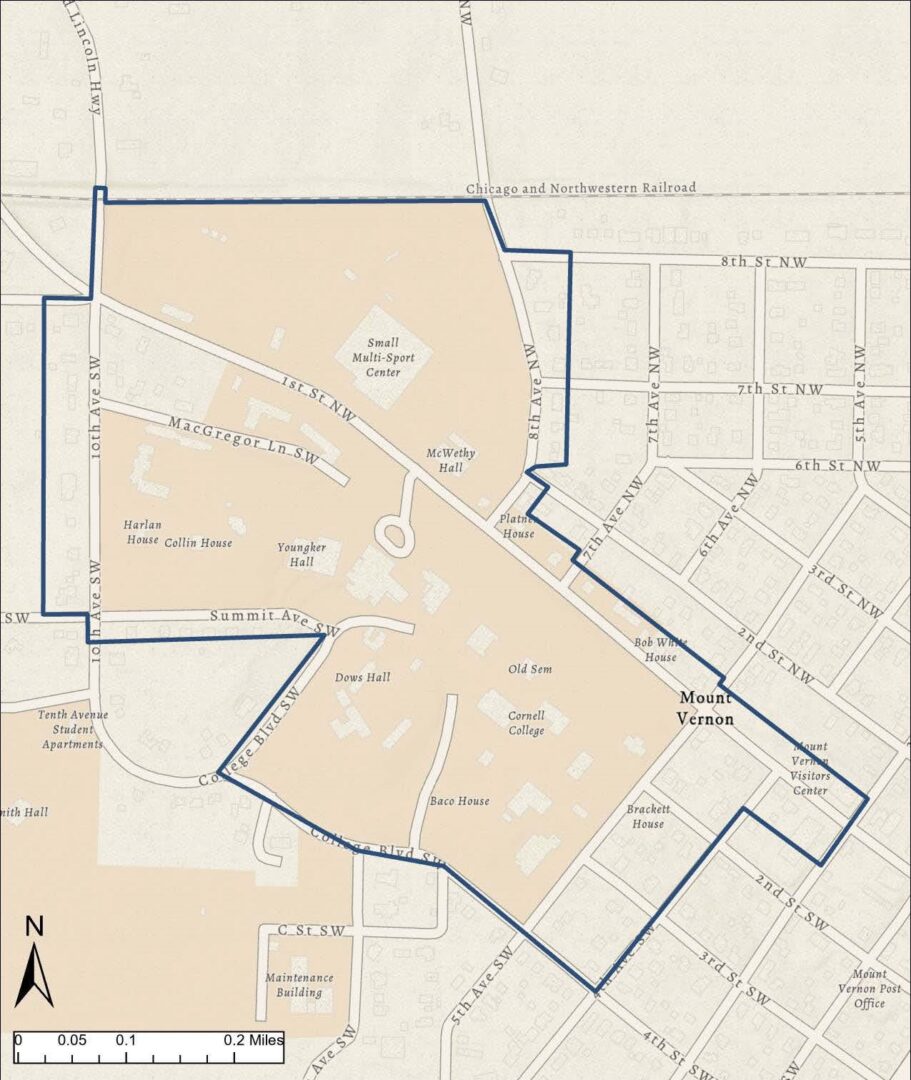
Cornell College District Map
* This map depicts the approximate boundary lines of the Cornell College historic district.
Individually Listed National Register Properties
While Mount Vernon has a number of properties listed on the National Register of Historic Places, only King Memorial Chapel is located within one of Mount Vernon’s historic districts. This property was listed in the NRHP in 1976 and is in the Cornell College District.
Mount Vernon’s other individually listed properties are the Wesley West House, which was listed in 1985 and eleven locally produced brick homes that were part of a multi-property nomination under the Historic Resources of Mount Vernon, Iowa submitted in 2019. These eleven properties are:
The Col. John and Rowena Wilds House
The Augustus and Elizabeth Bauman House
The Dr. Luther and Susette Pease House
The George W. and Mary J. Robinson House
The Frederick and Martha Knott House
The Elijah and Mary Waln House
The James and Anna Smith House #1
The Martin and Mary Jane Shantz House
The Henry and Juliana Albright House
The James and Anna Smith House #2
The James and Mayetta McCartney House
513 First Street SE
These properties are not subject to the Design Review process, however the MVHPC recommends property owners to adopt these guidelines as best practices.
3.1. Introduction to the Mount Vernon Historic Preservation Commission
Mount Vernon’s City Council created the Mount Vernon Historic Preservation Commission (MVHPC) in 1985 to identify, promote, and protect the city’s architectural heritage. The MVHPC’s mission is as follows:
“[T]o identify, interpret and protect the historic and archaeological resources of our community and encourage historic tourism.”
The Commission’s responsibilities are to create historical and architectural awareness by conducting preservation and education projects which include organizing historic architecture surveys and evaluations, conducting historic tours, publishing newsletters, hosting outreach programs, and nominating individual properties and districts for listing in the National Register of Historic Places. The MVHPC has also obtained three grants, one at the federal level, one at the state level, and the third at the county level to preserve and restore Mount Vernon’s Visitors Center.
Physical Address: 213 First Street NW, Mount Vernon, IA 52314 Phone: 319-895-8742 Fax: 319-895-6108 Email:[email protected]
MVHPC Membership, Powers, and Duties
In accordance with the Mount Vernon Code of Ordinances, Chapter 24, Historic Preservation: The MVHPC consists of no more than twelve commission members who are appointed by the Mayor with the advice and consent of the City Council and serve three-year terms. These members show a positive interest in historic preservation and may come from a variety of backgrounds that include architecture, architectural history, historic preservation, city planning, building rehabilitation, conservation, and real estate. At least one resident of each designated HD Historic Overlay District is appointed to the Historic Preservation Commission. Commissioners are required to be at least 21 and to complete state-approved continuing education once in every two-year period.
The MVHPC’s responsibility is to protect, promote, and enhance the perpetuation of sites and districts of historical and cultural significance through preservation, heritage tourism, and economic development. The MVHPC aims to foster pride in the legacy and beauty of Mount Vernon’s past achievements for the welfare of the people of the city. As such, properties that are located within Mount Vernon’s historic districts are subject to a Design Review Process conducted by the MVHPC for projects that will alter the exterior of a property.
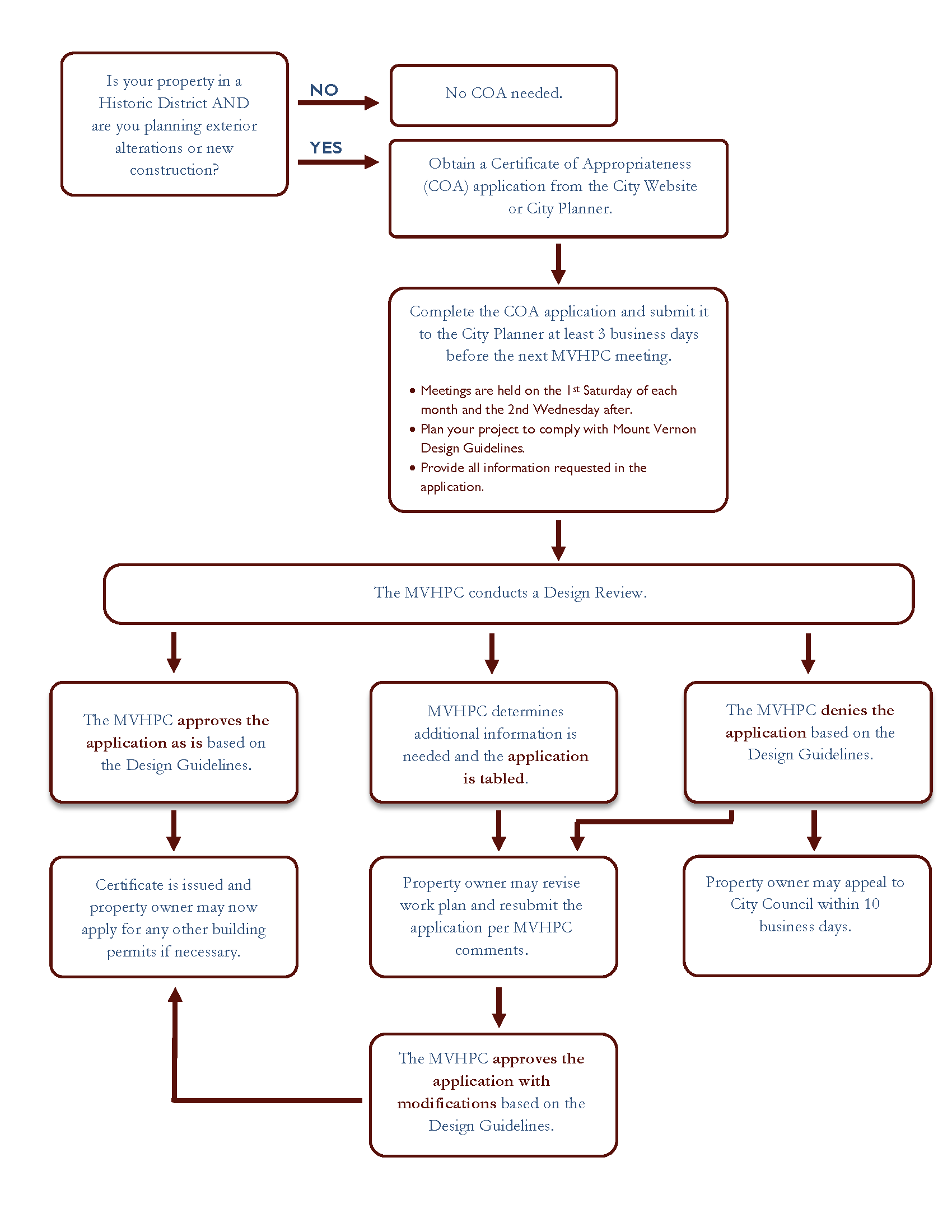
Such projects require a Certificate of Appropriateness (COA) that will be reviewed for approval by the MVHPC to protect places, districts, sites, buildings, structures, objects, and works of art having a special historical, cultural, or aesthetic interest or value to the community. Additionally, the MVHPC can make recommendations to the City Council and other City commission and boards regarding preservation issues that help protect and enhance historic districts and sites with historical, architectural, or cultural value.
A COA application can be obtained at City Hall or in the Permits and Forms section of The City of Mount Vernon’s website. The application must be completed by the property owner and submitted to the city Planning and Zoning department. The COA application should be accompanied by requested drawings and other exhibits as specified in the COA.
Each project will be scheduled for review at the first MVHPC meeting that occurs after the COA application is received. Applications must be submitted at least 3 days before the meeting date. Applicants are strongly encouraged, but not required, to attend the Design Review meeting.
The MVHPC meets in the Conference Room at City Hall on the 1st Saturday of each month at 8:30 AM and mid-month on Wednesday at 7:00 PM when necessary to complete a Design Review. All meetings are open to the public.
Building permits originate either with the Building Division of Linn County Planning and Development or with the City of Mount Vernon.
Mount Vernon’s City Planner may provide answers to questions regarding permits.
Certificate of Appropriateness and Certificate of No Material Effect
Any exterior project that will change the appearance to a building or site that is located in a historic district may not be executed nor issued a regulated permit by the Building Official unless the MVHPC has granted a Certificate of Appropriateness or a Certificate of No Material Effect.
A Certificate of Appropriateness indicates that after review of the project, the MVHPC determined the proposed project conforms to the standards set forth by the Secretary of the Interior’s “Standards for Rehabilitation” or the City of Mount Vernon Design Guidelines.
A Certificate of No Material Effect is issued if the MVHCP determines that the proposed work will have no effect on any significant architectural features of the structure or on the historic district.
a) Appeals
If the applicant is not satisfied with the findings of the MVHPC, they may appeal the resolution to the City Council within ten (10) days of the decision. The City Council may then approve, reverse, or modify this decision. If the applicant is not satisfied with the City Council’s findings, they may appeal to the Iowa District Court within sixty (60) days.
b) Violations
The Building Official is responsible for enforcing the regulations of the Mount Vernon Code of Ordinances and bringing any violations or lack of compliance to the attention of the MVHPC. Any violations or failure to comply with any requirements will be enforced in accordance with Chapter 4 of the Mount Vernon Code of Ordinances.
Chapter 4. Architectural Style Guide
4.1. Introduction
Historic buildings are frequently characterized according to their architectural style. Architectural style is defined by hallmark forms, shapes, proportions, materials, and ornamentation that make up a building’s overall character. Architectural styles have changed throughout history as certain design movements became popular, and others faded out of fashion. Understanding your property’s architectural style, and the character-defining features that contribute to that style, will help you to understand which features are critical to the preservation of its historic character. Before proceeding, it is helpful to understand the following terms as they relate to historic architecture.
“Building Type” describes a structure’s function, while “building form” describes a structure’s shape and the components that influence that shape such as number of stories, depth of rooms, etc. Some building types and building forms are closely associated with a particular architectural style, while others are used in many architectural styles.
The term “vernacular” when applied to architecture, describes buildings constructed according to traditional methods of construction within a specific locality or for a particular group of people. These local variations in architectural styles often occurred when builders or designers combined common building forms, pattern book designs of popular styles, and their own ideas. Often these buildings were designed and built by individuals who were influenced by the needs of their location, such as climate, the available building materials and technique, and contemporary architectural and decorative fashions.
The term “high style” refers to buildings designed according to doctrines of a specific, readily identifiable, national, or regional architectural style. They are designed by professional architects and builders or are derived from architectural plan books. Designers of high style buildings were often strongly influenced by contemporary trends, fashions, and academic principles. While there are examples of high-style architecture in Mount Vernon, most buildings are vernacular.
4.2. Building Types
A building’s type is defined by the function of the property. The following types are found within Mount Vernon’s historic districts:
Residential buildings include single-family homes and multi-family homes, such as apartments and duplexes.
Commercial buildings are buildings used for business purposes, such as stores, offices, and banks.
Institutional buildings are those which were constructed to accommodate the needs of the government, such as schools, churches, and similar organizations.
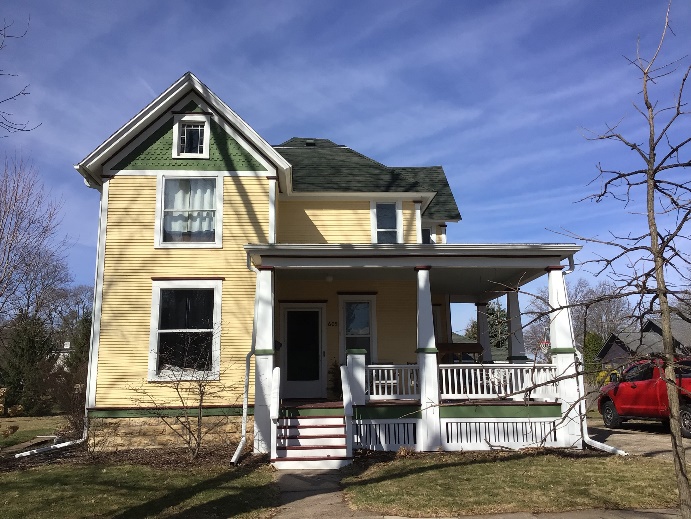
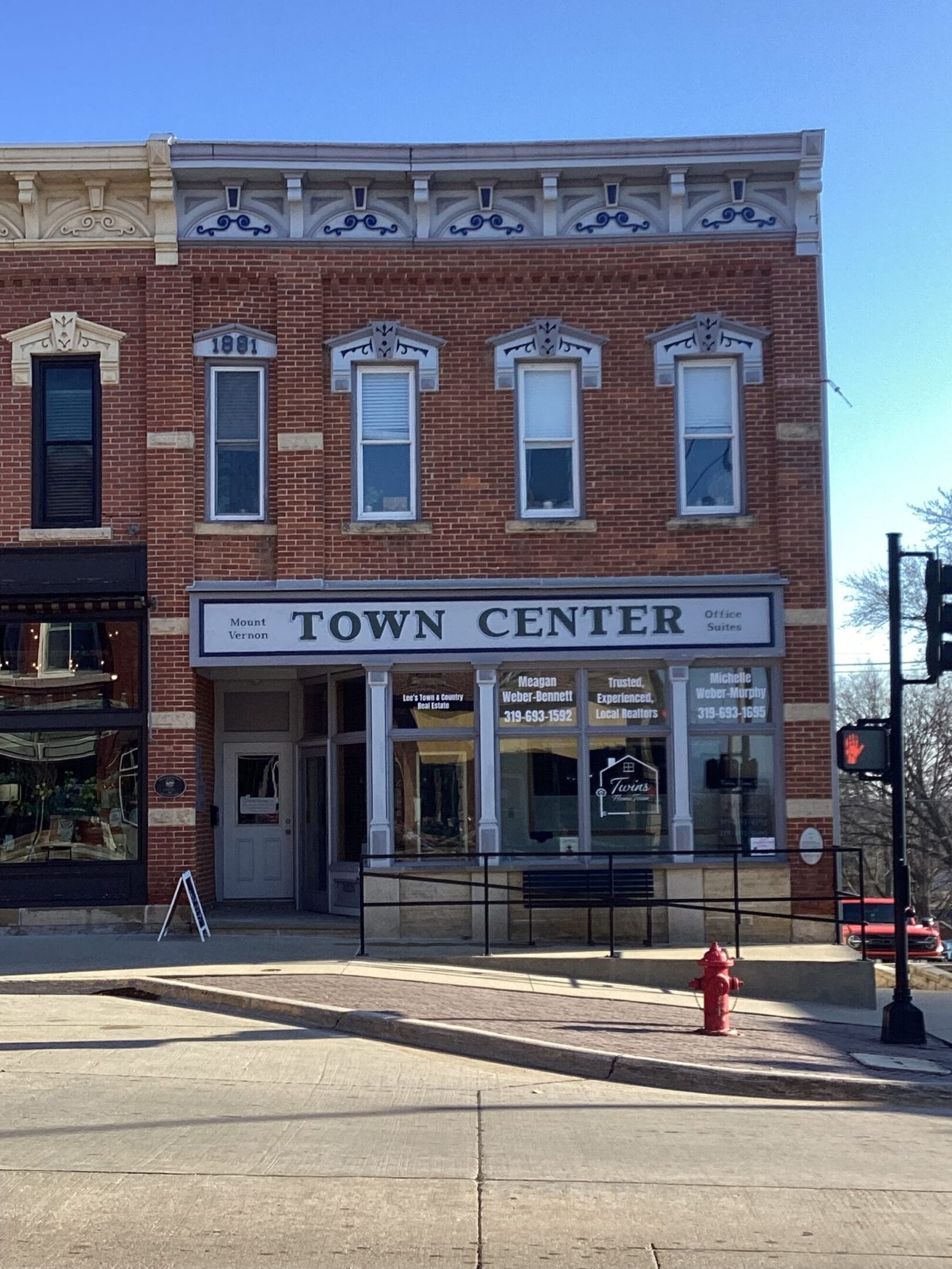
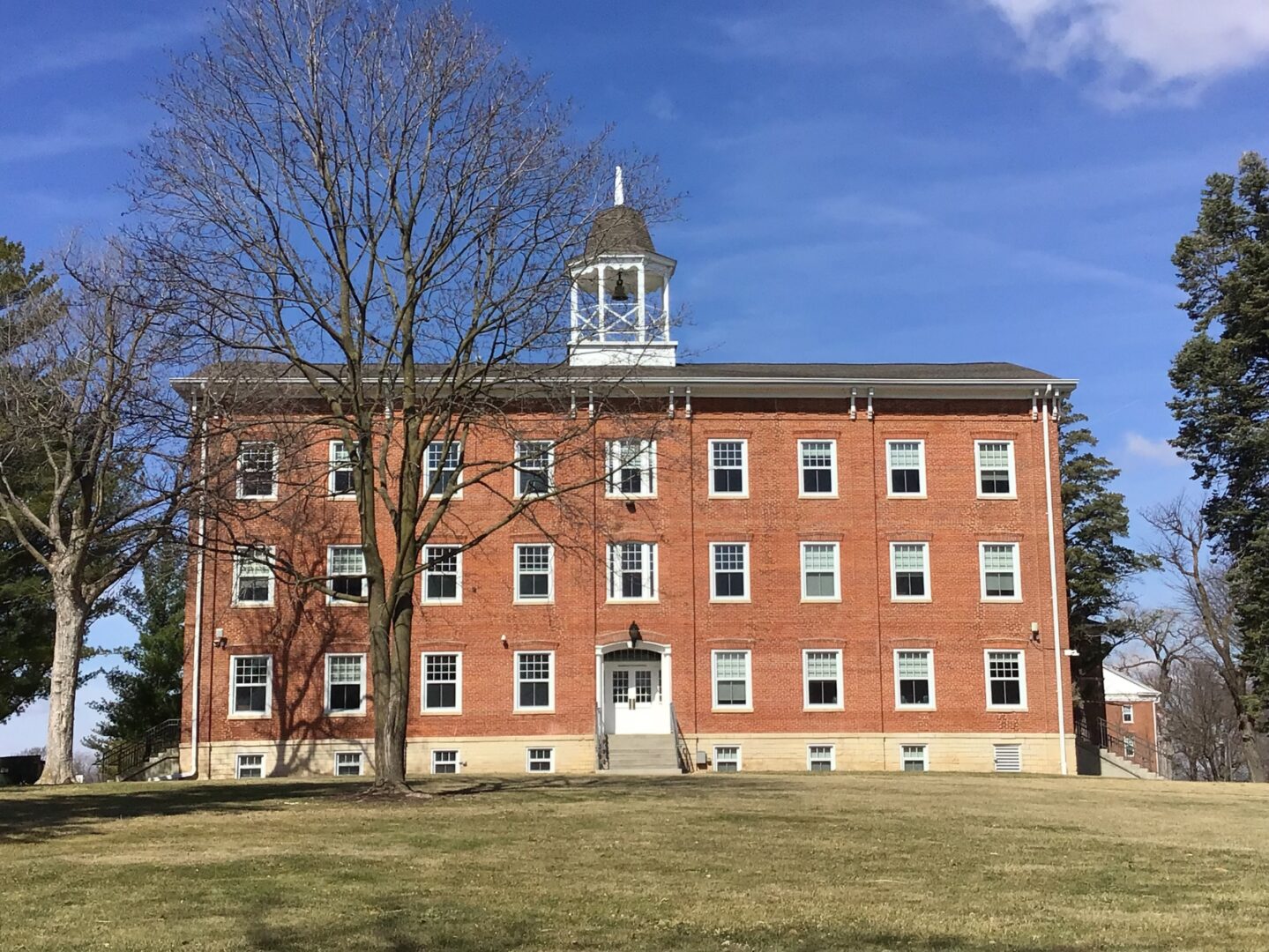
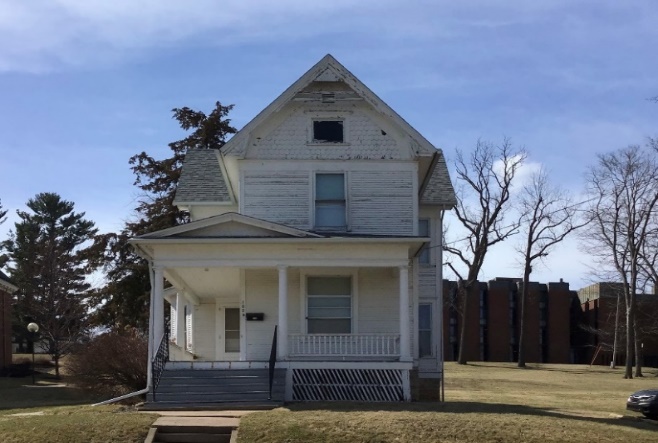
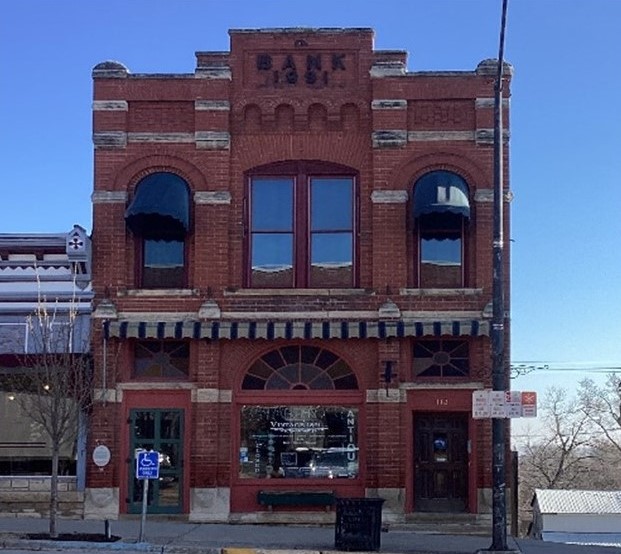
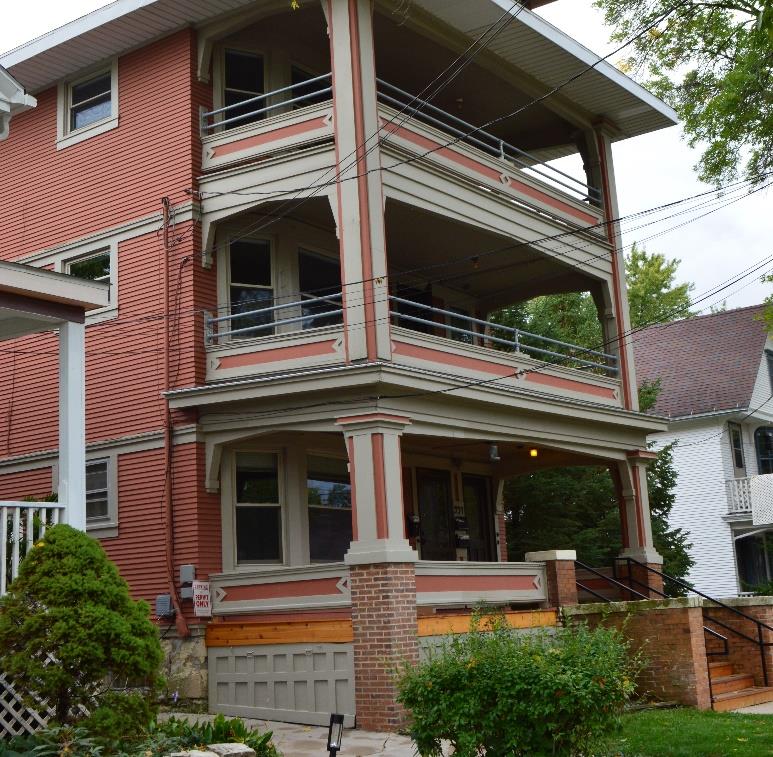
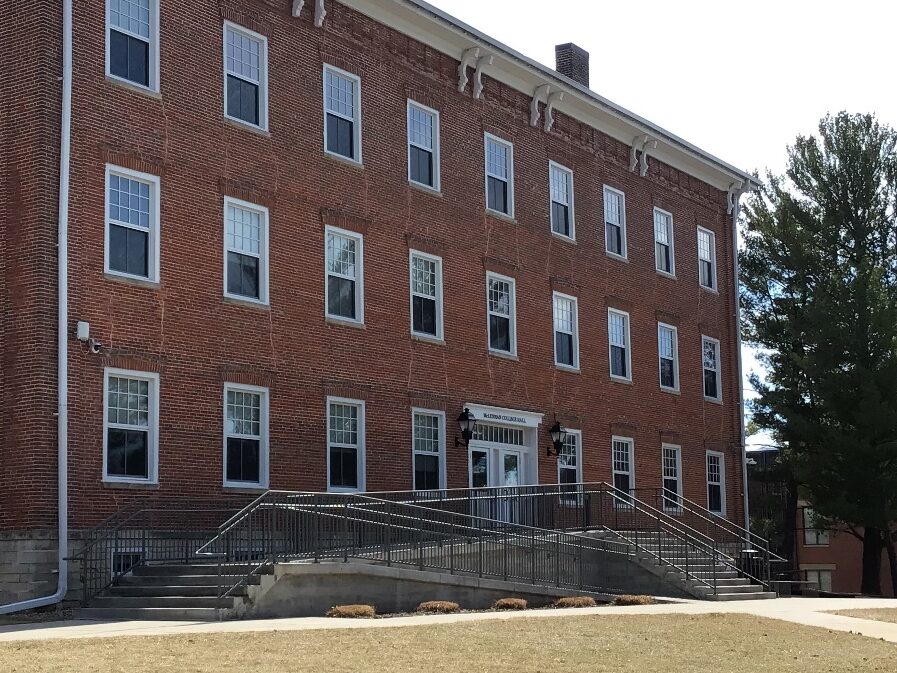
Typical residential property in Mount Vernon’s Ash Park historic districtA typical building in the Commercial Historic DistrictTypical institutional building in Cornell’s Historic District.Figure 10: Typical residential, commercial, and institutional building types found in Mount Vernon’s historic districts.
4.3. Building Forms
A building’s form refers to the shape or configuration of a building. Its form is closely related to its type or function. Some forms can be seen across a wide variety of architectural styles, while others are closely related to a specific style.
Non-Residential Buildings
One-Part Commercial Block (1850s-190s)
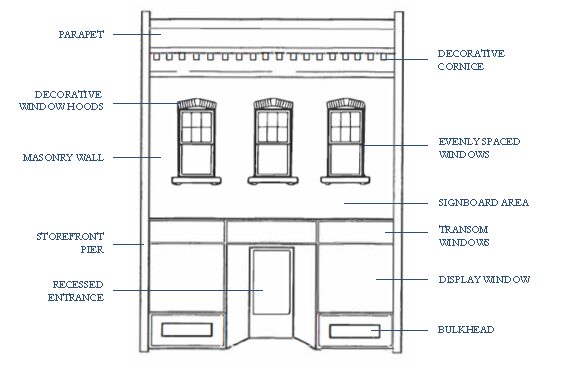
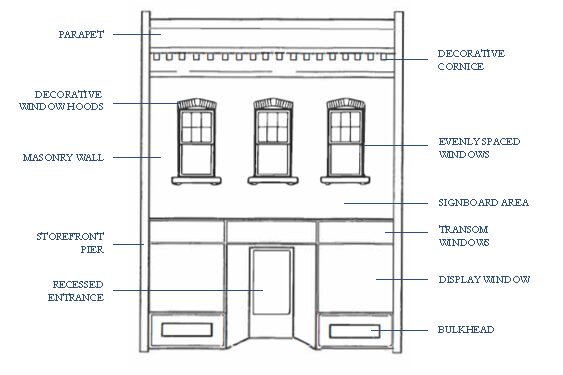
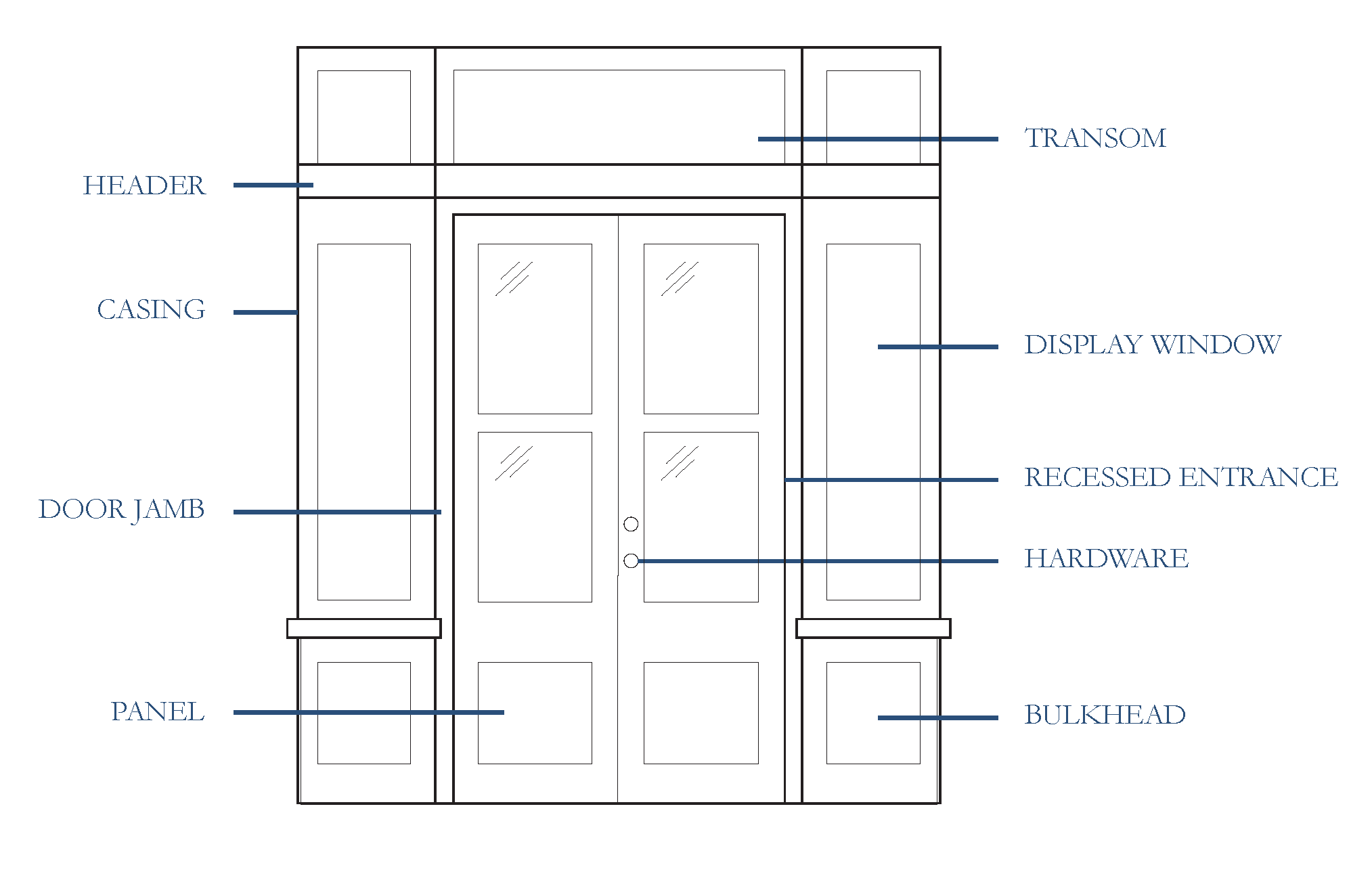
This building type is a single story and was typically constructed in urban settings to house retail shops, banks, or restaurants. These buildings tend to be tall, with a decorated façade featuring decorative cornices and parapets, recessed entrances, and large display windows to advertise the goods and/or services provided inside.
Figure 11: One-Part Commercial Block diagram.
Two-Part Commercial Block (1850s- 1950s)
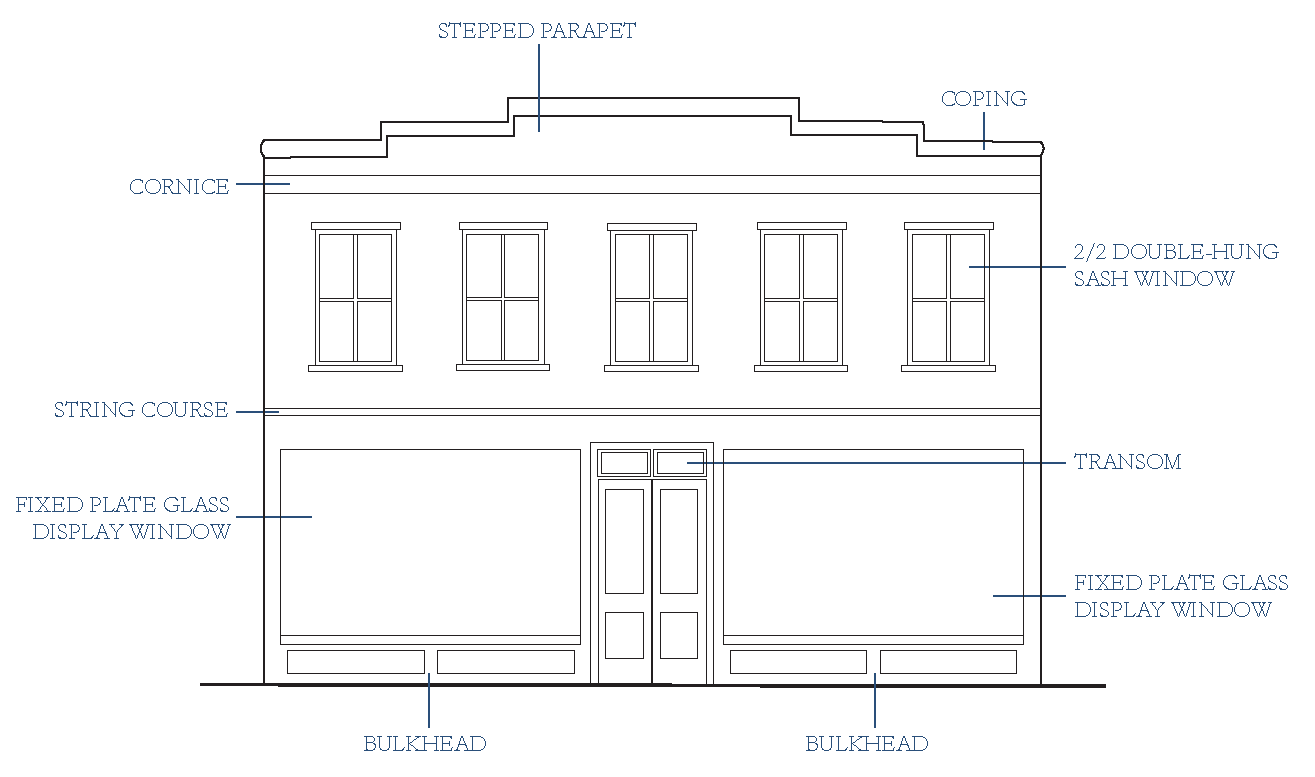
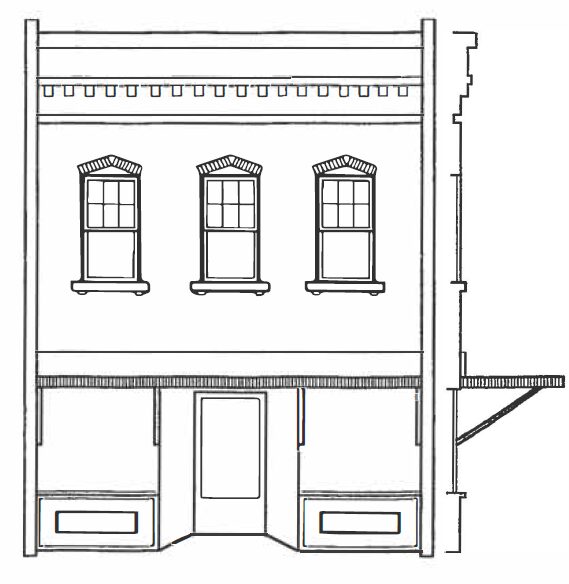
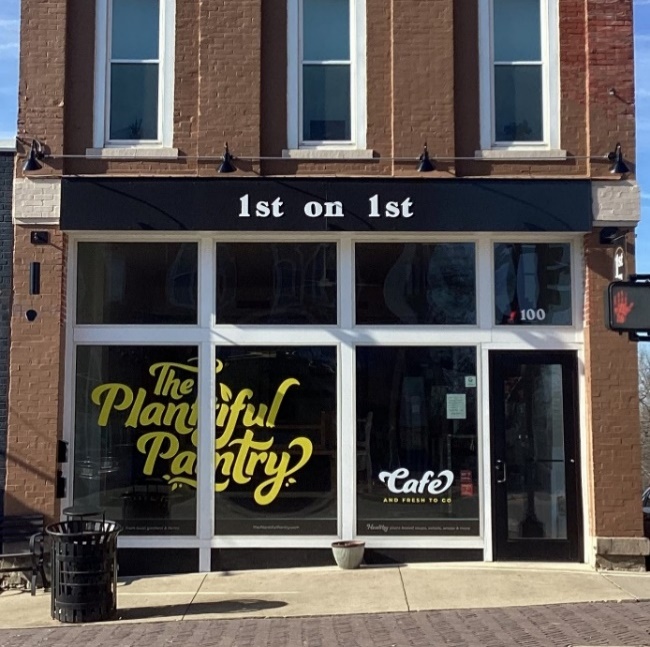
This building type is two to four-stories tall and divided into two distinct parts based on interior uses. Public spaces, such as lobbies or commercial businesses, are located on the ground floor and private spaces, such as offices or apartments, are on the upper floors. These building types also tend to feature decorated facades. Most of the structures in Mount Vernon’s commercial district are two-part commercial block buildings.
Figure 12: Two-Part Commercial Block diagram.
Vernacular Storefront (1850-1950s)
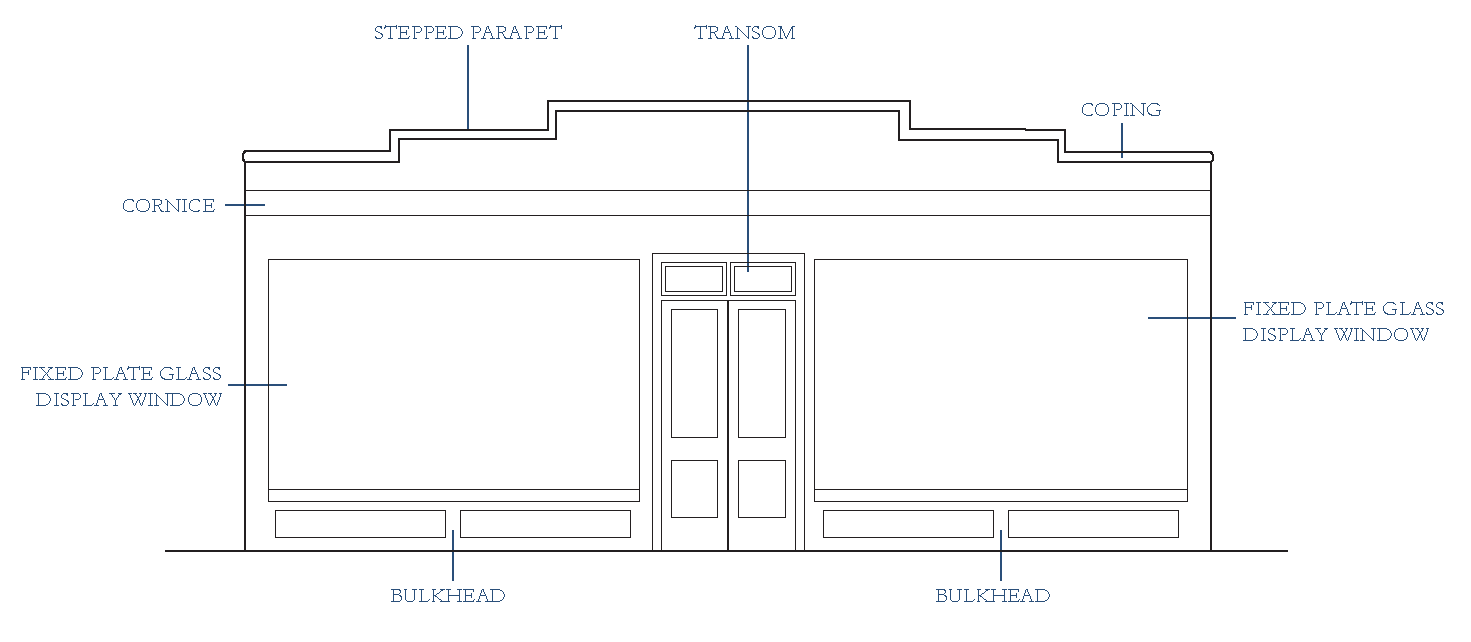
These storefronts commonly appear as the first-floor level of the two, and sometimes three-part, commercial block. These storefronts typically feature large windows for the display of goods, with a bulkhead below the display windows, and a recessed main entrance which may be centered or aligned to one side of the building. The majority of Mount Vernon’s historic commercial buildings feature vernacular storefronts.
Figure 13: Vernacular Storefront diagram.
Residential Buildings
Single Pile
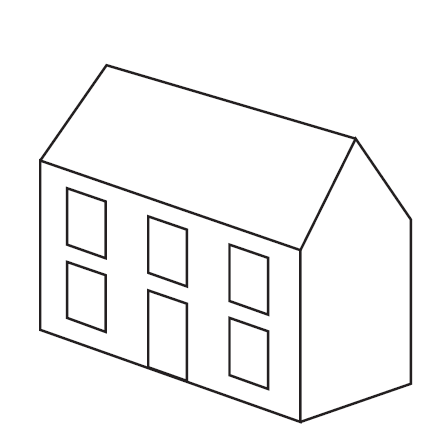
Figure 14: Single Pile diagram.
This style, also called an “I-House,” is traditionally three bays wide, one room deep, and two stories tall with a side- or front-gabled roof. It has a symmetrical façade, often with end chimneys and a front porch. On the interior, it typically has a central hall flanked by rooms. It is a common type of vernacular home, and many were constructed in the region during the 19th century. These homes were often enlarged with rear ell additions, and the front porch was often updated to suit changing architectural fashions. Gothic Revival, Queen Anne, and Italianate variations are common.
Double Pile
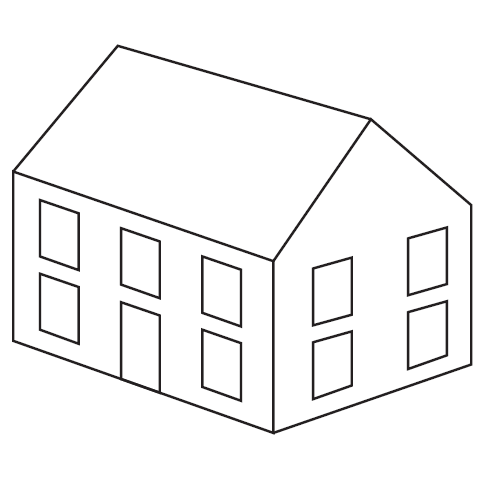
Figure 15: Double Pile diagram.
Like the I-House, the Double Pile is typically three to five bays wide and two stories tall with a rectilinear shape and side-gable roofline. The Double Pile house is defined by its two-room depth. It follows one of the most common domestic floor plans found in the United States, the “Hall and Parlor” plan, in which a central hall with staircase is flanked by pairs of rooms on each side. The double pile form is most closely associated with the Georgian and Federal styles but was also commonly ornamented with Greek Revival, Gothic Revival, Italianate, Colonial Revival, and Classical Revival style details. It is also commonly found in its simple vernacular form with little stylistic detail.
Gable-Front
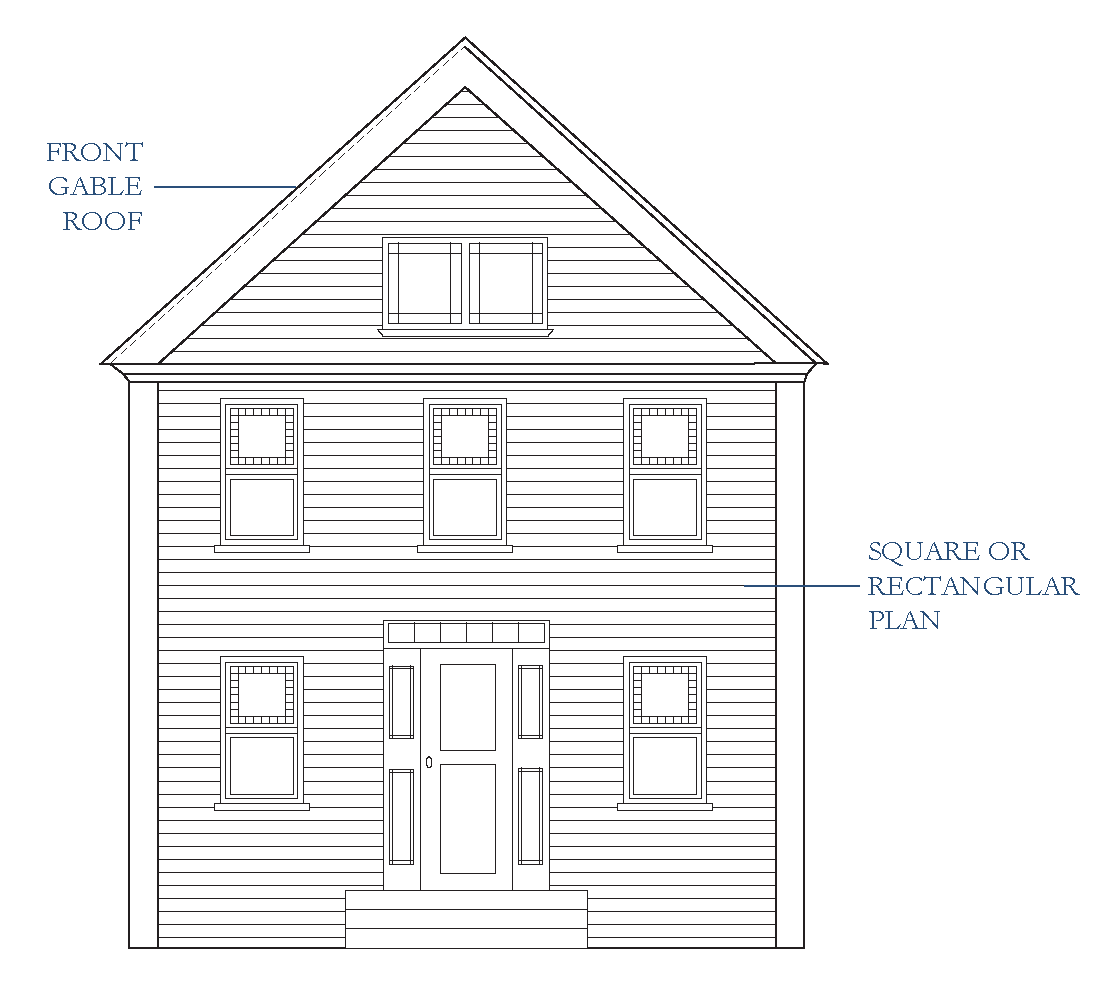
Figure 16: Gable-front diagram.
The Gable-front house is another common vernacular form. Characterized by its simple, front-gabled roof, the Gable-front house type is typically rectangular or square in form. The narrow form of the gable-front type was well suited to narrow lots and the type is commonly found in urban neighborhoods and towns. Like other vernacular forms, this type may be found unornamented or with applied ornamentation from a variety of architectural styles.
Gable-Ell
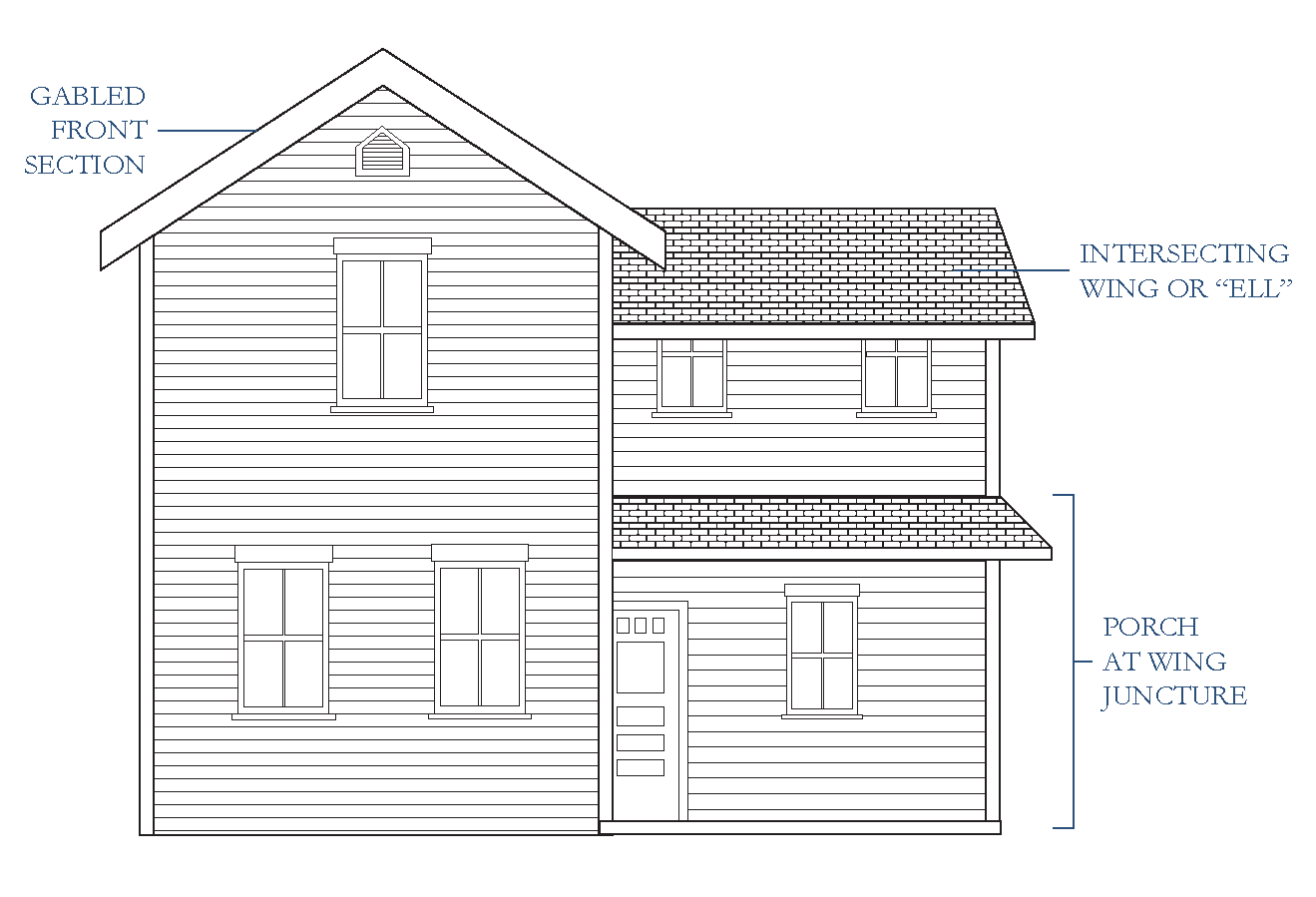
Figure 17: Gable-Ell diagram.
The Gable-Ell house is typically two stories and is characterized by a gable-front central mass with an intersecting wing (the “ell”) placed perpendicularly, creating an L shaped plan. The long side of the ell is typically oriented towards the street, and a porch is often located at the juncture of the two wings. Like the other building types mentioned, the gabled ell house was often ornamented with Victorian-era details, and the porch was commonly updated to reflect changing tastes and architectural fashions.
American Foursquare
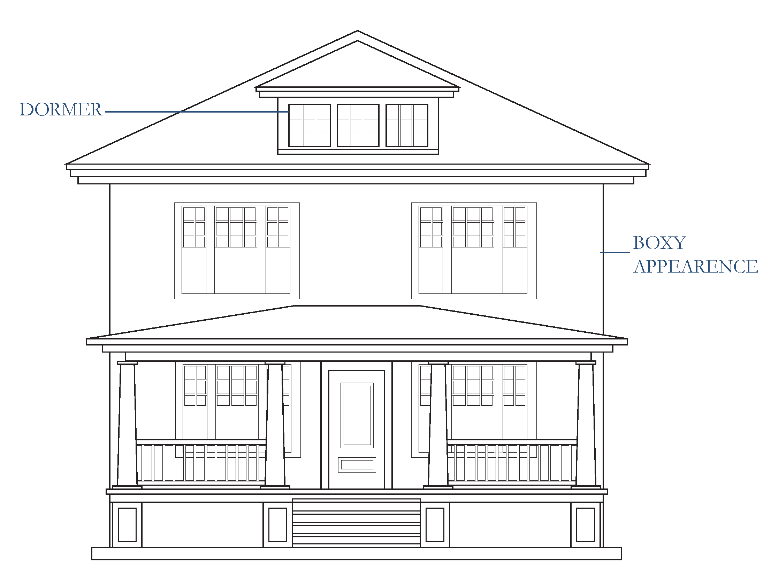
Figure 18: American Foursquare diagram.
The American Foursquare is characterized by its boxy appearance, square or rectangular plan, and hipped or pyramidal roof. They are two-and-a-half stories high, and many have hipped or shed dormers. Dormers were typically centered over the front façade or placed on all four sides of the hipped roof. The form was ubiquitously popular on farms, in suburbs, and in more urban areas with larger lot sizes. These houses were popularized by their appearance in pattern books. Prefabricated versions were also available for purchase. These houses commonly incorporated Craftsman style elements but can be found with stylistic details from a variety of architectural styles, including Mediterranean Revival style barrel tile roofs or Colonial Revival style porches.
Bungalow
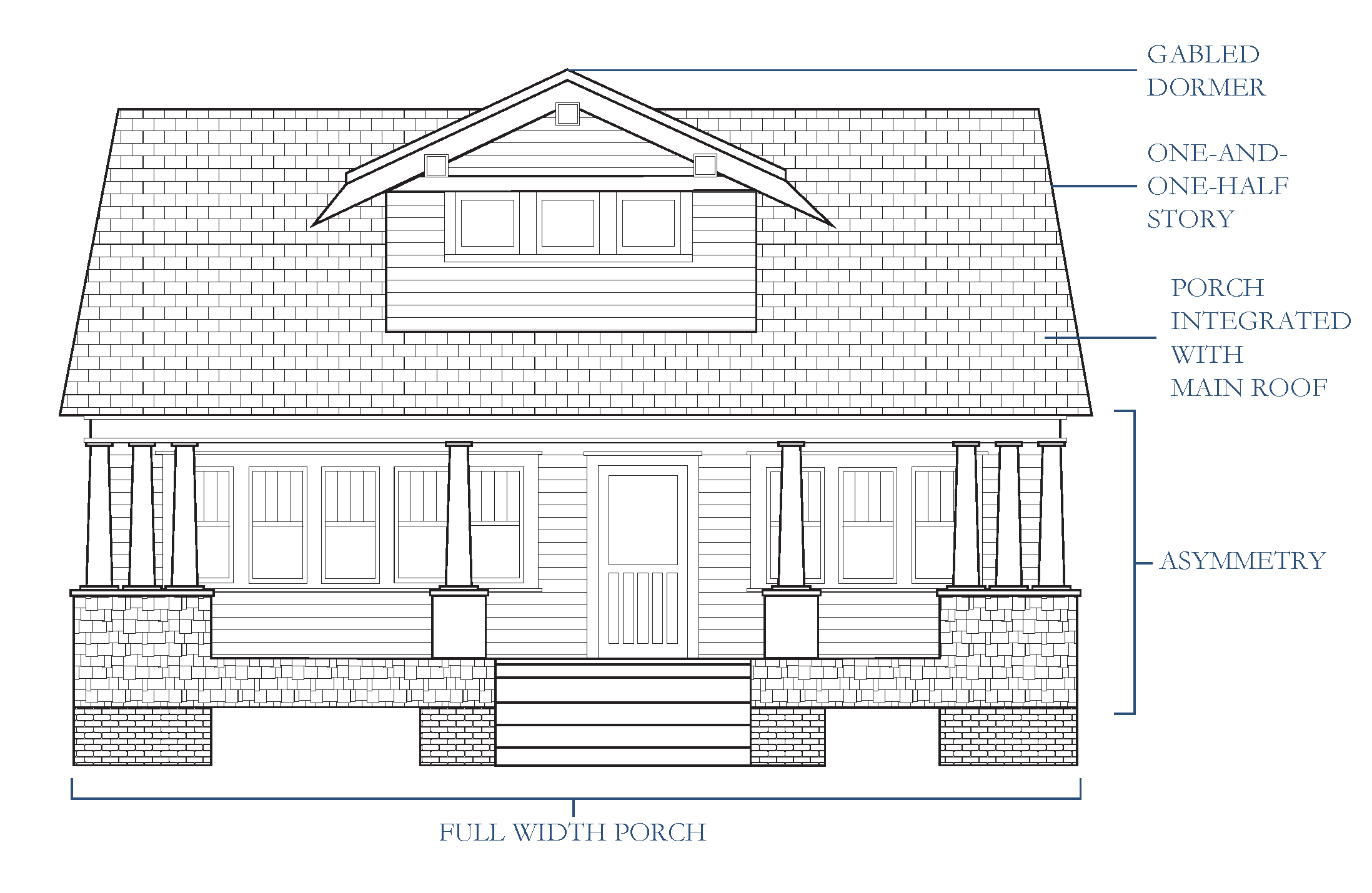
Figure 19: Bungalow diagram.
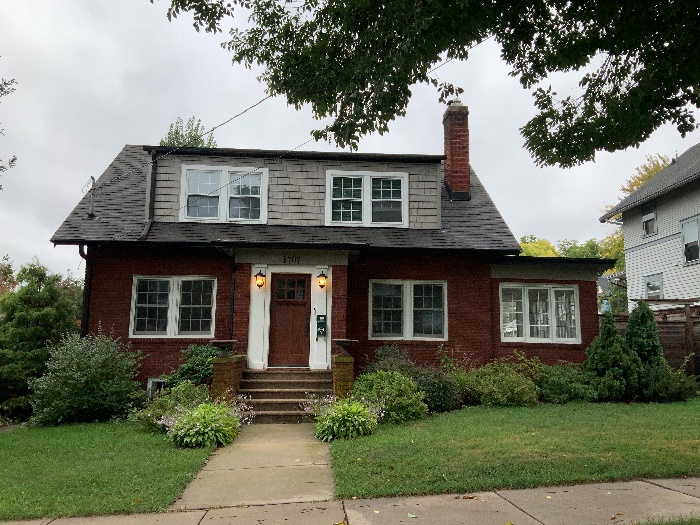
The Bungalow was a common house type in the United States and examples can be found dating to the 1900s through the 1940s. Bungalows are one to one-and-a-half stories and are compact in size. These houses typically have projecting eaves, multiple gables, asymmetrical facades, and low-pitched roofs with large dormers and integrated porches. The bungalow is most commonly associated with the Craftsman style. Like the American Foursquare, prefabricated versions were available as “kit houses”, and the form was widely popular for use in both rural and more urban settings.
4.4. Mount Vernon’s Architectural Style
Historic neighborhoods and commercial districts derive their distinctive feel from their own unique combination of architectural styles, building materials, and other landscape and design elements. Identifying architectural styles can help building owners understand the historic character of their own building as well as how it fits within the overall setting. The buildings within Mount Vernon’s historic districts reflect influences from major architectural styles which were popular in the 19th through the 20th century. The following section describes several historic architectural styles commonly found in Mount Vernon’s historic districts, including residential, commercial, and institutional buildings.
Vernacular (1847-present)
Vernacular is the term given to indigenous forms of residential and commercial building construction. Vernacular buildings are not architect-designed but most likely built by the property owner themselves. Some refer to vernacular buildings built after mill-sawn lumber was available as National Style. Buildings continued to be built according to the earlier traditional folk forms, but with widely available lumber some new shape innovations occurred. Some may have details taken from high styles such as Greek Revival or Colonial Revival, or later high style modifications. Commercial vernacular buildings may borrow from Italianate or Classical architectural features. Vernacular residences can be multi-family buildings that are designed as a central hall, side hall, double-decker, and triple-decker structure. Although many vernacular buildings may not have a distinct architectural style, they have an identifiable building type and form.
Greek Revival (1825-1860)
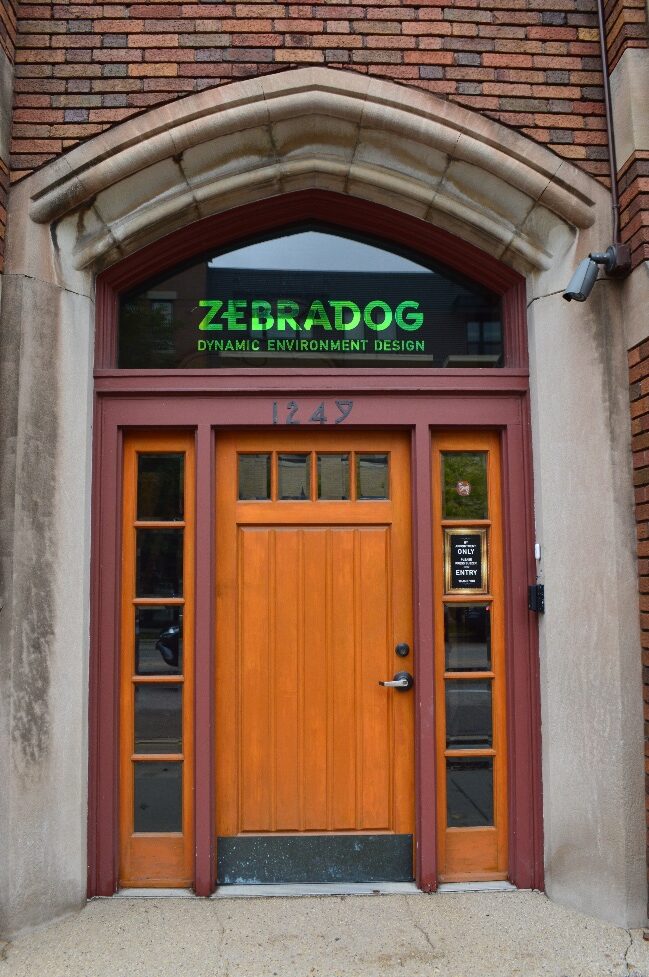
The Greek Revival style referenced the ornament and architecture of Ancient Greece and was nationally popular during the settlement of Mount Vernon. These buildings were typically two-story, sometimes one-story, clapboard sided buildings with a low-pitched gable roof or less often, a hipped roof. The cornice has a wide plain frieze board, or band, as part of the entablature together with a cornice above and an architrave below. The main building form may have a lower wing. Narrow sidelights and a rectangular transom surround the front door. Porches are supported by square or round columns and located at the entry, sometimes extending over the full façade.
Gothic Revival (1840-1880)
Popularized by the widely distributed plan books of Andrew Jackson Downing, the Gothic Revival style reached its height of popularity during the 1830s and 1840s. It was the earliest of the Victorian-era styles to challenge the classical norms. The movement abandoned the symmetry and order of Classicism in favor of asymmetry and variety in texture and color. This style is typified by an asymmetrical plan, steeply pitched gables, and pointed arches. Character defining features of the Gothic Revival style include an emphasis on verticality in proportions, a proliferation of “gingerbread” and scrolled woodwork detailing, such as vergeboard trim, and diamond-pane casement windows.
Second Empire (1855-1885)
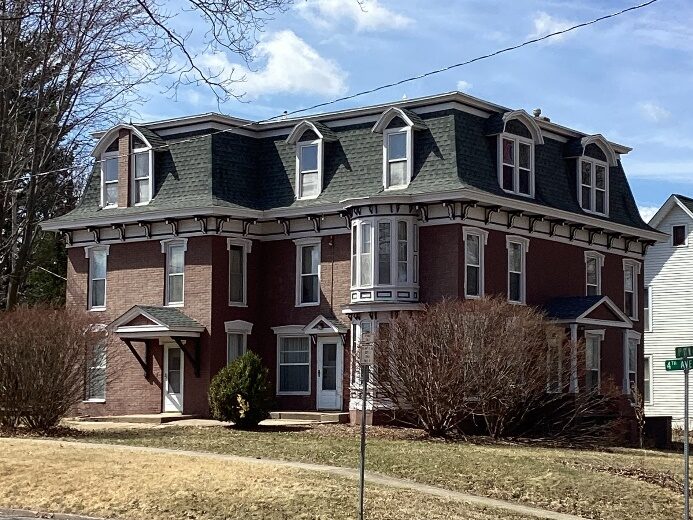
The Second Empire style was inspired by the buildings of Paris, which had been redesigned dramatically during the country’s Second Empire period which spanned 1852-1870, coinciding with the reign of Napoleon III. The style is similar in both form and detail to the Italianate and was popular in the United States during the building boom following the Civil War. The style was adapted to both symmetrical and asymmetrical floor plans and was used in both commercial and residential buildings. The signature feature of this style is the mansard roof, whose nearly vertical pitch allowed for more usable attic space than more steeply pitched roof types. Other hallmarks of the style include polychrome patterned slate shingles, prominent cornices, roof cresting, and rounded dormers.
Stick style (1860-1890)
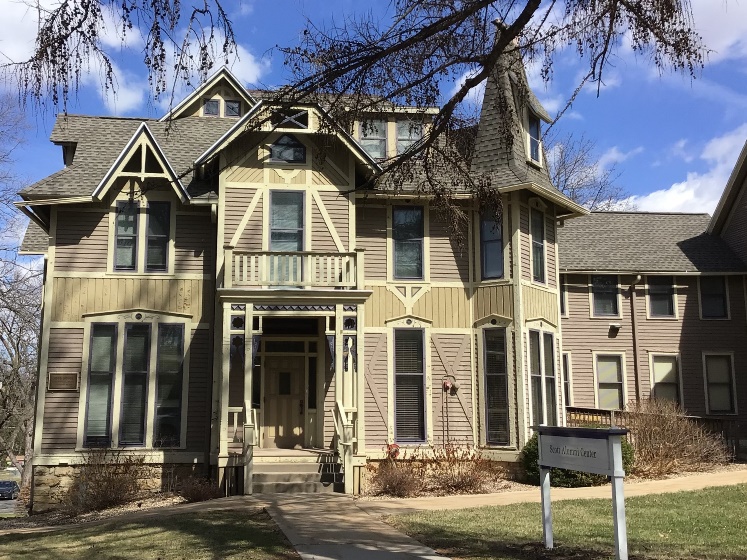
The Stick style was influenced by European trends in the mid-19th century which revived interest in the late medieval rustic country architecture. The style is centered on balloon frame construction and expresses truthfulness in its wooden construction through the use of conspicuous external wall treatments and joints. Stick style buildings emphasize height with steeply pitched and intersecting gable roofs. Decoration is two-dimensional, expressing the structural and skeletal character of the building through purely decorative crisscrossing timbers, called “stickwork” for which the style is named.
Folk Victorian (1870-1910)
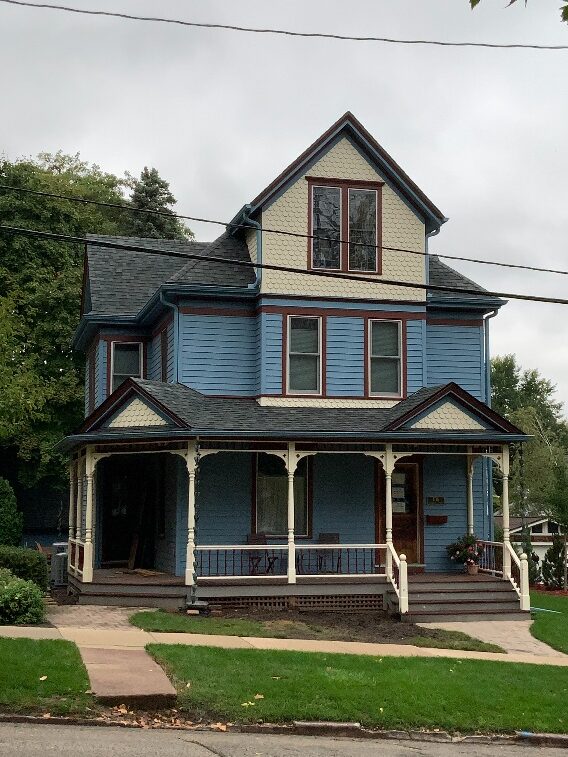
Folk Victorian is another style that is more often seen represented by residential buildings, although it is not unheard of to be represented by a commercial building. The buildings are primarily constructed with lumber, and so the spread of the style was greatly enabled by the growth of the railroad system. The style features Victorian style detailing on simple house forms. Much of the characteristic detailing is found in the porch or cornice line of the building. The details, like spindle work on porches, flat or jigsaw trim, and brackets in the cornice are common. While the style’s details are heavily influenced by the Queen Anne architectural style, differentiating characteristics of the style include the Folk Victorian’s symmetry and lack of texture used in the exterior materials.
Queen Anne (1880-1910)
The Queen Anne style merged a variety of classical and medieval ornamentation and is the style most commonly brought to mind with the use of the generic “Victorian” label. The Queen Anne style was successfully adapted to residential, commercial, and institutional uses. Queen Anne buildings are typically asymmetrical in plan, and feature turrets, window bays, towers, complex rooflines, decorated chimneys, and large and ornate porches. A variety of materials with contrasting textures, including brick, wood, stone, slate, and tile were often combined to create a picturesque effect.
Tudor Revival (1890-1940)
The Tudor Revival style is another period revival style that is reminiscent of countryside cottages in England, featuring steeply pitched and side gabled slate roofs, tall chimneys, and decorative half-timbered wall surfaces. Common elements include asymmetrical plans, front-facing peaked gables which may extend over entrances, and Tudor arches and ogee arched doorways. Narrow, multi-paned casement windows with leaded glass and diamond shaped panes, decorative brickwork of English and Flemish bond types, and decorated chimneys are other common features of Tudor Revival buildings.
Colonial Revival (1895-1940)
The Colonial Revival style emerged in the 1880s following America’s Centennial celebrations and was a backlash to what was perceived to be the Victorian excesses of American domestic architecture. The Colonial Revival style borrowed heavily from early American Georgian and Federal architecture of the 18th century. The Colonial Revival style often combined authentic colonial details with contemporary features on a more exaggerated scale than its 18th century models. The name “Colonial” actually encompasses several styles, all loosely associated with the revival of American and “old world” buildings. Character-defining features associated with the Colonial Revival style include symmetrical massing, use of red brick and white trim, multi-pane, double-hung windows, classical embellishments – especially entrance ways with decorative pediments and pilasters, and a main entry door topped by fanlights or rectangular transoms and flanked by side lights.
Craftsman (1895-1940)
The Craftsman style emerged at the very end of the 19th century and was heavily influenced by the English Arts and Crafts Movement, which emphasized a return to traditional handcraftsmanship and the use of natural materials. It became highly popularized through pattern books and magazine depictions and was the dominant style for small houses and the bungalow building type from the turn of the 20th century through the 1930’s. Craftsman Style dwellings often include deep overhanging eaves with exposed rafter tails, or widely overhanging eaves supported by large open brackets. Full or partial width porches which are integral to the main roof, gabled roofs, and double-hung windows, often grouped, with multiple panes in the top sash.
Contemporary (1945-1990)
The Contemporary style encompasses a design that is created from the inside out, with attention to the functionality of the interior space and the integration of the outside view. Entry facades reveal little of the house and they oftentimes feature recessed entries. Contemporary homes could be built on steep hillsides, from where the house could look completely different on the downhill side than the uphill side.
4.5. Historic Integrity
There are seven aspects of integrity which contribute to a historic property’s overall significance: location, design, setting, materials, workmanship, feeling, and association. These aspects are used in assessing historic properties’ eligibility for listing in the National Register of Historic Places but are also used by the MVHPC in assessing whether a property contributes to the district as a whole, and in turn, in evaluating the appropriateness of proposed projects. Understanding your property’s level of integrity will help determine the most appropriate approach to treatments and alterations. The following are the seven aspects of integrity:
Location is the place where the historic property was constructed or the place where the historic event occurred.
Design is the combination of elements that create the form, plan, space, structure, and style of a property.
Setting is the physical environment of a historic property.
Materials are the physical elements that were combined or deposited during a particular period of time and in a particular pattern or configuration to form a historic property.
Workmanship is the physical evidence of the crafts of a particular culture or people during any given period in history or prehistory.
Feeling is a property’s expression of the aesthetic or historic sense of a particular period of time.
Association is the direct link between an important historic event or person and a historic property.
Figure 20: Before (left) and after (right) example of how the loss of building’s character-defining details, in this case the removal of a residence’s original cornice dentils, windows, part of the chimney stack, and enclosing its porch, damages the character of a historic building
High Integrity
A property with high integrity retains its overall design materials, workmanship, and feeling, with minimal alterations and additions. Preservation of the historic appearance is the preferred approach for these treating properties; however, rehabilitation may also be appropriate when some original features are in need of repair or replacement.
Figure 21: These examples of properties with high historic integrity have all retained their form, materials, and stylistic details
Moderate Integrity
A property with moderate integrity is one that has only been partially altered but retains many of its historic features. A good example of a property with moderate integrity would be a commercial property where the first-floor storefront was modernized in later periods, but the historic appearance of the upper floors remains intact. Another example would be a residence whose roof and siding has been replaced with modern materials but whose windows, doors, and other architectural details remain in place. Several approaches may be appropriate for treating properties with moderate integrity. This may include restoring the property to its historic appearance based on historic photographs or other documentary evidence or maintaining the appearance of the existing historic fabric while updating materials and features which have already been replaced with new features that are compatible with the building’s overall design.
Figure 22: These examples of properties with moderate historic integrity have all retained their form, but some materials and some stylistic details have been lost or changed, in this case the widows and enclosed porch addition
Low Integrity
In a property with low integrity, the building’s form may be the only recognizable historic feature, as most materials and details have been lost, altered, covered, or replaced. An example would be a historic Foursquare whose roof, siding, porch, windows, doors, and siding have all been replaced with modern materials. Options for rehabilitating properties with low integrity might include maintaining the building “as-is,” for example, replacing existing composite windows with new composite windows; restoring the property to its original historic appearance, if the budget allows and sufficient documentary evidence is available; or creating a new design for the building which is compatible with the surrounding properties in terms of mass, scale, and design.
Figure 23: Examples of properties with low historic integrity have lost most of their original historic features, including materials and design elements. When low integrity buildings are rehabilitated, the historic appearance may be restored, or a new design that is compatible with the surrounding may be utilized
The following design principles correspond to specific characteristics which contribute to the integrity of individual buildings, sites, and districts.
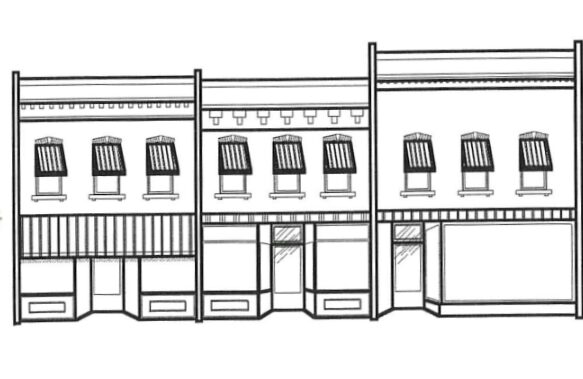
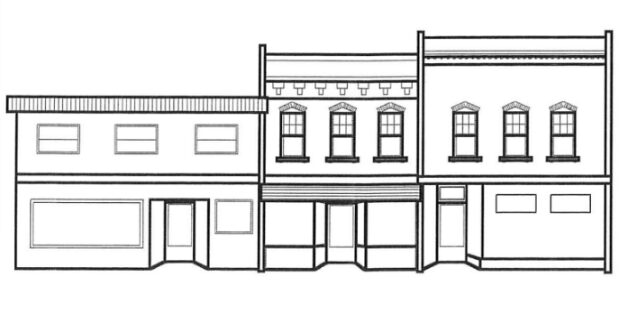
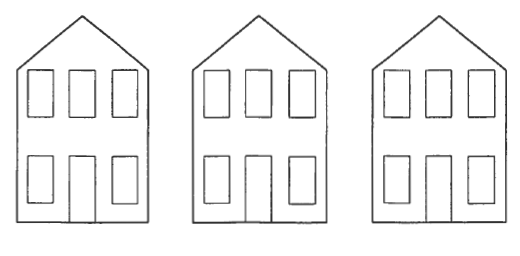
Figure 24: Example of appropriate proportions
Height
A building’s height is determined by the number of stories, as well as the shape of the roof and the presence or absence of projecting features such as chimneys or towers.
Scale
Scale is the size of a building in relation to the buildings that surround it. Scale can be expressed through the size of a building itself as well as through the size of building elements.
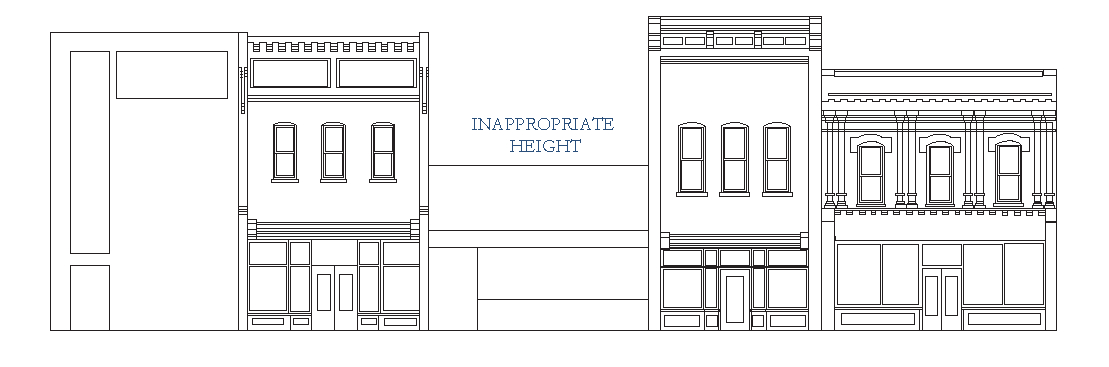
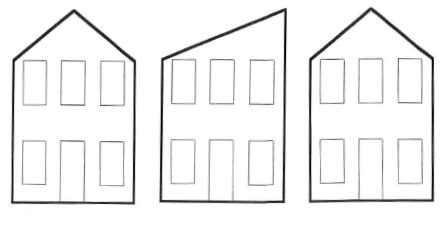
Figure 25: Example with inappropriate proportions, including incompatible height, and disproportionate window sizes
Proportion
Proportion refers to the visual effect of the relationship between architectural elements and the building as a whole.
Symmetry
Symmetry refers to a façade arrangement in which both sides are equal in proportion and arrangement of architectural features. Asymmetry is the opposite, where the elements of a façade arrangement are organized with emphasis to one side of the façade. Symmetry or asymmetry can be closely associated with particular styles and a building’s symmetry, or asymmetry should be maintained.
Massing
Massing is the large-scale units that comprise a building. These masses define the overall shape and form of a building. Massing is a central part of its architectural design and can be altered through additions or demolition of parts. Alterations of a building’s massing can adversely affect its overall form and diminish its historic integrity.
Alignment
Alignment is when buildings on the same street are constructed with the same setback distance, making them in line with one another.
Rhythm
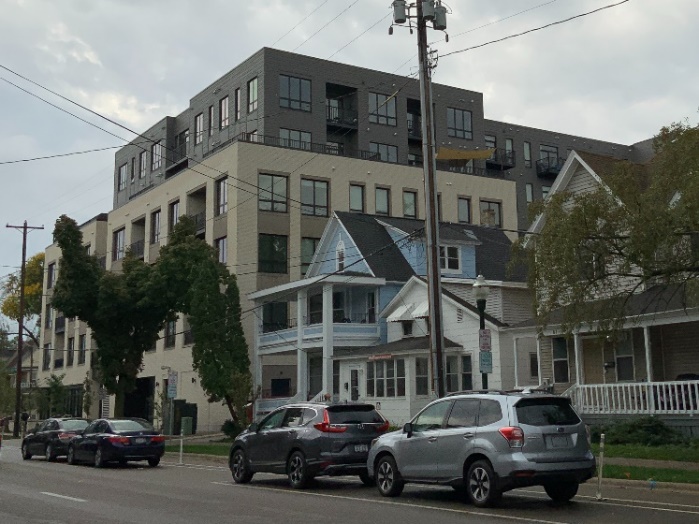
Rhythm is the repetition of architectural forms along a streetscape. Width, height, spacing, setback, and orientation, as well as the placement of architectural details, contribute to the rhythm of the street. Demolition of existing historic structures or the construction of new buildings that are incongruous with height, spacing, or other rhythm-defining elements can disrupt the historic rhythm of the street and alter the overall character of the historic district.
Orientation
The term “orientation” refers to the direction that a building faces in relation to the street. Most buildings are oriented so that the main entrance on the façade faces the street.
Unity
Unity refers to the effect created when all of the buildings in a district or area conform to a particular defined range of overarching building characteristics, including height, alignment, scale, massing, and spacing. New construction can disrupt unity when it is not consistent with the existing neighborhood.
Style
A building’s architectural style is defined by its overall appearance and common features which refer to particular trends that were in use in the region and time period in which the building was designed and constructed. Architectural styles combine qualities of massing, scale, proportion, rhythm, detail, and ornamentation.
Figure 26: Inappropriate façade arrangement and height of new construction interrupts street rhythm
Setback
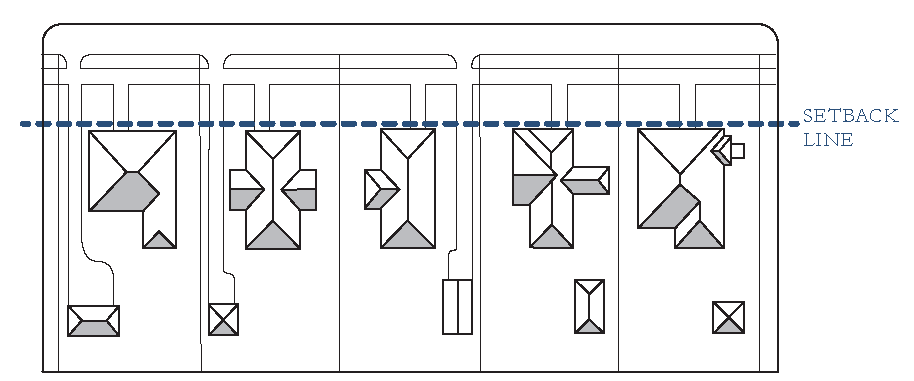
Setback describes the distance between a building and its property line. It generally refers to the setback from the street-adjacent property boundary, forming a front yard on the property in many cases. It is common for residential properties to have setbacks but less common for commercial properties.
Figure 27: Example of a consistent setback line
Chapter 5. Universal Guidelines for all Projects
5.1. Preserve Significant Historic Features
Every historic building, from each style of architecture, has a set of distinctive details that contribute to the overall character of the building. Care should be taken to preserve these features.
To begin a project requiring a COA, you will first need to identify the character defining features of your historic property based on the design principles described in Chapter 4.6. Design Principles.
Avoid the removal of historic architectural features and materials. Historic architectural features include large scale characteristics including the building’s overall shape, roof form, and fenestration patterns, as well as small-scale features like moldings, brackets, ornaments, and other examples of skilled craftsmanship.
Retain existing historic building materials, including brick and stone masonry, wood shingles and siding, stucco, etc., to the greatest extent possible. Avoid removing historic materials that are in serviceable condition.
Materials or additions which were added after the building’s initial construction – for example a porch, or a kitchen addition – may have since achieved historic significance in their own right and should be preserved.
Historic outbuildings, including sheds and garages, should be maintained, and preserved. Avoid removing or drastically altering historic outbuildings.
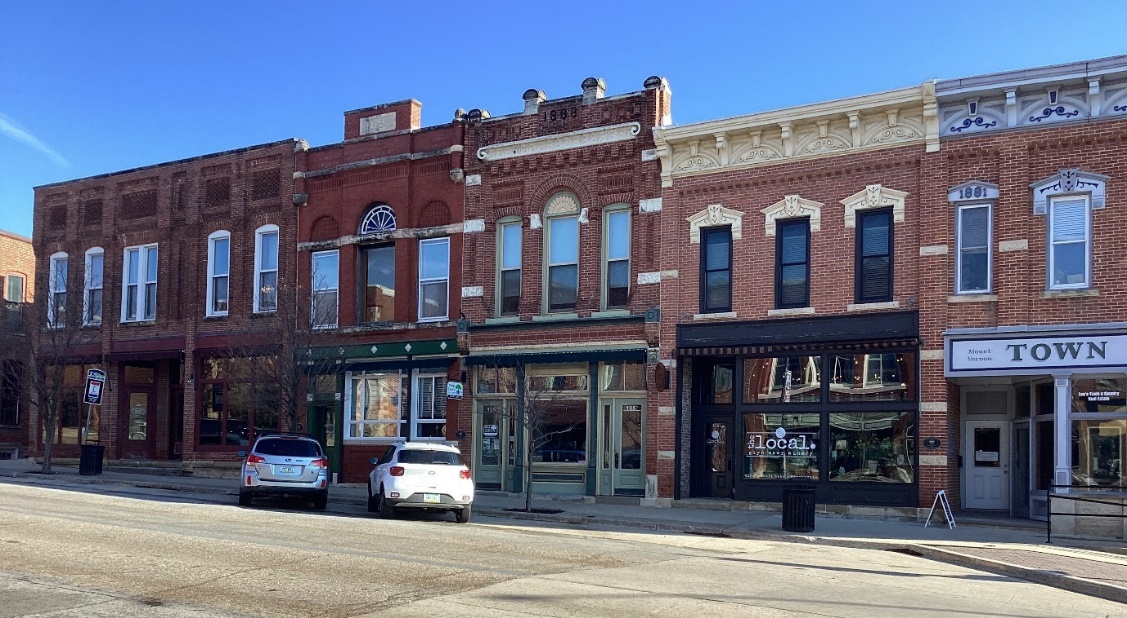
Figure 28: Mount Vernon Commercial District streetscape
5.2. Repair Rather than Replace
Where possible, repair historic materials and features rather than replacing them. When repairing historic materials, adhere to the following guidelines:
Use the recommended technical procedures for cleaning, refinishing, and repairing historic materials. See Appendix D: Historic Preservation Resources for technical resources.
Some cleaning methods and repair techniques can cause or exacerbate damage to the historic materials of the building, thus hastening their need for replacement and causing increased costs to the owner. Always use the gentlest methods available.
When a historic element is deteriorated to the point that replacement is required, the replacement should replicate the element as closely as possible. The following is recommended when replacement has been approved:
Patch, piece-in, splice, or otherwise upgrade the existing material using recognized preservation methods wherever possible
Try to match similar pieces on the building or use historic photographic documentation to replicate the feature. Do not add architectural features representative of other architectural styles.
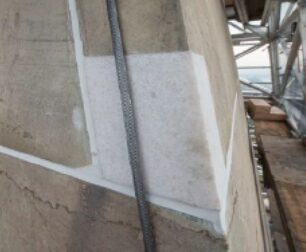
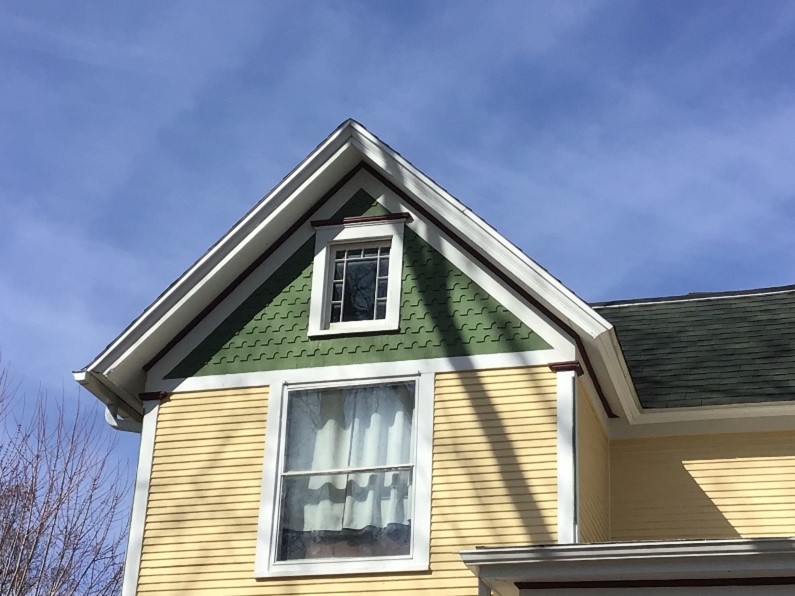
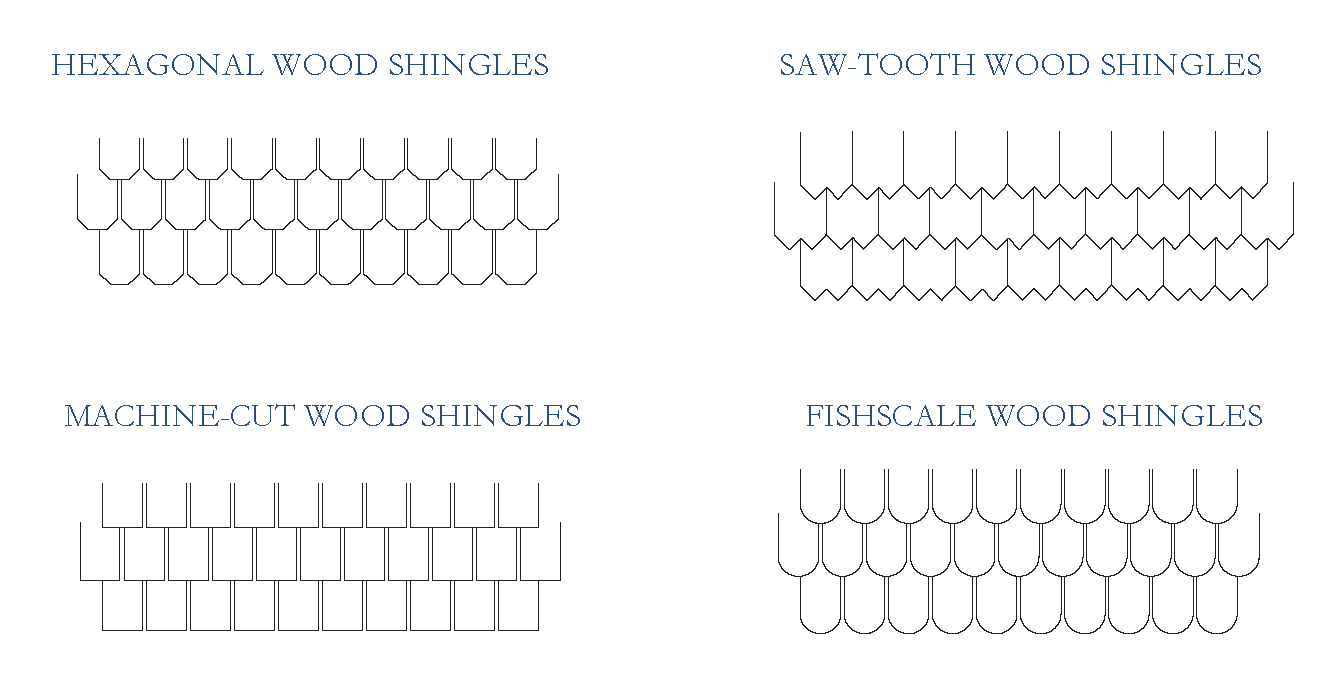
Figure 29: Appropriate Dutchman Repair on MasonryFigure 30: Fishscale shingles replaced with substitute materials that are similar in visual quality
5.3. Make Appropriate Replacements
When a historic element is deteriorated to the point that replacement is required, the replacement should replicate the element as closely as possible.
Replace as little historic material as possible. This may include patching, splicing, or piecing-in replacement materials such as individual roofing tiles, shingles, or siding, masonry patches, or dutchman repairs for stone or wood elements. A dutchman repair refers to any new or salvaged material (stone or wood) fitted into the existing facade material. This new material is chosen and installed to match existing.
Match the historic feature’s size, shape, profile, texture, and color to the greatest extent possible. The new materials should match the old when possible. In some cases, replacement with features recreated in synthetic materials may be appropriate (for additional information on substituting historic materials, see Chapter 5.8. Replacement in Kind vs. Substitute Materials.
Substitute materials should only be used if they do not cause damage or change the character of the historic resource. The new material should match the form, color, and texture of the historic feature.
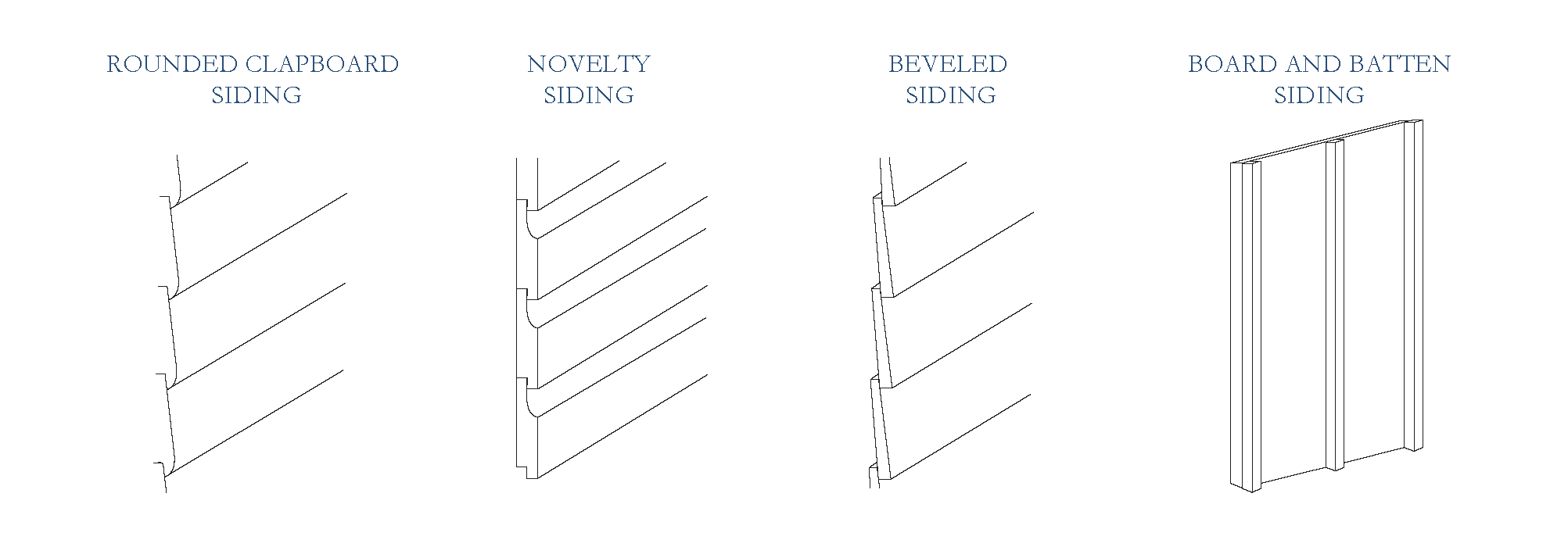
Avoid changing the character of historic features. For example, original horizontal board siding should not be replaced by vertically oriented siding or shingles, even of the same material. Avoid adding architectural features representative of other architectural styles to an existing historic building.
5.4. Restore Significant Features
Whenever feasible, historic materials and details should be restored. It is appropriate to restore previously damaged or altered historic features to their historic appearance. Restoration should be based on physical evidence and/or documentation of the building’s historic appearance.
Remove non-historic materials that cover all or part of the façade. This may include inappropriate siding, cladding, or wrapping on façade elements such as cornices or storefronts.
Restore or replace underlying historic materials with new elements that closely replicate the historic appearance.
Take care to remove non-historic materials in a way that does not damage underlying historic materials.
Replace missing features (such as cornices, storefronts, etc.) with historically appropriate replacement features. The design of replacement features should be based on its historical appearance and substantiated by documentary, physical, or pictorial evidence. This may be accomplished by locating historic photographs which show the original appearance of the element, replicating existing but incomplete elements, or by reproducing elements visible on neighboring buildings of the same style and date range.
Where no evidence of the feature’s original appearance exists, utilize a simple design consistent with the scale, massing, and style of the building and surrounding area.
Historic additions that are in keeping with the overall design of the building and are over 50 years old have achieved significance in their own right and should be retained or restored.
Recent additions that are not historically significant may be removed via a process that does not damage the visible significant features of the historic resource.
5.5. Comply with Health and Safety Codes
It is important that all buildings comply with local and state safety codes, including providing handicapped access to residents or visitors, as needed. This can be achieved without compromising the significance or integrity of historic buildings.
Compliance with health and safety codes and handicapped access requirements must be carried out with minimum impact on the historic character of buildings.
When permitted by law, fire escapes or fire towers shall be placed at the rear of buildings as a secondary means of egress.
Provide barrier-free access that promotes independence for the disabled to the highest degree practicable, while preserving significant historic features.
Construction of ramps, lifts, fire escapes, and similar accessibility features should be constructed in an area that is hidden from public view, such as on a rear or side elevation, when possible.
Ramps should have little to no visual impact or should be designed to be as unobtrusive as possible.
Install ramps and other accessibility features in a manner that is reversible where practical and does not permanently impact the historic building.
Access ramps shall be in scale and visually compatible in design and materials with the building.
5.6. Adaptive Reuse
According to the Secretary of Interior’s Standards for Rehabilitation, “A property shall be used for its historic purpose or be placed in a new use that requires minimal change to the defining characteristics of the building and its site and environment.”
The reuse of historic buildings is encouraged and adaptations of a property to a new use should retain the building’s historic character and significant features while conforming to existing zoning codes. For example, conversion of a single-family residence to a multi-unit apartment may require the addition of new exterior entrances. These should be designed sensitively and positioned on a non-visible façade whenever possible.
After consulting the Mount Vernon Code of Ordinances for permitted uses in your project area, a meeting with City staff in the early planning stages of adaptive reuse projects is recommended to determine which characteristics are the most significant to the building and to minimize adverse impacts to the structure and the surrounding area is preferable. Adaptive reuse projects should take into account the following criteria:
Adhere to Mount Vernon’s zoning code for permitted uses.
It is preferable to retain a building’s historic use whenever possible.
Retain the building’s historic character when adapting to a new use. A residential building converted to commercial use should retain the building’s residential character, and vice versa.
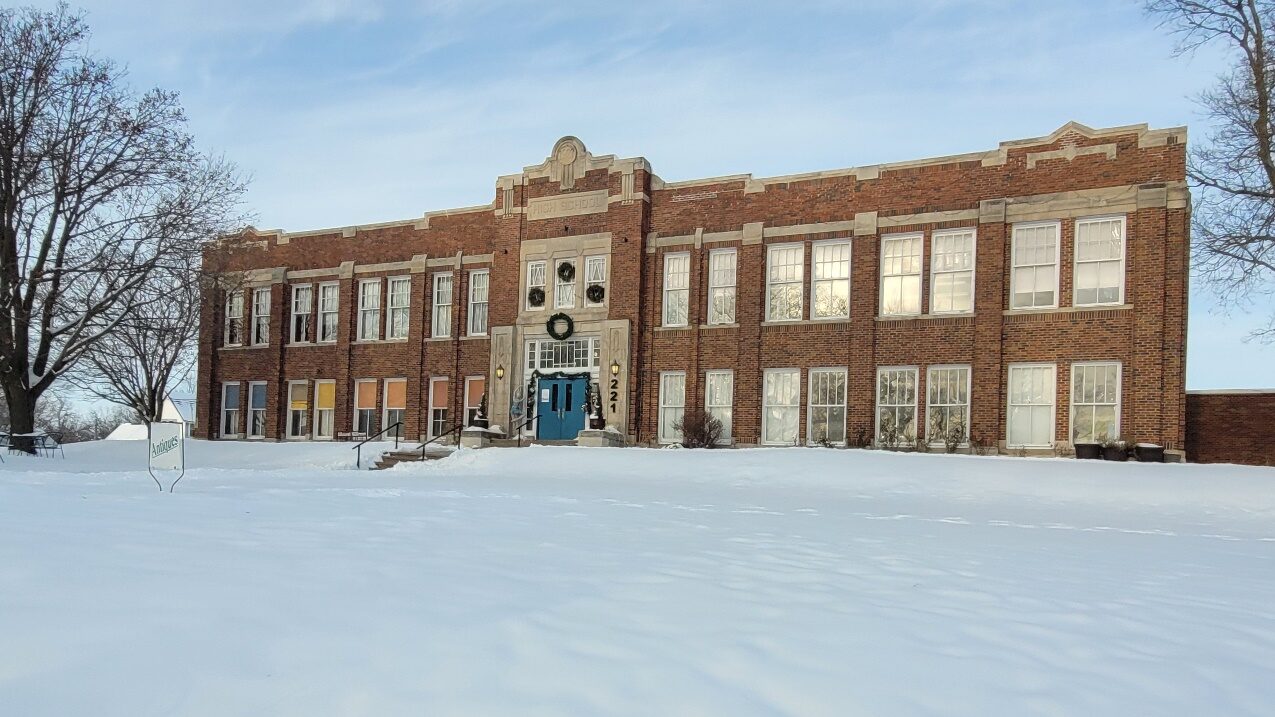
Figure 31: View of 221 First St. NE, a former high school that was converted to the First Street Community Center. It contains shops, a theater, and a dance and yoga studio.
5.7. The Secretary of the Interior’s Standards for the Treatment of Historic Properties
The purpose of the Secretary of the Interior’s Standards for the Treatment of Historic Properties (Department of Interior regulations, 36 CFR 68) is to provide guidance to historic building owners and building managers, preservation consultants, architects, contractors, and project reviewers prior to beginning work.
According to the Secretary of the Interior, there are four principal approaches to working with historic structures: Restoration, Preservation, Rehabilitation, and Remodeling. When a structure has not been maintained or has been altered by the removal or replacement of character-defining features, it is important to define which principal approach or combination of approaches should be applied to the structure.
The Standards for Rehabilitation (Department of Interior regulations, 36 CFR 67) are regulatory for the Historic Rehabilitation Tax Credit Program and are most often used by local historic district commissions nationwide. They are to be applied to specific rehabilitation projects, such as the federal historic tax credit program, in a reasonable manner, taking into consideration economic and technical feasibility. The standards are as follows:
A property shall be used for its historic purpose or be placed in a new use that requires minimal change to the defining characteristics of the building and its site and environment.
The historic character of a property shall be retained and preserved. The removal of historic materials or alteration of features and spaces that characterize a property shall be avoided.
Each property shall be recognized as a physical record of its time, place, and use. Changes that create a false sense of historical development, such as adding conjectural features or architectural elements from other buildings, shall not be undertaken.
Most properties change over time; those changes that have acquired historic significance in their own right shall be retained and preserved.
Distinctive features, finishes, and construction techniques or examples of craftsmanship that characterize a property shall be preserved.
Deteriorated historic features shall be repaired rather than replaced. Where the severity of deterioration requires replacement of a distinctive feature, the new feature shall match the old in design, color, texture, and other visual qualities and, where possible, materials. Replacement of missing features shall be substantiated by documentary, physical, or pictorial evidence.
Chemical or physical treatments, such as sandblasting, that cause damage to historic materials shall not be used. The surface cleaning of structures, if appropriate, shall be undertaken using the gentlest means possible.
Significant archeological resources affected by a project shall be protected and preserved. If such resources must be disturbed, mitigation measures shall be undertaken.
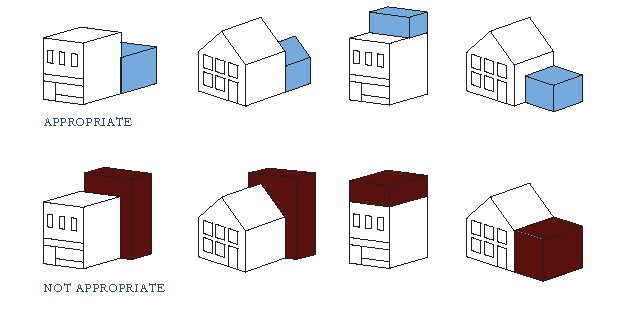
New additions, exterior alterations, or related new construction shall not destroy historic materials that characterize the property. The new work shall be differentiated from the old and shall be compatible with the massing, size, scale, and architectural features to protect the historic integrity of the property and its environment.
New additions and adjacent or related new construction shall be undertaken in such a manner that if removed in the future, the essential form and integrity of the historic property and its environment would be unimpaired.
[National Park Service. The Secretary of the Interior’s Standards for Rehabilitation, 2025.]
5.8. Replacement In-Kind vs. Substitute Materials
Replacement In-Kind means replacing a material with the same material as the existing thing needing to be repaired. For example, a deteriorated wooden door sash can only be replaced in-kind with wood. Replacement in-kind is the highest degree of integrity available when architectural elements need replacing.
Sometimes, replacement in-kind is not financially feasible or necessary to maintain a property’s integrity. It may be appropriate to replace elements of a building with a matching element of a different material, if that material can mimic the appearance of the historic material. Substitute materials are new materials designed to simulate the appearance of a historic material. Substitute materials are often made of synthetics and are appropriate to use when the historic material is no longer available or does not meet project requirements.
Substitute materials may only be used if they will not cause damage to existing historic features. Their use must not negatively alter the appearance of the historic resource, and the new material must copy the original as closely as possible. A replacement feature should match the original in form, profile, color, and perceived texture. A substitute material cannot be chosen for sake of convenience alone when a more historically appropriate material is viable and covering or wrapping existing historic materials with synthetic materials is not appropriate.
Appropriate use of substitute materials includes
Where the historic material does not meet existing code requirements.
When the historic material is unavailable, such as a particular type of slate or old growth lumber.
Where historic craft techniques or skilled artisans are unavailable.
When the historic feature has already been lost, and little is known about its original appearance.
Factors to consider when evaluating the use of substitute materials
Is the existing material historic?
Is it a character defining feature of the building?
Will new materials cover or replace existing historic fabric?
Will the new product be physically compatible with the surrounding building materials?
Will the product realistically match the original feature or material in size, proportion, detail, profile, texture, and finish?
Is the new product as durable compared to the historic material in the same environment?
Cost Evaluation
Maintenance of a material, particularly where accessibility is difficult or expensive, can be an important part of a cost evaluation. Maintenance costs should not be considered without also considering life-cycle expenses. While some substitute materials may offer reduced initial costs, they may be as or more costly than traditional materials to maintain over time. For example, many substitute materials are not readily repairable, necessitating full replacement when damaged. The cost to replace a material or assembly at the end of its lifespan may also be greater than the accumulated incremental expense to maintain the historic material, particularly if it is a more traditional, repairable material.
Maintenance cost should never be the sole reason for replacing a historic material that is not deteriorated.
The MVHPC will consider the use of a substitute material in place of historic materials on a case-by-case basis and may approve or deny such materials based on the significance of the feature and compatibility of the replacement unit.
5.9. Common Substitute Materials
Architectural Details and Trim
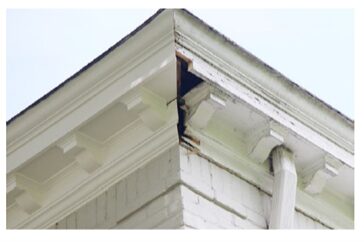
Architectural details help convey the style of a building. Architectural details should be retained and never permanently removed. When formerly hidden ornamentation is discovered, it should be maintained and preserved.
High-quality synthetics may be an appropriate replacement for wood or plaster details where the profile, size, and dimension of the element can be accurately reproduced. Synthetic material use on architectural details and trim will be considered on a case-by-case basis by the MVHPC and all synthetics are subject to a painting requirement.
Cellular PVC
Polyvinyl chloride is more commonly known as PVC. Cellular PVC board is used to produce trim, moldings, and other decorative architectural elements. These are durable products that can be painted.
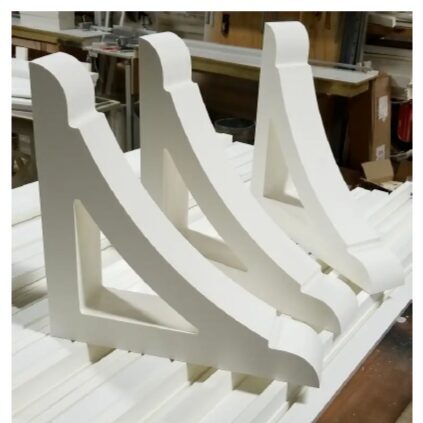
Cellular PVC brackets
Metal
Metal is only appropriate for architectural details and trim when it was the original material.
Vinyl
Vinyl is not an appropriate material for architectural detail and trim replacements unless the details are not visible from the street.
Example of an appropriate substitute material replacement
Porches and Decks
Historic porch and deck materials typically include wood, brick, stone, and concrete. There are no appropriate substitutes available for brick, stone, and concrete and therefore these elements should be replaced in-kind. Porch elements such as columns, railings, balusters, floors, and ornaments are typically made from wood. Repairing and maintaining historic wood porches is the preferred approach, though alternative materials may be appropriate on a case-by-case basis.
Composite
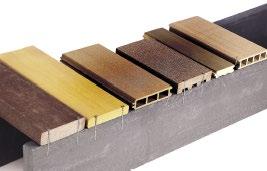
Composite materials are made from a mixture of plastic and wood fibers and is manufactured for use as floorboards and stair treads. These materials are formed into planks to imitate wood decking and are installed in a manner similar to traditional wood planks. The product is sometimes available in a paintable finish. Composite materials are appropriate for installations on non-visible sections of a property.
Porch deck substitute materials
Fiberglass
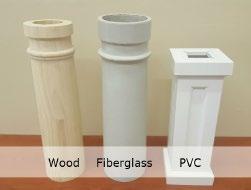
Fiberglass can be used to replicate decorative features, such as columns and balusters, and are available in a variety of shapes and sizes. Fiberglass products which mimic historic forms are commercially available. Fiberglass is typically more expensive than their wooden counterparts. A fiberglass replacement may be appropriate if it closely matches the design and proportion of the original elements.
Porch column substitute materials
Metal
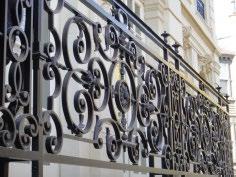
Railings, balusters, and porch columns can be constructed of metal. Metal porch elements made of cast iron may be of historic age, or may be a later, possibly historic age modification to a property. Aluminum may be appropriate for mid-20th century properties but would be an inappropriate choice for an older property. Metal on front porches should only be used when there is evidence that it was the original material. Metal may be appropriate on a rear, non-public visible porch on a case-by-case basis.
Metal railing
Pressure Treated Lumber
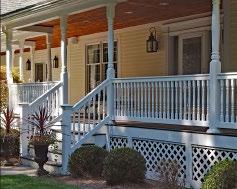
Pressure treated lumber is preserved through a process that uses high pressure to inject a preservative into the wood, adding years to the life of the material. Pressure treated lumber is not stronger than untreated wood, but it does withstand the elements better while still being susceptible to deterioration of checks (separation in wood fibers across the annual rings of a piece of wood), warping, and splitting. Pressure-treated wood can be effective when used for hidden structural elements such as posts, joists, and sills. It is not a good substitute for visible porch parts.
Pressure treated lumber balustrade and railing
Vinyl
Vinyl is a common material for replacement columns and railings, often used in new construction. Vinyl can be appropriate for buildings constructed in the late 20th century or later. Vinyl is susceptible to fading and warping with a low lifespan.
Roofing
Roofing materials are among the most frequently substituted. Substitute materials have been designed to replace historic shingles and traditional metal roofs. While it may be appropriate to replace a deteriorated historic shingle roof with new, synthetic shingles similar in color and texture to the historic material, it would not be appropriate to replace a historic metal paneled roof with modern asphalt shingles. The original roofing type should be maintained.
Roofs may be re-roofed with substitute materials if the original materials are determined beyond repair, are no longer present or available, or if the retention of the original roof material is not economically feasible.
Asphalt
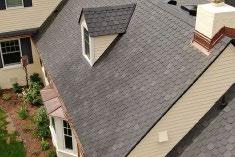
Asphalt shingles were first introduced in the late 19th century. Dimensional asphalt shingles are designed to have a more natural and irregular appearance and may be appropriate for some uses within the districts. Asphalt roll style covering is not historically appropriate on any building older than from the mid-20th century. New asphalt roofs should be one color and compatible with the historic colors and style period of the building.
Asphalt shingles
Composite and Synthetic
Composition shingles are strong asphalt roofing materials made with a fiberglass base and a top layer of ceramic-coated mineral granules set in asphalt. They are also called architectural, laminated, or dimensional shingles. Unlike regular three-tab asphalt shingles, they are thicker and have a more natural, textured look. These shingles can be a good replacement for badly worn slate or wood roofs, as well as older asphalt shingles. They may also work well on flat or low-slope roofs to help prevent damage to the structure.
Composite and synthetic shingles
Metal
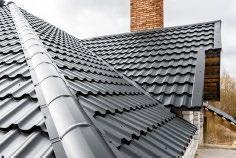
Sheet metals – tin, copper, zinc, tin plate, terne plate, and galvanized iron – are common historic metal roofing materials. Corrosion, pitting, and streaking are common deteriorations to metal roofs. Metal roofs are only appropriate where a metal roof was part of the original structure and should be replaced with similar details and proportions.
Metal roofing
Tile, Slate, and Concrete
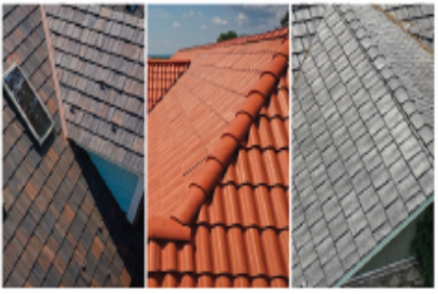
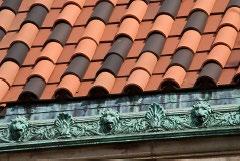
Clay tile and slate were common historic roofing materials as well as some of the most durable. Tile and slate require a level of craftsmanship and specialization that is not attainable to mimic exactly. When feasible, it is preferred to replace a historic tile or slate roof in-kind. If a roof historically did not have clay tile, it would not be an appropriate material.
Clay tile roofing
Siding
Maintaining and preserving existing historic wood siding, where present, is the general recommendation for buildings within Mount Vernon’s historic districts. Mixing siding materials, either within a wall or on different walls of a building is never appropriate. Only when the entirety of a building’s siding needs to be replaced should substitute materials be considered. The MVHPC will determine the appropriateness of substitute siding materials on a case-by-case basis. In all cases, the replacement siding should match the historic siding in terms of width, texture, profile, and overall appearance. In cases where existing synthetic siding is being replaced, the MVHPC will determine whether replacement with new synthetic siding or a more historically appropriate material is necessary to achieve an accurate historic appearance on a case-by-case basis.
Engineered Polymer
Polymer siding products are more durable than other synthetics, such as vinyl. However, it is not an appropriate covering for visible elevations of a historic building.
Engineered Wood
Engineered wood products, such as LP Smartsiding, can be an appropriate replacement siding for the rear, non-visible elevations of a building.
Engineered Wood
Fiber Cement Board
Fiber cement board siding is made from combining wood pulp or cellulose with Portland cement, silica, and other products. It is commonly known as HardiPlank or Hardiboard. These products may be approved for repairing the rear, non-visible elevations of a building.
Fiber Cement Board
Synthetics
Synthetic siding, such as vinyl, is not an appropriate covering in the historic district. Asbestos cladding that is original to a dwelling should be kept stained or painted to avoid any health hazards. If the asbestos siding is deteriorating, it may be removed and replaced with wood or other substitute siding.
Wood
Wood siding or shingles, when the historic covering, are always the best choice due to their durability and repairability. In many cases where wood siding is in poor condition, spot replacements using in-kind materials to replace boards that are deteriorated beyond repair is the best approach. Wood siding and shingles should be replaced to match the original size, placement, and design.
Unpainted wood shinglesUnpainted wood siding
Types of historic siding patterns.
Metal is not an appropriate siding choice in historic districts, including products that try to mimic historic patterns.
Windows and Doors
Windows and Doors are character-defining features that help convey the age and architectural style of a building, especially when located on the primary façade. For windows and doors on the primary façade, it is always preferred to repair and retrofit the original material.
Wood
Most historic buildings, except those from more recent times, were built with wood windows. Replacing an original wood window or door with a new one that matches the original in dimensions and configuration is considered a replacement in-kind. However, modern wood products are typically made from fast-growing trees and are not as high in quality as the old-growth wood used in the past. As a result, new wood windows and doors are usually less durable. If maintaining wood features is important, repairing the original elements is often the better option.
Fiberglass
Fiberglass windows and doors have a matte finish and are available in proportions that mimic their historic replacement. Fiberglass windows may be appropriate if they can match the appearance of the historic windows.
Fiberglass door
Composite
Composite windows and doors are made from a mixture of materials, typically fiberglass and wood fibers. Composite is paintable and is a good lower-cost option for residences in historic districts. Composite windows may be appropriate if they can match the appearance of the historic windows in terms of profile and finish.
Composite windows
Metal
Metal doors and windows can be suitable for buildings from after 1900, especially industrial or commercial styles, or on parts of a building that aren’t easily seen. Aluminum is a common material used for windows. Aluminum-clad windows are made of wood or composite materials with aluminum covering the exterior parts like the trim, sash, and muntins. These may be approved to replace historic windows if the originals are too damaged to repair and the replacements closely match the size, shape, and design of the originals. However, aluminum-clad windows usually have a permanent anodized or enamel finish, which means they can’t be painted—this can be a problem if the building’s color scheme changes. Shiny metal screen doors don’t fit the look of historic homes and should be avoided on the main front door.
Metal windows
Vinyl
Vinyl can be used either as a covering over wood or composite windows, like aluminum, or as the main material for fully vinyl (PVC) windows and doors. However, vinyl is generally not suitable for historic districts because it rarely matches the proportions or finishes of traditional materials. Vinyl windows usually have thinner frames that don’t align with the thicker, more detailed look of historic windows. They also cannot be painted and have a shorter lifespan—typically only 10 to 15 years—making them the least durable option. Still, vinyl may be appropriate for mid-20th century buildings, for parts of a building that aren’t visible from the street, or for properties that are not historically significant.
Vinyl windows
Chapter 6. Guidelines for Residential Properties
There is history in any existing home, especially in homes that have been around as long as many of those in Mount Vernon. For the most part, these homes have been filled with families, and their lives are in some way remembered in these houses. They were symbols of pride for their owners, who took great care in maintaining and embellishing their homes. Some of these embellishments and alterations may be desirable now and some may not. For those owners wishing to restore their historic homes, there may be a lot of work ahead, since many alterations that were considered “improvements” can cause more problems, and other alterations may destroy the historic character of the building.
Many historic homes in Mount Vernon were built between 1895 and 1919. These homes exist in many stages of historical accuracy and repair. This section is meant to be an aid in deciding how to improve and/or renovate these older homes. It is meant to give an overview of what is involved in historically sensitive construction, and to help owners find more detailed information on how to go about these changes. In many cases, more information will be needed if people want to make improvements to their homes.
Figure 32: Historic residences in the Ash Park and Cornell College Historic Districts.
6.1. Accessibility, Code, Compliance & Safety
The Americans with Disabilities Act (ADA) requires public buildings and spaces to be accessible for Americans with impaired mobility. A common problem that must be addressed when rehabilitating a historic structure is providing appropriate access to and from raised entrances and upper floors. As elevators are not common installations in residential buildings, common accessibility features include ramps and railings. Compliance with health and safety codes and handicapped access requirements must be carried out with minimum impact on the historic character of buildings. It is best practices to provide barrier free access that promotes independence for the disabled to the highest degree practicable while preserving significant historic features.
Railings
Contact the Linn County Building Division at (319) 892-5130 to confirm the railing height requirements for your project. Partial replacement may allow the existing railing height to remain, while full replacement must comply with the current building code.
Best Practices
Railings should be constructed with materials complimentary to the historic structure.
Match new railings with the style and features of the historic design.
Figure 33: Example of appropriate railing
Not Appropriate
Removing historic features, including stairs and porches to accommodate a railing.
Figure 34: Example of inappropriate railing on a residential property.
Ramps
The Americans with Disabilities Act (ADA) frequently necessitates the construction of ramps to allow access to historic buildings and structures. Ramps should be designed sensitively to ensure they are appropriate both for the historic setting and for the user. The materials chosen for ramps should blend with the surrounding built environment and be compatible with the style and materials of the existing porch and/or structure. Ramps should be installed so as to not damage or alter the historic structure.
Best Practices
Construct ramps with materials that blend in with the surrounding built environment. Ramps can be faced with brick, stone, wood, or other material.
Ramps should be installed on the rear, side, or secondary elevations of a building whenever possible but should not compromise accessibility.
Ramps should be screened with plantings on more visible locations.
Figure 35: Example of appropriate ramp.
May Be Appropriate – An appropriate ramp on the front façade when efforts to install a ramp elsewhere is not viable.
Not Appropriate – Removing historic features and doorways, including stairs, porches, and railings to accommodate a ramp.
6.2. Exterior Materials
Wood, masonry, and stone are the most common building materials found within Mount Vernon’s Ash Park District and Cornell College District. Metals were primarily used for roofing, details and ornamentation, and landscape features. The size, texture, surface finish, and other defining characteristics of exterior materials are as important as the type of material.
Foundations
The foundation is the base on which the entire home is built. A sturdy foundation will make a more stable house, so it is important to maintain it well. Though it is important to keep the foundation in good condition, maintaining it in its historic condition can be difficult. Finding the correct materials for repairs and making those repairs without altering the area greatly can be a long process. Limestone foundations are very common in Mount Vernon. Locally quarried limestone is likely to provide the best match for repairs.
Masonry
The texture, scale, color, bonding pattern, joints, and detail of the masonry surfaces contribute to the overall character of the historic building. Masonry features such as chimneys, arches, quoins, lintels, sills, cornices, and pediments further define a building’s historic character. Brick is a common façade material and stone is a common foundation material for all types of buildings in Mount Vernon’s historic districts. Stone and brick are among the most durable building materials, but they are susceptible to erosion from environmental and chemical factors. Shrubs in direct contact with masonry, as well as attached vines, can harm the structure and should be avoided.
Brick is a naturally porous and breathable material. It absorbs moisture from rain, snow, or indoor humidity, and then releases it through evaporation. However, if historic brick is painted or sealed, that moisture can get trapped inside. When trapped water freezes, it expands and puts pressure on the brick, causing serious damage like cracking, flaking, or pieces of the brick face breaking off. Once this happens, the damaged bricks usually need to be cut out and replaced. Finding the best match in replacement bricks is necessary but may be very difficult, especially for the soft bricks that were produced locally for the oldest houses in Mount Vernon. Thus, proper maintenance is critical.
Figure 36: Diagrams of typical brick bonds and mortar joints.
It is recommended that historically unpainted stone and brick should remain unpainted, as the resulting surface is neither as attractive nor as durable as the original, unpainted version. Painting brick also results in added maintenance requirements as the coating will need to be reapplied as it wears. Once masonry has been painted, it is very difficult to restore it to its original appearance.
Best Practices
12- to18-inches of exposed masonry is appropriate.
On masonry structures, foundations were usually composed of a contrasting material and separated by a band of another material.
Maintain drainage away from the foundation. It is recommended you have 6-inches of slope in the first 24- to 36-inches away from the structure.
Not Appropriate
Filling around the foundation. It detracts from the home and causes more damage.
Fill in basement windows with brick or any material other than glass.
Figure 37: Example of masonry on residential buildings. Masonry, including on the foundation should be preserved and maintained.
Siding
Wood is a very common exterior material used for historic residential buildings, however it is less common on historic commercial or industrial buildings. Most of the wood-sided buildings in Mount Vernon use narrow wood clapboards – tapered horizontal boards with four, six, and sometimes eight inches of exposure. Other types of wood siding include weatherboard and shiplap.
Some historic wood exteriors have been covered with asbestos, metal, vinyl, and other inappropriate materials. They obscure the original material, often damage historic details and ornamentation, and can cause moisture to be trapped inside walls. Substitute materials may be approved on a case-by-case basis. Further discussion of substitute materials can be found in Chapter 5.8. Replacement in Kind vs. Substitute Materials.
Figure 38a: Examples of appropriate wood siding.
Figure 38b: Examples of appropriate wood shingle patterns.
When ghosting or outlines of decorative missing features are revealed when replacing inappropriate covering, these should be replicated and reinstalled. If these features are not replaced, the ghosting should be recorded through photographs or drawings with measurements for possible future replication.
Best Practices
Maintain the existing wood exterior using appropriate paint or other protective coatings.
Repair minor deterioration using an appropriate wood filler.
Remove metal vinyl, asbestos shingles, and other inappropriate materials from exteriors and repair damaged wood underneath as needed. Removal of asbestos should follow hazardous material disposal guidelines.
May Be Appropriate
In cases of severe deterioration, replace only the affected areas with wood siding that matches in shape, size, profile, and texture.
Replace existing synthetic siding with new synthetic siding.
In cases where asbestos cladding is original to the building, it should be kept stained or painted. If it is deteriorated or poses a health hazard, it may be replaced with wood or other substitute siding that is consistent with the building’s style.
Figure 39: Example of appropriate replacement using clapboard.
Not Appropriate
Replacing wood siding with a different type or shape of wood siding.
Replacing wood siding on a contributing building with a synthetic siding.
Applying replacement material that will damage underlying materials, trap moisture, or compromise the structural capacity of the exterior.
Using blown insulation on exteriors of wood frame buildings, as it creates moisture issues and damages interior historic plaster.
Figure 40: Example of inappropriate replacement using fake stone.
6.3. Paint and Color
While paint color is not regulated in the MVHPC Review Area, the MVHPC has purview over the appropriate maintenance of historically painted surfaces and projects that involve matching existing paint color when patching or piecing. Some of the construction materials used for the buildings in Mount Vernon’s historic districts have colors that are integral to their manufacture, including brick, stone, cast stone, concrete, copper, and bronze. Other materials are painted or finished with other types of applied architectural coatings. They include wood, tin, zinc, and stucco. Besides aesthetic appearance, paint or other architectural coatings applied to the latter materials play a role in the durability of building materials through weather protection, as well as contribute to the character of a building. Paint is a protective coating for wood and metal surfaces but can cause damage to masonry surfaces which were not intended to be coated.
When choosing a new paint scheme for a building, choose a harmonious color palette with contrasting colors to accent details such as trim, dentil molding, etc. Consider whether the building is usually in shadow or bright light when choosing paint colors. Darker colors are more appropriate on well-lit facades, while lighter colors are more appropriate for shadowed facades.
Figure 41: Most buildings can be categorized into three parts for a color scheme: body of the building, major trim, minor trim, and accent.
Best Practices
Maintain historically painted building surfaces.
Colors should complement the colors of the homes in the area, as well as the style and period of the house.
Use paint schemes to tie elements of the building together.
New or replacement building features of the types that were historically painted, should be painted to match like features on the building.
Paint that is known to have been applied before 1978 should be lead-tested before removing If lead paint is found, appropriate abatement or encapsulation should be undertaken.
Figure 42: Example of appropriate paint scheme.
Not Appropriate
Leaving wood surfaces exposed.
Sandblasting or other abrasive methods to strip paint from wood, masonry, tin, or zinc.
Using flame or heat ironing to remove paint from wooden surfaces.
Inharmonious, clashing colors palettes.
Figure 43: Example of inharmonious paint colors.
If a building is listed on the National Register, a paint analysis to determine historic colors and paint composition is recommended and strong consideration should be given to repainting using the historic color scheme.
6.4. Roofs
The roof is one of the prominent defining features of a historic building. Historic roof shapes and elements such as chimneys, gables, dormers, and steeples are important character-defining features. A variety of roof types are common within Mount Vernon’s historic districts and are largely dependent on the architectural style and form of the building.
Roof Lines and Materials
A roof’s original shape and pitch should be retained. The construction of new dormers should be carefully considered so as to not compromise the original design of the house. If a dormer is added, its size, design and placement should be in scale with the overall size of the building, its siding and roofing materials should match those on the rest of the house, and its windows should be consistent with the existing windows on the house in style, orientation, and material. Other alterations, such as roof decks, vents, skylights, and mechanical and electrical equipment (such as solar panels), should be installed so that they are not visible from the public right-of-way and do not damage historic fabric. On properties sited on corner lots with few non-visible rooftop locations, consider locating equipment in a location that minimizes their visibility as much as possible.
Roof systems are selected and assembled to resist the environmental forces of nature such as rain, snow, wind, solar radiation, and gravity loads. Any additions to the roof line, such as antennas and vents, have to be carefully considered.
Figure 44: Diagram showing various roof elements.
Best Practices
Pitch and color should be matched when a new roof is added.
Gabled roofs with decorative shingle work at the ends are common in the Mount Vernon area and should be preserved.
Replace damaged historic roofs with the same roof forms or a similar form complementary to the architecture style.
Coat and seal flat roofs per the manufacturer’s recommendation, typically every five years.
Retain and repair visible historic roofing materials where feasible.
New roofing should match the existing material or be a roofing material that is consistent with the building’s architectural style.
May Be Appropriate
Adding dormers when their size, placement, and design are keeping with the character of the building and in scale with its size.
Replacing a historic roof material at the end of its useful life with a new material that successfully mimics the texture, pattern, and color of the original, such as heavyweight architectural shingles.
Figure 45: Example of compatible roof lines.
Not Appropriate
Skylights, antennas, or other alterations placed in view from the front of the house. If needed, they should be placed to the rear.
Increasing the height or changing the shape of a roof.
Replacing an entire roof or isolated sections of a roof with materials that do not match the size, style, texture, and color of historic material.
Figure 46: Example of incompatible roof lines.
Gutters and Downspouts
Gutters and downspouts are essential for diverting moisture away from a building, which naturally extends the longevity of both historic and non-historic buildings. Gutters and downspouts should be kept clear of debris and in good repair. While gutters and downspouts are generally not character defining features, they do still need to be cohesive with overall design of a historic building. When it is necessary to repair or replace gutters and downspouts, keep elements as close to the original.
Figure 47: Example of appropriate gutter.Figure 48: Example of inappropriate gutter.
Figure 49: Examples of typical gutter types.
Best Practices
Gutters and downspouts should blend in with the rest of the structure.
Be sure that downspout extensions bring water to the ground level well away from the foundation walls.
Nail hanger straps under, not on top, of the roofing material. If a new roof is installed at the same time as the gutters, the straps should be nailed under roofing material.
Locate downspouts on inconspicuous locations on the façade.
May Be Appropriate – Half-round gutters and round downspouts are generally more appropriate than corrugated or “K-style” gutters.
Figure 50: Example of appropriate gutter with downspout leading away from the building.
Not Appropriate
Not keeping with routine maintenance.
Installation of gutters or downspouts should not result in the removal or covering of any existing eave features.
Figure 51: Example of inappropriate gutter, causing damage to the masonry.
Chimneys
As with other structural components of historic architecture, chimneys should be altered as little as possible to maintain the character of the building.
Best Practices
Changes on the inside, when done for safety reasons, are encouraged. These changes usually do not alter the appearance.
Repoint and conduct other repairs with proper materials.
Chimneys should be regularly checked for cracking, leaning, spalling, and infestation by birds and insects. The use of chimney caps over chimneys or flue openings is recommended to keep out moisture.
Figure 52: Example of an appropriate chimney shape.
Not Appropriate – Removing or downsizing existing chimneys.
Figure 53: Example of an inappropriate alteration to a historic chimney.
6.5 Decorative Architectural Features
Character-defining details and ornamentation can be found on all four elevations of a historic building and are essential to conveying the age and architectural style of a property. These details can be constructed of a wide variety of materials, such as wood, brick, stone, terra cotta, and metal.
Best Practices
Maintain original historic details and ornamentation.
Repair deteriorated details and ornamentation. Only the deteriorated elements should be replaced, matching the original in material, size, profile, and texture as closely as possible.
Replace missing details and ornamentation based on documentary evidence.
May Be Appropriate – Repairing deteriorated details and ornamentation with a substitute material, only if visually, physically, and chemically compatible with surrounding original materials.
Not Appropriate
Adding conjectural features or historically incorrect details or ornamentation to a building.
Removing or covering details or ornamentation.
Figure 54: Example of Folk Victorian Home with character defining features such as the fishscale shingles and the spindle work.
6.6 Doors
Main entry doors on residential buildings are usually designed to have a warm, welcoming appearance. Side and rear doors of both residential and commercial buildings are usually more utilitarian. Historically, residential doors were made of wood with raised or recessed panels. Those located on front facades may incorporate plain, colored, stained, beveled, or etched glass panels. Fanlights, transoms, and sidelights often surround residential entry doors.
Figure 55: Diagram of typical door parts.
Figure 56: Comparison of a preserved original door (left) next to an inappropriate replacement door (right) on a historic residence.
Best Practices
Replace inappropriate doors or surrounds with an appropriately designed door or surround based on documentary or photographic evidence.
Maintain historic doors, including historic screen doors and paint on wood surfaces. Install new screen doors in a design that is compatible with the design of the door, preferred material being wood.
Glass storm doors should be framed with wood.
Garage doors consistent with the architecture of the house and garage.added damage to existing areas.
May Be Appropriate
When no documentary evidence of original doors or surrounds exists, the design should be complimentary to the character of the elevation in which it is located.
Installing additional doors at the side or the rear of a property when needed.
If approved by MVHPC, installing metal security doors on a front entrance if they allow most of the historic door to remain visible.
If approved by the MVHPC, full light storm doors are preferred when used on the front façade.
Figure 57: Example of appropriate storm door addition compatible with the original door.
Not Appropriate
Inappropriately detailed replacement doors, such as ones that are not keeping with the character of a residential building.
Adding a new door to the front façade, particularly flat, smooth, or flush doors.
Installing storm or screen doors that are not compatible to or obscure the view of the original door.
Converting window opening to door openings, on any elevation of a building but especially on elevations visible to the public.
Figure 58: Example of inappropriate front door replacement.
6.7. Windows
Windows are often character-defining features of historic buildings, with specific styles, materials, and placement that are crucial to a building’s historical and architectural significance. A window is composed of a number of elements, each of which is important to its character. These elements, such as the sash, muntins, and sill, as well as the wood or masonry materials that surround them, are designed to complement the exterior detailing of the building. Until the late nineteenth century, window surrounds in residential buildings were almost always made of wood or brick with little detail or ornamentation. In the latter part of that century, elaborate surrounds of scrolled wood, pressed metal and patterned brick were found on many residential buildings.
When properly maintained, historic wood windows can have a serviceable life of 150 years. While many windows are replaced under the guise of “energy efficiency,” historic windows, when properly maintained and with appropriate storm windows, can be just as efficient as modern windows. Weatherstripping and caulking can be used to improve the thermal and acoustic performance of an existing window.
Figure 59: Diagram of typical wood window section.
Figure 60: Diagram of typical window parts.
Figure 61: Various window grid types.
Best Practices
Retain and repair historic window sashes, exterior cap moldings, sills, and frames.
Maintaining the condition of historic windows through routine maintenance such as weatherstripping and reg-glazing.
If replacement is necessary, replace in-kind with original window material.
Replace inappropriate replacements, such as vinyl units with more historically appropriate units. Missing elements should be replaced in-kind and informed by documentary evidence.
May Be Appropriate
Replacing original window with aluminum, aluminum clad wood, or fiberglass windows on non-primary elevations with minimal visibility from the public right of way.
Replacing vinyl windows in kind.
While replacement in-kind is typically the standard for material replacement, new wood windows are often not of the same quality as historic wood windows due to the unavailability of old growth lumber.
Figure 62: Example of storm windows appropriately installed to preserve historic windows.
Not Appropriate
Replacing a historic window with modern vinyl replacements.
Changing the size of window openings.
Enclosing historic window openings, including basement windows.
Adding window openings on the front or sides of a structure where there was not a window historically as this changes the fundamental appearance of the structure – an added window would also not match the original craftsmanship and would disrupt the building’s overall appearance.
Installing screen or storm windows that conceal the glass and/or do not properly align with the sash.
Figure 63: Example of an inappropriate modern window replacement that does not fit within the original wood casing on a historic residential building.
6.8. Porches
Many historic homes have front porches that were used for socializing outdoors and often contained many decorative elements. Porches are especially susceptible to deterioration and were historically altered to fit the changing needs and styles of the time. Front porches are held to a higher standard than side or rear porches. Architecturally, porches helped define the character of the building, and as such, should be maintained in their original manner.
Best Practices
Maintain and repair original elements of porches.
Remove enclosures of historically open porches to reveal the original porch and details.
Replace missing elements where necessary to match size, shape, profile, proportion, and spacing to the historic feature.
Materials such as brick, stone, and concrete should be replaced in-kind.
Screening materials should be placed behind the original features and decorative elements should not be hidden behind screens.
May Be Appropriate
Enclosing a porch if it is not located in a visible location. The structural framework for the screen panels should be minimal so the open appearance is maintained.
Alternate materials may be allowable on a side or rear porch if the new material, size, scale, and overall appearance matches the historic feature.
Figure 64: Example of an appropriately designed porch.
Not Appropriate
Removing original columns and railings and replacing them with other materials or removing these elements without any replacement.
Opening a historically enclosed porch or adding a new porch to the front or sides of a building, as porches are character-defining features and such changes alter the building’s fundamental appearance.
Figure 65: Example of inappropriately designed porch.
6.9. Fencing
Fences add texture and variety to the historic district. Historic fence materials in the districts include wood, green or black chain-link, PVC/ resin, metal, stone and masonry materials. Fences and perimeter walls are typically located along the side, rear, and front property lines in residential areas. They help to define public from private space, as well as significantly contribute to the character of the districts. All new fences must adhere to the height, material, and opening requirements outlined in the Code of Ordinances of the City of Mount Vernon, Iowa.
Best Practices
Retain and preserve original fences whose features are character-defining elements of the property including, gates, pillars, hardware, decorative pickets, and rails.
Repair or restore damaged or deteriorated historic perimeter walls and fences. Where repair is not possible due to the severity of the deterioration, replace historic walls or fences in-kind using the same material as the original and matching profile, texture, and color. If use of the same material is not feasible, the substitute material should approximate the original as closely as possible.
New walls and fences should be consistent with the setback of the subject building and adjacent properties and shall match the style of the building in scale and material.
Historic wood fences should be protected with a painted surface.
May Be Appropriate
When replacement is necessary, in-kind replacements are the first choice. A simple fence in a style that complements the surrounding architecture may also be appropriate.
Chain link fences may be permitted at the rear of a property not visible from a primary right of way.
Figure 66: Appropriate side yard fencing that is a maximum height of four feet.
Not Appropriate
Using multiple fencing materials and/or styles.
Replacing a historic fence with non-historic and/or incongruous material.
Using fences or walls to screen front or street side yards.
Figure 67: Inappropriate side yard fence that does not contain 50 percent or more openings.
6.10. Utilities
Best Practices
Place electric, telephone, and cable services underground whenever possible.
Where underground placement is not possible, utilize the rear or a nonvisible side of the property.
Exterior conduit and housing should be located inconspicuously, and if possible, the housing should be painted to match the exterior surface to which it is applied.
Rooftop mechanical systems should be positioned as to not be visible from the street.
May Be Appropriate – Utilizing the rear or other non-visible elevation to place utilities.
Figure 68: Example of appropriately located and painted utilities on a residence.
Not Appropriate
Locating conduits and hardware in conspicuous locations when other less visible locations are extant.
Locating utility equipment where it is visible from the public right-of-way.
Figure 69: Example of inappropriately located utilities on a residence.
6.11. Energy Conservation
Property owners are encouraged to actively reduce energy use and to generate renewable energy where possible, but they should do so without compromising the integrity of their historic building or the historic district. Take a holistic planning approach that considers the entire building, its existing systems, and its site and environmental considerations as well as the potential impact on historic materials and features and on the district as a whole.
Before committing to a system that requires the installation of new equipment onto the exterior of your historic building, it is recommended that a property owner obtain an energy audit from a certified energy efficiency contractor. This will inform the property owner where a building is losing energy and provide a prioritized list of recommended retrofits.
Maintain Historic Windows for Energy Efficiency
When historic windows are too deteriorated to repair, install compatible and energy-efficient replacement windows that match the historic windows. They should also be durable, repairable, and recyclable.
Replace missing windows with new, energy efficient windows matching the remainder of the historic windows on the building.
Retrofit historic windows with high-performance glazing or clear film if the historic character can be maintained.
Weatherization and Insulation
Caulk gaps in the exterior envelope such as around doors and windows.
Install and maintain weatherstripping at windows and doors to eliminate drafts.
Insulate unfinished spaces, such as attics, basements, and crawlspaces. Use appropriate materials for the space and ensure that it is adequately ventilated.
HVAC Systems
Retain and maintain existing functional, efficient HVAC systems.
Upgrade existing systems to increase efficiency when the existing system has reached the end of its useful life.
Increase efficiency of HVAC systems by installing programmable thermostats, ceiling fans, and louvers and vents where appropriate.
Place equipment on non-visible rooftop locations, in the rear of buildings, or in other locations that are not visible from the street.
Site Features
Add natural sustainable features to the site, such as shade trees, where possible. Locate shade trees where they will not grow to damage historic buildings.
Avoid paving up to the building foundation, which can create a heat island effect. Use permeable materials or landscaping with native plants to help control stormwater and reduce heat transmission to the building interior.
Avoid removing existing shade trees or vegetation.
Use permeable paving where appropriate to manage stormwater.
Items such as solar panels, batteries, electric vehicle charging equipment, etc., shall not be located in front yards and/or shall be screened from view.
Maximize Daylight
Retain historic features that provide natural light to the building interior, such as glass doors and transom, clearstories, and roof monitors.
Reopen historic windows that have been blocked to provide additional light and ventilation.
Add skylights or dormers on non-visible elevations.
Solar Panels
There are three types of common solar system installations: photovoltaic (PV), solar shingles, and freestanding. PV systems or solar panels are most commonly found on residential properties and result in minimal or no effects to historic properties when certain conditions are met. Solar shingles are solar cells designed to look like roofing materials; they should not replace original or historic materials. Freestanding systems should be installed in locations that minimize visibility from the public right of way and their placement and design should not detract from the historic character of the site or destroy historic landscape materials.
Install solar panels or a rear or side roof slope not visible from the street, where possible.
Panels should not be installed in a vertical position where their appearance is most noticeable, but rather on horizontal or sloped surfaces.
When placed on a roof, the solar panels shall not affect the roof façade elevation or roofline.
Solar panels shall be low profile and exposed hardware, frames, and piping shall have a matte finish and be of a color similar to the roofing material color.
Solar shingles will be approved on a case-by-case basis.
Install ground-mounted equipment so that it is not visible from the street or install appropriate screening materials such as shrubbery or fencing.
Figure 70: Example of appropriate location of solar panels on the side elevation of a roof.
Figure 71: Example of inappropriate location of solar panels on the front of a roof.
Figure 72: Example of integrated solar shingles.
6.12. Outbuildings and Auxiliary Structures
Garden sheds, carriage houses, garages, summer kitchens, chicken coops, and other small auxiliary buildings are primarily associated with residential buildings. They face the same repair needs as the principal home of a property. Small auxiliary buildings contribute to the overall character of a property and the districts. Existing auxiliary buildings are subordinate to and compatible with the main building and often were not easily seen from the front of the building.
Best Practices
Outbuildings that contribute to a property’s historic character or are original to a property should be preserved and maintained. Original features should be repaired to match the original.
Avoid replacing reparable historic outbuildings with new, prefabricated buildings.
May Be Appropriate
Installing double-wide doors if accessed from an alley.
Original doors should be maintained but may be retrofitted with modern hardware.
Not Appropriate
Metal, vinyl, sheet, or paneled siding.
Outbuildings with disproportionate roof pitch or building mass.
Moving or relocating accessory buildings original to a property to another part of the lot.
Removing architectural detailing, especially when visible from the street.
Figure 73: Example of outbuilding located at the rear of the property.
Figure 74: Example of outbuilding with features that should be preserved.
6.13. General Guidelines for New Construction
New Residential Construction
This section provides design guidelines for new residential buildings of all types, including multi-family homes and apartment buildings. While the MVHPC only reviews new constructions in the local historic districts, these guidelines also provide useful recommendations for those building new residential buildings in other areas of Mount Vernon with historic character.
New buildings should be compatible with the overall historic and architectural character of the area, yet they should also be recognizable as products of their own time. New construction needs to reflect and maintain the existing building scale, height, number of stories, massing, foundation height, roof form, window size, door size, porches, and arrangement of windows and door openings found within the surrounding historic district. It is appropriate to utilize existing vacant lots for new construction. Proposed new construction on an open lot should be compatible with existing setbacks, spacing of buildings, and the orientation of adjacent buildings. Compatible new construction strengthens the historic streetscape by filling in the gaps left by homes lost to demolition while reinforcing the neighborhood’s residential character and scale.
New construction should not be monolithic in scale or greatly contrast with the existing scale of the area. A sense of human scale is achieved when one can reasonably interpret the size of a building by comparing features of its design to comparable elements in one’s experience. To ensure that human scale is achieved in new construction, it is important to focus design attention on aspects most directly experienced by pedestrians, such as the scale of buildings and architectural details at the street level. For example, providing front porches creates a human scale, especially in a residential setting. These features should be respected in new construction.
Best Practices
Use surrounding historic buildings to inspire new construction.
Maintain the design of the neighborhood and design new structures to be compatible within its specific context.
Site new construction on existing vacant lots.
The width and proportion of infill buildings should be similar to or compatible with surrounding buildings.
Construct new buildings to a height compatible with adjacent buildings.
Maintain solid-to-void (wall-to-window) ratios as found on surrounding historic buildings.
Orient new construction toward the street and align new buildings with the setback of the surrounding buildings.
Figure 75: Appropriate new construction that is compatible with a historic neighborhood.
Not Appropriate
New construction that is not compatible with its surroundings or does not reflect historic design features.
Aligning new construction with a shallower or deeper setback than is extant on surrounding buildings.
New construction with blank façades.
Contemporary designs and massing.
Covering front yard space with paving or a large outdoor deck.
Using modern dimensions that are out of scale with the surrounding neighborhood.
Using roof forms not seen historically, especially exotic or shed roof forms, on a primary structure.
Figure 76: Inappropriate new construction of an apartment building that is not compatible with the style, massing, or materials of the surrounding historic residences.
Additions
The Secretary of the Interior notes that ‘when a building’s historic status derives from its inclusion in a historic district, it is also necessary to look beyond the building itself in evaluating an addition. … all aspects of a rehabilitation, including a new addition, will be reviewed first as they affect the historic building and second as they affect the district in which the building is located.’
New additions should be compatible with—but not replicate—the historic building’s style, form, roof shape, height, and massing. Window proportions, rooflines, and other features should relate to the historic building and, where appropriate, to adjacent structures. Additions should be reversible to allow future restoration of the original building.
Additions should be located on rear or secondary side elevations to minimize visual impacts from primary public views. Rear additions should not extend beyond the building width. Vertical additions are discouraged but may be permitted under special circumstances when designed to minimize impacts on the historic building and its character-defining features.
Historic materials are appropriate for additions; however, modern materials may be approved by the MVHPC. Samples of non-historic materials should be provided to staff prior to the MVHPC’s consideration of a COA.
Figure 77: Diagram of appropriate and inappropriate locations of rear and side additions.
Best Practices
Locate additions on the rear of the property with scale and massing relative to the existing house – the same or lower height as the existing building.
Additions should not imitate earlier architectural styles.
Materials should harmonize with the historic materials – siding, windows, and similar roofing material.
May Be Appropriate
Additions located on the side of a building only when they align with the main façade and respect the alignment and setbacks of adjacent buildings along the street.
Addition located on the rooftop of a building only when set back from the front façade, uses a roof form similar to the existing building, and does not remove or alter character-defining rooftop features.
Not Appropriate
Materials that are not harmonious with the main structure – metal, vinyl, sheet, or paneled siding and vinyl or metal windows are inappropriate.
Disproportionate building mass and roof pitch when compared to the main structure.
Enclosing porches.
Rooftop additions when a rear or side addition design is possible.
Figure 78: Appropriate side addition that is compatible in its massing, scale, and proportions.
Figure 79: Inappropriate rooftop dormer addition with incompatible massing, height., scale, and proportions.
Accessory Structures
Accessory or secondary structures are traditionally subordinate in scale and character to the primary structure. They are typically located in the rear of a lot and used for parking garages and storage. While structures in the rear generally have little impact on the character of the street, they do have an impact on the character of the alley and the neighbors to the rear. The subordinate character of accessory structures should be maintained when constructing a new accessory structure.
Best Practices
New accessory structures are compatible in scale, massing, material, and style with its primary building.
New accessory structures are subordinate in height to primary structures as seen along the street front, of no more than one-and-a-half stories.
Locate new accessory structures at the rear of the property.
Maintain the orientation of new accessory structures relative to others along the same street or alley.
Garages should be located along an alley where possible.
May Be Appropriate
Pre-fabricated and non-permanent sheds in the rear of a property.
Using contemporary building materials on new accessory structures, where compatible with the primary structure.
Figure 80: Example of appropriate new accessory structure, located at the rear of the property and is consistent with the historic residence.
Not Appropriate
Locating accessory structures in the front or other visually prominent location of the property
Using incompatible building design or materials.
Building Materials
Use of contemporary building materials on new construction within a historic district is more tolerable because the use of contemporary materials assists in making the new construction appear a product of its own time, rather than conveying a false sense of history. These may include engineered polymer, engineered wood, fiber cement board, metal panels, or “smart siding.” However, such materials should still contribute to the visual continuity within its context and appear similar to those seen traditionally. Use of such materials will be approved on a case-by-case basis based on the proposed design and character of the surrounding area.
Best Practices
New materials on new construction will not detract from historic building materials on adjacent properties.
Proven to be durable in the Mount Vernon climate.
Incorporation of materials similarly to their traditional use.
Use of accents that mirror those found on a historic home.
Use of locally manufactured materials
Use of recycled materials.
Not Appropriate
Use of vinyl or metal siding, soffits, fascia, or skirting.
Incorporating materials differently than the way they were used traditionally.
Use of variety of building materials on the façade.
Use of products with short lifespans.
Use of products manufactured using harmful chemicals.
Windows
Windows on new construction should mimic the arrangement, design, and placement of openings of surrounding historic examples. Contemporary materials, including aluminum and composite materials, are generally appropriate in new construction. Use of exterior materials will be approved on a case-by-case basis based on the overall design and character of the surrounding area.
Best Practices – Match cornice and window heights to promote streetscape unity.
Not Appropriate
Oddly shaped new windows
Oversized windows that disrupt the window-to-wall ratio established by surrounding older buildings.
Utilities
Utilities associated with new construction have the same requirements as utilities associated with historic buildings.
Best Practices
Utilities are buried underground whenever possible.
Locate exterior conduit and housing in an inconspicuous area, painted to match the exterior surface to which it is applied.
Rooftop mechanical systems should be positioned as to not be visible from the street.
May Be Appropriate
Utilizing the rear or other non-visible elevation to place utilities.
If mechanical systems, such as HVAC units, cannot be placed inconspicuously on a rooftop, they should be located on a side or rear elevation and screened from view with fencing or landscaping.
Not Appropriate – Locating utility equipment where it is visible from the public-right-of-way.
Chapter 7. Guidelines for Commercial and Institutional Properties
The concept of “Main Street” is an integral part of small-town American life. Because of its importance, changes in the look of Main Street can affect the entire city or town. It is because of this that great thought must be put into any alterations of the buildings along this important street.
Changes through the years are to be expected and have significance for the history of the town. However, once the town gets to the point where history becomes of great importance (when many buildings in the area are on the National Register of Historic Places, for example), it is useful to focus on maintaining the historical significance and character of the buildings.
Because of the historical significance of the city of Mount Vernon and Cornell College, maintaining the historical integrity of the Main Street area and the campus has become important to residents. The growing importance of tourism in the area increased the need for historically sensitive planning and preparation for all the buildings in the area.
This guide is meant to be an aid in deciding how to go about improvements and/ or renovations in the downtown area and in and around Cornell College. It is meant to give an overview of what is involved in historically sensitive construction and to help owners find more detailed information of how to enact these changes.
Figure 81: View of Commercial and Institutional buildings in the Mount Vernon Commercial and Cornell College districts.
7.1. Accessibility, Code Compliance & Safety
The Americans with Disabilities Act (ADA) requires public buildings and spaces to be accessible for Americans with impaired mobility. A common problem that must be addressed when rehabilitating a historic structure is providing appropriate access to and from raised entrances and upper floors. Most local building codes require two separate means of egress from commercial buildings. In addition, the ADA, as well as basic real estate marketing, often dictate the need for elevators in buildings that historically did not offer this amenity.
Access should ideally be provided via an exterior elevator, lift, or ramp with appropriate railings located and designed to be compatible with the historic character of the property.
Railings
Contact the Linn County Building Division at (319) 892-5130 to confirm the railing height requirements for your project. Partial replacement may allow the existing railing height to remain, while full replacement must comply with the current building code.
Best Practices
Railings should be constructed with complimentary materials to the historic structure.
Match new railings with the style and features of the historic design.
Figure 82: Example of an appropriate railing on the front of a commercial building
Not Appropriate – Removing historic features, including stairs and porches to accommodate a railing.
Figure 83: Example of an inappropriate railing in front of a commercial building.
Ramps
The Americans with Disabilities Act (ADA) requires public buildings and spaces to be accessible for Americans with impaired mobility. This requirement frequently necessitates the construction of ramps to allow for access to historic buildings and structures. Ramps should be designed sensitively to ensure they are appropriate both for the historic setting and for the user.
Best Practices
Construct ramps with materials that blend in with the surrounding built environment. Ramps can be faced with brick, stone, wood, or other material.
Ramps should be installed on the rear, side, or secondary elevations of a building whenever possible but should not compromise accessibility.
Ramps should be screened with plantings on more visible locations.
May Be Appropriate – Locating an appropriate ramp on the front façade when efforts to install a ramp elsewhere is not viable.
Not Appropriate – Removing historic features and doorways, including stairs, porches, and railings to accommodate a ramp.
Figure 84: Example of appropriate ramp addition in front of institutional building.
Elevators
Best Practices
The construction of an internal elevator should typically not be visible from the exterior of the new commercial building.
When necessary, an exterior elevator tower should be located on a secondary elevation and not be highly visible from public spaces.
Elevator tower addition designs that are compatible with the massing, size, scale, and architectural features of the historic structure, and designed so that it clear that it is a later alteration.
Not Appropriate – Installing an elevator tower addition on the front façade when efforts to install a tower elsewhere is not viable.
Figure 85: Example of appropriate exterior tower addition to the rear of a commercial building.
7.2. Exterior Materials
Unifying features in Mount Vernon are unusual patterns of pressed brick, limestone trim, checkerboard panels, corbelling, similar size and shape of rough dressed stone trim, and bricks which are set at an angle. Many commercial and institutional buildings in Mount Vernon also feature stone foundations and raised basements.
Foundations
The foundation is the base on which the entire building is constructed. A sturdy foundation will make a more stable building, so it is important to maintain it well. Though it is important to keep the foundation in good condition, maintaining it in its historic condition can be difficult. Finding the correct materials for repairs and making those repairs without altering the area greatly can be a long process. Limestone foundations are very common in Mount Vernon. Locally quarried limestone is likely to provide the best match for repairs.
Masonry
The texture, scale, color, bonding pattern, joints, and detail of the masonry surfaces contribute to the overall character of the historic building. Masonry features such as arches, quoins, lintels, sills, cornices, and pediments further define a building’s historic character. Brick is a common façade material and stone is used as well for all types of buildings in Mount Vernon’s historic districts. Stone and brick are among the most durable building materials, but they are susceptible to erosion from environmental and chemical factors. Shrubs in direct contact with masonry, as well as attached vines, can harm the structure and should be avoided.
Brick is a naturally porous and breathable material. It absorbs moisture from rain, snow, or indoor humidity, and then releases it through evaporation. However, if historic brick is painted or sealed, that moisture can get trapped inside. When trapped water freezes, it expands and puts pressure on the brick, causing serious damage like cracking, flaking, or pieces of the brick face breaking off. Once this happens, the damaged bricks usually need to be cut out and replaced. Finding the best match in replacement bricks is necessary but may be very difficult, especially for the soft bricks that were produced locally for the oldest buildings in Mount Vernon. Thus, proper maintenance is critical.
Figure 86a: Diagrams of typical brick bonds.
Figure 86b: Diagrams of typical mortar joints
It is recommended that historically unpainted stone and brick should remain unpainted, as the resulting surface is neither as attractive nor as durable as the original, unpainted version. Painting brick also results in added maintenance requirements as the coating will need to be reapplied as it wears. Once masonry has been painted, it is very difficult to restore it to its original appearance.
Best Practices
Maintain and repair character-defining brick, stone, and stucco.
Replace masonry with materials that match the original in size texture, color and profile.
Maintain painted masonry.
Remove modern covering materials such as metal and vinyl siding applied over original masonry.
Clean historic masonry with the gentlest effective means possible with low pressure water washing with soft, natural bristle brushed and appropriate masonry cleaners.
Repoint only when there is evidence of deterioration or water infiltration, looking for loose or disintegrating mortar, cracks, and loose bricks.
Not Appropriate
Painting or staining historically unpainted surfaces.
Applying waterproof coatings to masonry wall that change their appearance or that cause moisture to be trapped inside of a brick or other masonry cavity.
Covering original masonry walls.
Removing original masonry features.
Depositing rock salt where it may come into contact with historic masonry as dissolved salts can penetrate porous masonry causing staining and accelerated deterioration.
Sandblasting, grit blasting, or using other inappropriate and destructive methods to clean masonry.
Figure 87: Example of masonry on Mount Vernon commercial and institutional buildings. Masonry, including on the foundation, should be preserved and maintained.
Siding
Wood is a very common exterior material used for historic residential buildings; however, it is less common on historic commercial or institutional buildings. Most of the wood-sided buildings in Mount Vernon use narrow wood clapboards – tapered horizontal boards with four, six, and sometimes eight inches of exposure. Other types of wood siding include weatherboard and shiplap.
Some historic wood exteriors have been covered with asbestos, metal, vinyl, and other inappropriate materials. They obscure the original material, often damage historic details and ornamentation, and can cause moisture to be trapped inside walls. Substitute materials may be approved on a case-by-case basis. Further discussion of substitute materials can be found in Chapter 5.8. Replacement in Kind vs. Substitute Materials.
Figure 88a: Examples of appropriate wood siding.
Figure 88b: Examples of appropriate shingle patterns.
When ghosting or outlines of decorative missing features are revealed when replacing inappropriate covering, these should be replicated and reinstalled. If these features are not replaced, the ghosting should be recorded through photographs or drawings with measurements for possible future replication.
Best Practices
Maintain the existing wood exteriors using appropriate paint or other protective coatings.
Repair minor deterioration using an appropriate wood consolidant or filler.
Remove metal, vinyl, asbestos shingles, and other inappropriate materials from exteriors and repair damaged wood underneath as needed. Removal of asbestos should follow hazardous material disposal guidelines.
May Be Appropriate
In cases of severe deterioration, replace only the affected areas with wood siding that matches in size, shape, profile, and texture.
Replacing existing synthetic siding with new synthetic siding.
In cases where asbestos cladding is original to the building, it should be kept stained or painted. If it is deteriorated or poses a health hazard, it may be replaced with wood or other substitute siding that is consistent with the building’s style.
Figure 89: Example of appropriate replacement using clapboard.
Not Appropriate
Replacing wood siding with a different type or shape of wood siding.
Replacing wood siding on a contributing building with synthetic siding.
Applying replacement material that will damage underlying materials, trap moisture, or compromise the structural capacity of the exterior.
Applying replacement materials so that it damages or destroys other character-defining elements including trim and ornamental pieces.
Using blown in insulation on exteriors of wood frame buildings, as it creates moisture issues and damages interior historic plaster.
Figure 90: Example of inappropriate replacement using fake stone.
7.3. Paint and Color
While paint color is not regulated in the MVHPC Review Area, the MVHPC has purview over the appropriate maintenance of historically painted surfaces and projects that involve matching existing paint color when patching or piecing. Some of the construction materials used for the buildings in Mount Vernon’s historic districts have colors that are integral to their manufacture, including brick, stone, cast stone, concrete, copper, and bronze. Other materials are painted or finished with other types of applied architectural coatings. They include wood, tin, zinc, and stucco. Besides aesthetic appearance, paint or other architectural coatings applied to the latter materials play a role in the durability of building materials through weather protection, as well as contribute to the character of a building. Paint is a protective coating for wood and metal surfaces but can cause damage to masonry surfaces which were not intended to be coated.
When choosing a new paint scheme for a building, choose a harmonious color palette with contrasting colors to accent details such as trim, dentil molding, etc. Consider whether the building is usually in shadow or bright light when choosing paint colors. Darker colors are more appropriate on well-lit facades, while lighter colors are more appropriate for shadowed facades.
Best Practices
Maintain historically painted building surfaces.
New or replacement building features of the types that were historically painted, should be painted to match like features on the building.
Paint that is known to have been applied before 1978 should be lead-tested before removing If lead paint is found, appropriate abatement or encapsulation should be undertaken.
Not Appropriate
Leaving wood surfaces exposed.
Sandblasting or other abrasive methods to strip paint from wood, masonry, tin, or zinc.
Using flame or heat ironing to remove paint from wooden surfaces.
Inharmonious, clashing color palettes.
Painting brick that has not been painted previously and is not particularly porous.
If a building is listed on the National Register, a paint analysis to determine historic colors and paint composition is recommended and strong consideration should be given to repainting using the historic color scheme.
7.4. Roofs
The roof is one of the prominent defining features of a historic building. Historic roof shapes and elements such as chimneys, gables, dormers, and steeples are important character-defining features. A variety of roof types are common within Mount Vernon’s historic districts and are largely dependent on the architectural style and form of the building.
Roof Lines and Materials
A roof’s original shape and pitch should be retained. Other alterations, such as roof decks, vents, skylights, and mechanical and electrical equipment (such as solar panels), should be installed so that they are not visible from the public right-of-way and do not damage historic fabric. On properties sited on corner lots with few non-visible rooftop locations, consider locating equipment in a location that minimizes their visibility as much as possible.
Roof systems are selected and assembled to resist the environmental forces of nature such as rain, snow, wind, solar radiation, and gravity loads. Any additions to the roof line, such as antennas and vents, have to be carefully considered.
Figure 91: Diagram showing various roof elements.
Best Practices
Pitch and color should be matched when a new roof is added.
Gabled roofs with decorative shingle work at the ends are common in the Mount Vernon area and should be preserved.
Replace damaged historic roofs with the same roof forms or a similar form complementary to the architecture style.
Coat and seal flat roofs per the manufacturer’s recommendation, typically every five years.
Retain and repair visible historic roofing materials where feasible.
New roofing should match the existing material or be a roofing material that is consistent with the building’s architectural style.
May Be Appropriate
Adding dormers when their size, placement, and design are keeping with the character of the building and in scale with its size.
Replacing a historic roof material at the end of its useful life with a new material that successfully mimics the texture, pattern, and color of the original, such as heavyweight architectural shingles.
Not Appropriate
Skylights, antennas, or other alterations placed in view from the front of the building. If needed, they should be placed to the rear.
Increasing the height or changing the shape of a roof.
Replacing an entire roof or isolated sections of a roof with materials that do not match the size, style, texture, and color of historic material.
Figure 92: Complex rooflines should be preserved and taken into consideration when repairing or replacing elements
Gutters and Downspouts
Gutters and downspouts are essential for diverting moisture away from a building, which naturally extends the longevity of both historic and non-historic buildings. Gutters and downspouts should be kept clear of debris and in good repair. While gutters and downspouts are generally not character defining features, they do still need to be cohesive with overall design of a historic building. When it is necessary to repair or replace gutters and downspouts, keep elements as close to the original as possible.
Figure 93: Example of appropriate gutter.Figure 94: Example of inappropriate gutter.
Figure 95: Examples of typical gutter types.
Best Practices
Gutters and downspouts should blend in with the rest of the structure.
Be sure that downspout extensions bring water to the ground level well away from the foundation walls.
Nail hanger straps under, not on top, of the roofing material. If a new roof is installed at the same time as the gutters, the straps should be nailed under roofing material.
Locate downspouts on inconspicuous locations on the façade.
May Be Appropriate – Half-round gutters and round downspouts are generally more appropriate than corrugated or “K-style” gutters.
Figure 96: Appropriate gutter located on an inconspicuous location.
Not Appropriate
Not keeping with routine maintenance.
Installation of gutters or downspouts should not result in the removal or covering of any existing eave features.
Figure 97: Example of inappropriate gutter, causing damage to the masonry.
Chimneys
As with other structural components of historic architecture, chimneys should be altered as little as possible to maintain the character of the building.
Best Practices
Changes on the inside, when done for safety reasons, are encourages. These changes usually do not alter the appearance.
Repoint and conduct other repairs with proper materials.
Chimneys should be regularly checked for cracking, leaning, spalling, and infestation by birds and insects. The use of chimney caps over chimneys or flue openings is recommended to keep out moisture.
Figure 98: Example of an appropriate chimney shape.
Not Appropriate – Removing or downsizing existing chimneys.
Figure 99: Example of an inappropriate alteration to a historic chimney.
7.5. Decorative Architectural Elements
Most of the historic commercial buildings in Mount Vernon have character-defining details and ornamentation on their front façades. Historic commercial and institutional buildings often have elaborate details and ornamentation on all four elevations, and sometimes on roofs. Details and ornamentation on Mount Vernon’s historic buildings are constructed of a wide range of materials, including wood, brick, stone, terra cotta and metal and are essential to conveying the age and architectural style of a property.
Best Practices
Maintain original historic details and ornamentation.
Repair deteriorated details and ornamentation. Only the deteriorated elements should be replaced, matching the original in material, size, profile, and texture as closely as possible.
Replace missing details and ornamentation-based documentary evidence.
May Be Appropriate – Repairing deteriorated details and ornamentation with a substitute material, only if visually, physically, and chemically compatible with surrounding original materials.
Not Appropriate
Adding conjectural features or historically incorrect details or ornamentation to a building.
Removing or covering details or ornamentation.
Figure 100: Example of decorative architectural elements in Mount Vernon’s Commercial District.Figure 101: Example of decorative architectural elements in Mount Vernon’s Cornell College District.
7.6. The Storefront
Storefronts are some of the most important elements of the front façade of commercial buildings. They help attract customers and clients to a business by providing an inviting appearance and allowing a view of the ground floor. Traditional storefronts are composed of a storefront cornice, signboard area, display windows, and framing elements consisting of storefront piers, and bulkheads. The main entries of commercial buildings were often constructed of wood frames with a large, inset pane of glass. A transom window, often operable, is typically located above the doors. Main entry doors designed as part of a storefront were often recessed to provide protection from the weather and allow more room for the display of products within the recessed entry.
The storefront has gone through some major changes over the years, because of the changes in the way that people shop and different approaches to merchandising. The original shape may be buried under many later renovations, or it may even have been destroyed. It may be possible to find an original photograph in the local library to help with restoration, but it is not recommended to recreate the original facade if it is gone.
Best Practices
Repair rather than replace deteriorated elements. Replacements should be made in-kind and match the original element as closely as possible in size, shape, profile, color, and material.
Avoid removing original elements such as decorative cornices, brackets, window hoods, cast iron, ceramic tile, terra cotta, decorative masonry, or structural glass panels.
Avoid changing or reorientating the location of an original storefront entrance.
Newly designed storefront features and elements should be pedestrian friendly, and the commercial character of a storefront should be maintained even if the building’s use has changed.
May Be Appropriate
Alternate materials that resemble the original in size, shape, profile, color, and other characteristics may be used.
When no documentary evidence exists for missing storefront elements, the replacement should be designed to be compatible in size, shape, profile, color, and character of the storefront.
If the use of the ground floor requires more privacy than allowed by the display windows, install curtains or blinds.
• Electronic security systems should not alter the appearance of the storefront.
Not Appropriate
Use of inappropriate materials such as vinyl and aluminum siding, bare anodized aluminum, mirrored or tinted glass, artificial stone, and the like for a new storefront.
Blocking in or otherwise removing or reducing storefront windows.
Adding new detail or ornamentation without documentary evidence to existing storefronts creates a false sense of history or is incompatible with the overall design of the storefront.
Figure 102: Example of historic corner storefront.Figure 103: Example of typical two-part commercial block building in Mount Vernon’s Commercial District.
Doors
The main entries of commercial buildings were often constructed of wood frame with a large, inset pane of glass. A transom window, often operable, is typically located above the doors. Main entry doors designed as part of a storefront were often recessed to provide protection from the weather and allow more room for the display of products within the recessed entry.
Figure 104: Diagram of typical commercial door parts.
Figure 105: Example of typical commercial doors and storefront in Mount Vernon’s Commercial District.
Best Practices
Maintain historic doors in original location.
Repair rather than replace deteriorated elements. Replacements should be made in-kind and should match the original element as closely as possible in size, shape, profile, color, and material.
Retrofit existing historic doors to meet code requirements for commercial properties.
Retain as much original detailing as possible.
May Be Appropriate
Alternate materials that resemble the original in size, shape, profile, color, and other characteristics may be used.
Installing new code compliant doors that are appropriate to the style of architecture on contributing buildings.
Electronic security systems should not alter the appearance of the storefront.
Figure 106: Example of screen door on storefront entrance.
Not Appropriate
Inappropriately detailed doors that are not in keeping with the character of the building.
Converting window openings to door openings, on any elevation of a building, especially on elevations visible to the public.
Use of inappropriate materials such as vinyl and aluminum siding, bare anodized aluminum, mirrored or tinted glass, artificial stone, and the like for a new storefront.
Blocking in or otherwise removing or reducing storefront windows.
Figure 107: Example of inappropriate replacement door on storefront.
Windows
Originally, storefronts were composed almost entirely of glass. This was to get as much light as possible into the shallow, windowless space. It also allowed potential customers to see the window displays and the interior. This minimal barrier of glass helped merge the sidewalk and store into one making the stores a part of the public street area and making the stores more accessible to customers.
Best Practices
Maintain the historic shape, size, alignment, pattern and detailing of existing display windows.
Repair rather than replace deteriorated elements. Replacements should be made in-kind and should match the original element as closely as possible in size, shape, profile, color, and material.
Maintain the condition of historic windows through routine maintenance such as weatherstripping and reg-glazing.
Repair drafty windows by replacing weather stripping and ensuring that the window is well-fitted to the window opening.
May Be Appropriate
Alternate materials that resemble the original in size, shape, profile, color, and other characteristics may be used.
If the use of the ground floor requires more privacy than allowed by the display windows, install curtains or blinds.
Figure 108: Retain original design and configuration of the historic storefront.
Not Appropriate
Replacing a historic window with modern vinyl replacements.
Changing the size of window openings.
Enclosing historic window openings, including basement windows.
Adding window openings where there was not a window historically.
Figure 109: Refrain from changing the size and configuration of display windows on commercial storefronts.
7.7. The Upper Story
The upper story is an extension of the storefront helping to convey the invitation to enter the establishment. The appearance of the upper story sends a message to potential customers about the quality of the establishment below. The quality and condition of the decoration of the upper story contributes to the respectability of the store below. If the upper story is in disrepair, it gives an unfavorable impression of the quality of the business located in the building. Merchants would be more likely to rent out of a building that is well looked after in totality than one where the upper story is neglected.
Cornices
Cornices are an important design characteristic of traditional commercial buildings. They provide a frame for the top of the structure, keeping the entire building grounded. These cornices range from extremely ornate pressed tin and steel to simply decorated bands of brick and stone along the roof thereby capping the structure.
Best Practices
Maintain original cornice design and keep them in place.
Repair rather than replace deteriorated elements. Replacements should be made in-kind and should match the original element as closely as possible in size, shape, profile, color, and material.
Figure 110: Retain original cornice designs.
Not Appropriate
Removing cornices and not repairing or replacing them in kind.
Replacing cornices with inappropriate materials such as aluminum siding, flat brick, block, or dissimilar materials.
Figure 111: Examples of inappropriate design and material alterations of an original cornice.
Windows
Visually, the traditional upper story windows help tie the different facades together. The regular repetition of openings provides a pattern to bring the eye along the street. Unfortunately, windows deteriorate and replacements for the unusual openings can get expensive. Inappropriate windows interrupt the continuity of the street. Windows are especially significant to the National Register of Historic Places.
Best Practices
Retain and repair historic window sashes, exterior cap moldings, sills, and frames.
Maintain the condition of historic windows through routine maintenance such as weatherstripping and re-glazing.
If replacement is necessary, replacement in-kind with original window material.
Replace inappropriate replacements, such as vinyl units with more historically appropriate units. Missing elements should be replaced in-kind and informed by documentary evidence.
May Be Appropriate
Replacing original window with aluminum, aluminum clad wood, or fiberglass windows on non-primary elevations with minimal visibility from the public right of way.
Replacing vinyl windows in kind.
Not Appropriate
Replacing a historic window with modern vinyl replacements.
Changing the size of window openings or adding windows that were not previously there.
Enclosing historic window openings, including basement windows.
Installing screen or storm windows that conceal the glass and/or do not properly align with the sash.
Installing inappropriate widow types such as casement or sliders.
Figure 112: Example of upper story windows on a historic storefront.
7.8. Exterior Lighting
Exterior light fixtures can be character-defining features of a property. Historically, lighting was confined to business signs, entries, and sometimes architectural features such as cornices. Public, religious, and institutional buildings were often fully illuminated to confirm their importance to the entire community.
Best Practices
Retain and maintain historic light fixtures.
Repair deteriorated or damaged light fixtures, keeping their historic appearance.
Replace missing or damaged light fixtures with replacements that replicate originals or other similar examples appropriate to the character of the building.
Illuminate significant features and details with unobtrusive lighting like uplighting or wall grazing.
Install unshielded floodlights to illuminate a building façade when full illumination is supported, such as on public, institutional, and religious buildings.
May Be Appropriate – Replacing missing or damaged light fixtures or placing them with modern light fixtures where light fixtures did not exist. New fixtures should be unobtrusive and not damage or obscure architectural features.
Not Appropriate
Over- or under illuminating buildings in ways that do not match historically. For example, obscuring original features like storefront transoms with light fixtures or using external spotlights that create excessive glare.
Avoid the addition of streetlights in styles that are inconsistent with the decorative lighting fixtures found throughout the district except where required by health and safety or traffic codes.
Installing flashing and blinking lights.
Figure 113: Example of typical lighting on a historic institutional building in Mount Vernon’s Cornell College District.
7.9. Awnings and Canopies
Historically, awnings were found on storefronts and sometimes on the upper floor front façade windows of commercial buildings. They were used much less frequently on residential buildings. Awnings provide shelter from the sun, rain, and snow, and help improve the thermal efficiency of windows exposed to direct sunlight in summer. Many historic awnings were operable so they could be retracted, either at night or to allow sunlight to enter the building during the winter.
Awnings were historically made of steel frames and canvas duck. Today the frames are made of aluminum covered with a fabric such as canvas treated with a fire retardant.
Best Practices
Awnings attached with care to prevent unnecessary damage of original details and materials.
Awnings made of canvas or similar woven material, compatible with the style of the building.
Awnings should be of colors to compliment the building. Awnings should fit the opening to which they are applied.
Arched openings should have curved or rounded (not bubble) awnings to match the opening.
Murals should be located and sized to engage and encourage pedestrian interaction.
Figure 114: Awnings should be composed of canvas or woven materials.
Not Appropriate
The use of metal, fiberglass, or vinyl awnings.
Awnings with illumination.
Installing awnings over windows with shutters.
Covering or concealing significant architectural details such as window hood molding.
Figure 115: Examples of inappropriate metal and vinyl awnings.
7.10. Public Art
“Public art” is a term which describes art in any media which is created for the general public and is publicly accessible. It commonly includes murals and artwork attached to buildings, but may also include publicly accessible works in a variety of media, including temporary installations. The following guidelines apply to permanent and temporary physical works of art installed within view of the public right-of-way.
Murals and Attached Artwork
Best Practices
Murals may be permissible on side elevations and will be reviewed on a case-by-case basis.
Any exterior building artwork will need to be composed on an alternate material that can then be mounted or anchored to the exterior surface without permanent damage to the original surface of the building.
Attach artwork to historic masonry through mortar joints, rather than through masonry units.
Murals should be located and sized to engage and encourage pedestrian interaction.
Not Appropriate
Murals that compete with or overwhelm existing architectural features such as windows, moldings, entryway, or other detailing.
Installing artwork that would conceal or result in the removal of character-defining architectural details or features.
Figure 116: Example of artwork attached to a historic building in Mount Vernon’s Commercial District.
7.11. Utilities
Best Practices
Place electric, telephone, and cable services underground whenever possible.
Where underground placement is not possible, utilize the rear or a non-visible side of the property.
Exterior conduit and housing should be located inconspicuously, and if possible, the housing should be painted to match the exterior surface to which it is applied.
Figure 117: Electrical housing appropriately painted to better match the building façade.
Not Appropriate – Locating conduits and hardware in conspicuous locations when other less visible locations are extant.
Figure 118: Example of inappropriately located AC unit on the front façade of a commercial building.
7.12. Energy Conservation
Property owners are encouraged to actively reduce energy use and to generate renewable energy where possible, but they should do so without compromising the integrity of their historic building or the historic district. Take a holistic planning approach that considers the entire building, its existing systems, and its site and environmental considerations as well as the potential impact on historic materials and features and on the district as a whole.
Before committing to a system that requires the installation of new equipment onto the exterior of your historic building, it is recommended that a property owner obtain an energy audit from a certified energy efficiency contractor. This will inform the property owner where a building is losing energy and provide a prioritized list of recommended retrofits.
Maintain Historic Windows for Energy Efficiency
When historic windows are too deteriorated to repair, install compatible and energy-efficient replacement windows that match the historic windows. They should also be durable, repairable, and recyclable.
Replace missing windows with new, energy efficient windows matching the remainder of the historic windows on the building.
Retrofit historic windows with high-performance glazing or clear film if the historic character can be maintained.
Weatherization and Insulation
Caulk gaps in the exterior envelope such as around doors and windows.
Install and maintain weatherstripping at windows and doors to eliminate drafts.
Insulate unfinished spaces, such as attics, basements, and crawlspaces. Use appropriate materials for the space and ensure that it is adequately ventilated.
HVAC Systems
Retain and maintain existing functional, efficient HVAC systems.
Upgrade existing systems to increase efficiency when the existing system has reached the end of its useful life.
Increase efficiency of HVAC systems by installing programmable thermostats, ceiling fans, and louvers and vents where appropriate.
Place equipment on non-visible rooftop locations, in the rear of buildings, or in other locations that are not visible from the street.
Site Features
Add natural sustainable features to the site, such as shade trees, where possible. Locate shade trees where they will not grow to damage historic buildings.
Avoid paving up to the building foundation, which can create a heat island effect. Use permeable materials or landscaping with native plants to help control stormwater and reduce heat transmission to the building interior.
Avoid removing existing shade trees or vegetation.
Use permeable paving where appropriate to manage stormwater.
Items such as solar panels, batteries, electric vehicle charging equipment, etc., shall not be located in front yards and/or shall be screened from view.
Maximize Daylight
Retain historic features that provide natural light to the building interior, such as glass doors and transom, clearstories, and roof monitors.
Reopen historic windows that have been blocked to provide additional light and ventilation.
Add skylights or dormers on non-visible elevations.
Solar Panels
There are three types of common solar system installations: photovoltaic (PV), solar shingles, and freestanding. PV systems are the standard for commercial buildings as their installation typically results in minimal or no effects on historic properties. PV system panels are most often installed on rooftops to generate electricity directly from sunlight. Freestanding systems are ground-mounted or pole-mounted systems which are less common on commercial buildings; if deemed appropriate, they should be installed in locations that minimize visibility from the public right of way, and their placement and design should not detract from the historic character of the site or destroy historic landscape materials.
Install solar panels on the rear or side slope of pitched roofs not visible from the street, where possible. Solar panels should be obscured behind the parapet of flat roof slopes.
Panels should not be installed in a vertical position where their appearance is most noticeable, but rather on horizontal or sloped surfaces, except when obscured on a flat roof.
When placed on a roof, solar panels shall not affect the roof façade elevation or roofline.
Solar panels shall be low profile and exposed hardware, frames, and piping shall have a matte finish and be of a color similar to the roofing material color.
Solar shingles will be approved on a case-by-case basis.
7.13. Outbuildings and Auxiliary Structures
Although more commonly found on residential properties, small auxiliary buildings can also contribute to the overall character of a commercial property within its district. Existing auxiliary buildings are subordinate to and compatible with the main building and often were not easily seen from the front of the building.
Best Practices
Original secondary structures should be maintained and preserved in accordance with the appropriate sections of these guidelines (roofs, walls, masonry, etc.).
When portions of a historic outbuilding require repair or replacement, those elements should be replaced in-kind or using substitute materials that replicate the historic appearance.
Not Appropriate
Metal, vinyl, or sheet siding.
Paneled siding.
Disproportionate roof pitch.
Disproportionate building mass.
Moving or relocating accessory buildings original to a property to another part of the lot.
Removing architectural detailing, especially when visible from the street.
Replacing reparable historic outbuildings with new, prefabricated buildings.
7.14. New Commercial and Institutional Construction
New commercial and institutional buildings should reflect many of the design features found within traditional buildings of their kind. The following standards are used by the MVHPC to assess application for any new commercial and institutional construction in Mount Vernon’s historic districts. However, they also provide useful recommendations for constructing new buildings that are compatible with national historic districts or other areas with historic character.
Setbacks create a strong edge to the street because they are traditionally aligned to the front lot line and usually built out the full width of the parcel to the side lot lines. Although small gaps may occur between buildings, they are the exception. These characteristics are important to the historic districts and in areas abutting the district where a street wall is a prominent feature. New builds should reflect the traditional setbacks with the façade on the property line.
Massing should fit within the established pattern and rhythm of the street without directly copying them. Existing patterns in building masing include varied heights, articulated masses, visually interesting skylines, and pedestrian-scaled street fronts. Building massing should provide a variety of pedestrian-friendly scales and visually appealing masses. Buildings should not be monolithic in scale or greatly contrast with the existing scale in the area. The form of a commercial building is most commonly rectangular, vertically oriented, and deeper than they are wide. Flat roofs are the most common.
Fenestration is the alignment and pattern of windows and doors on a building elevation. Commercial buildings express a strong horizontal alignment, expressed through molding found at the top of display windows, and cornices, windowsills, and headers on the upper floors. Major deviation from the established horizontal alignment disrupts the visual continuity of the street.
In the case of a new storefront being constructed on an existing historic commercial building, the new storefront should be designed to fit within the existing storefront piers and cornice line. It should not be recessed behind the framing elements. New storefronts should be compatible in scale, proportion, and details with the overall character of the front façade.
Best Practices
Maintain the design of the surrounding district and design new structures to be compatible within its specific context.
Use contemporary interpretations of historic architectural building types, forms, massing, materials, and details.
Use similar window and door proportions to those seen traditionally.
Windows with vertical emphasis – the height of the window should be twice the dimension of the width in most districts.
May Be Appropriate
Combining sets of vertically proportioned windows if a larger window opening is needed than those seen traditionally.
Use of contemporary exterior siding materials will be approved on a case-by-case basis based on the overall design and character of the surrounding area.
Not Appropriate
Odd window shapes such as octagons, triangles, and diamonds.
Disrupting visual continuity with surroundings.
Figure 119: Inappropriate new commercial construction with incompatible setback, massing, and fenestration.
Building Materials in New Construction
The materials used for walls, sloped roofs, and other visible elements of historic buildings should be carefully considered when designing a new building or addition. Designs for new buildings should utilize materials that are the same or similar to those found on buildings in the surrounding area in order to tie into the streetscape. Traditional wall materials found within Mount Vernon’s historic districts include wood, stone and masonry. Metals were primarily used for roofing, details and ornamentation, and landscape features.
The size, texture, surface finish, and other defining characteristics of exterior materials are as important as the type of material. For example, in a street of red brick façades, a new building constructed of glazed white brick would probably not be compatible.
Use of contemporary building materials on new construction within a historic district is more tolerable because the use of contemporary materials assists in making the new construction appear a product of its own time, rather than conveying a false sense of history. These may include engineered polymer, engineered wood, fiber cement board, metal panels, or “smart siding.” However, such materials should still contribute to the visual continuity within its context and appear similar to those seen traditionally. The use of such materials will be approved on a case-by-case basis based on the proposed design and character of the surrounding area.
Best Practices
Materials on new construction will not detract from historic building materials on adjacent properties.
Proven to be durable in the Mount Vernon climate.
Incorporation of materials similarly to their traditional use.
Use of accents that mirror those found on a historic home.
Use of locally manufactured materials.
Use of recycled materials.
Not Appropriate
Use of vinyl or metal siding soffits, fascia, or skirting.
Incorporating materials differently than the way they were used traditionally.
Use of variety of building materials on the façade.
Use of products with short lifespans.
Use of products manufactured using harmful chemicals.
Windows in New Construction
Windows on new construction should mimic the arrangement, design, and placement of openings of surrounding historic examples. Contemporary materials, including aluminum and composite materials, are generally appropriate in new construction.
Best Practices – Match cornice and window heights to promote streetscape unity.
Not Appropriate
Oddly shaped new windows.
Oversized windows that disrupt the window-to-wall ratio established by surrounding older buildings.
Utilities in New Construction
Utilities associated with new construction have the same requirements as utilities associated with historic buildings
Best Practices
Rooftop mechanical systems should be positioned as to not be visible from the street
Utilities buried underground
Locate exterior conduit and housing in an inconspicuous area, painted to match the exterior surface to which it is applied.
May Be Appropriate
Utilizing the rear or other non-visible elevation to place utilities.
If mechanical systems, such as HVAC units, cannot be placed inconspicuously on a rooftop, they should be located on a side or rear elevation and screened from view with fencing or landscaping.
Not Appropriate – Locating utility equipment where is it visible from the public right of way.
Additions
The Secretary of the Interior notes that ‘when a building’s historic status derives from its inclusion in a historic district, it is also necessary to look beyond the building itself in evaluating an addition. … all aspects of a rehabilitation, including a new addition, will be reviewed first as they affect the historic building and second as they affect the district in which the building is located.’
Additions to historic buildings should be designed and constructed so that the character of the original building is not adversely affected. Additions to original buildings may affect the appearance of the historic structure or character of the historic district as well as the external walls, roofing, drainage system, HVAC, and other building services. New structural loads may be imposed on existing walls, especially if the new addition is more than one story high. Small additions typically include fire stairs, mechanical equipment, storage areas, decks, entryways, porches, etc. All additions should be sensitive in style, size, and location to the historic building and the immediate surroundings within the MVHPC Review Area. Careful planning, staging, and phasing shall be considered to minimize disruption of original building systems, components, and operations.
New additions should reflect, but not copy, the historic nature of a building’s style, shape, roof, height, and mass. Additions on the side of a building are discouraged, while additions at the rear of a building should not extend beyond the width of the building.
Side Additions
Lateral additions should align with the façade of the historic building and respect the alignment and setback of other buildings on the street. Additions should be compatible with the massing and scale of the historic building. The original building should be dominant.
Rear Additions
Additions should be compatible with the massing and scale of the main building. In general, they should be the same or lower height as compared to the surrounding historic buildings. Additions should not imitate earlier architectural styles. Materials for the new addition should complement or otherwise harmonize with the historic materials.
Rooftop Additions
Although it is possible to add additional stories to historic buildings, it is frequently difficult to avoid adversely impacting the building’s historic character. Where possible, rear additions are usually preferable. Rooftop additions should be set back from the front façade to limit their visibility from the street and allow the historic mass to read as intended by its design. Rooftop additions should use similar roof forms to the original building. Rooftop additions should be placed to avoid removal or alteration of character-defining features, such as parapets and other roof-top features.
Figure 120: Diagram of appropriate and inappropriate locations of rear, side, and rooftop additions.
Best Practices
Addition located on the rear of the building.
Scale and massing relative to the existing building – the same or lower height as the existing building.
Additions that do not imitate earlier architectural styles.
Materials that harmonize with existing historic materials – siding, windows, and similar roofing material.
May Be Appropriate
Additions located on the side of a building only when they align with the main façade and respect the alignment and setbacks of adjacent buildings along the street.
Addition located on the rooftop of a building only when set back from the front façade, uses a roof form similar to the existing building, and does not remove or alter character-defining rooftop features.
Not Appropriate
Materials that are not harmonious with the main structure – metal, vinyl, sheet, or paneled siding and vinyl or metal windows are inappropriate.
Disproportionate building mass and roof pitch when compared to the main structure.
Rooftop additions when a rear or side addition design is possible.
New Accessory Structures
Accessory or secondary structures are traditionally subordinate in scale and character to the primary structure. They are typically located in the rear of a lot and used for parking garages and storage. While structures in the rear generally have little impact on the character of the street, they do have an impact on the character of the alley and the neighbors to the rear. The subordinate character of accessory structures should be maintained when constructing a new accessory.
Best Practices
New accessory structures compatible in scale, massing, material, and style with its primary building and neighboring properties within the historic district.
New accessory structures subordinate in height to primary structures as seen along the street front, of no more than one-and-a-half stories.
Locate new structures at the rear of the property.
Maintain the orientation of new accessory structures relative to others along the same street or alley.
May Be Appropriate
Prefabricated and non-permanent sheds are permitted in the rear of a property.
Use of contemporary building materials on new accessory structures, where compatible with the primary structure.
Not Appropriate
Locating accessory structures in the front or other visually prominent location of the property.
Using incompatible building design or materials.
7.15. Signage
On most commercial buildings, a continuous brick ledge or corbelling is used to separate the second floor and above from the entry-level storefront below. This space is ideal for sign placement, as it was often created for this purpose. In some instances, newer buildings contain areas above the highest windows for signage.
Business signs are among the most important contemporary elements of commercial buildings. Well-designed signs contribute to the appearance of a building as well as attract customers and clients. In the event of a residential building adaptively reused into a commercial space, such as an office, a well-placed sign will not detract from the building’s character while still informing passers-by of its current purpose. Common problems with poorly designed business signs include excessive size, illegible graphics or typeface, poor color selection, and improper location.
Each proposed sign must be approved by the MVHPC. Applications will be reviewed for the location of signage, mounting, style type and source of illumination. A sign permit must also be obtained from the City of Mount Vernon, demonstrating that all signs are in compliance with Chapter 165, 1000 Article Ten of the Municipal Code of Ordinances. Contact the zoning administrator at [email protected] for specific information.
The following guidelines are in addition to or might restrict otherwise allowed signage.
Historic Signage
Best Practices
Restore historic signs, including those constructed directly into an architectural detail of a structure.
Restore or re-create historic sign where documentary evidence exists.
May Be Appropriate – Wording changes on existing historic signs is acceptable but should be in keeping with the overall character of the sign and the structure on which it is placed.
Not Appropriate – Signage obscuring any historic elements or details.
Sign Illumination
Best Practices
Utilize indirect lighting such as gooseneck lamps or similar fixtures that direct light at a signboard.
Conceal lighting sources and associated conduit for signs from view.
May Be Appropriate – Internally illuminated signs, particularly box or cabinet signs in which the entire surface is illuminated, and neon signs are generally not appropriate.
Not Appropriate – Excessively bright or flashing lights and animated signs are inappropriate.
Figure 121: Gooseneck lamps may be used to illuminate signage and facades.Figure 122: Avoid excessively bright or flashing signs, especially in residential and institutional areas.
Sign Placement
On a commercial block building, a continuous brick ledge or corbelling is used to separate the second floor and above from the entry-level storefront below. This space is ideal for sign placements, as it was often created for this purpose. In some instances, newer buildings contain areas above the highest windows for signage.
Best Practices
Mount signs to historic masonry buildings through the mortar joints, rather than through masonry units.
Placing signage on awnings.
Figure 123: Appropriate signage should be limited to historic masonry or awnings and not detract from the historic elements.
Not Appropriate
Obscuring or hiding significant historic features or details, including windows, cornices, and architectural trim, with a sign.
Placing signs above the roofline of any building.
Figure 124: Avoid signage that obscured historic significant features or that overwhelms the storefront.
Types of Signage
A variety of sign types may be used, individually or in combination, provided they do not overwhelm a building’s architecture. Sign placement is critical to maintaining the order and integrity of historic buildings. Signs should be placed consistently based on building type, size, location, and materials to create a clear visual pattern that is easily understood by pedestrians and drivers, benefiting merchants, visitors, and customers.
The following are examples of sign types that are commonly appropriate in Mount Vernon:
Signs on Awnings and Canopies
Business names and logos may also be located on the slopes, returns and valances of awnings. To be legible, the sign or logo should be in a color contrasting to the background or be outlined in a contrasting color. Awning signs may be silkscreened or sewn onto the awning material.
The limiting measurements for awning signage is delineated through calculating the square footage of the smallest plane that will wholly contain the sign.
Projecting Signs
Small projecting signs, located above the entry to ground or upper floor businesses, are an effective means of communicating to pedestrians. They may be constructed of wood, metal or other appropriate material.
Utilize existing sign brackets where possible.
Mount projecting signs to a masonry building with connections through the mortar joints rather than through brick or stone units to the greatest extent possible.
The bracket itself of a projecting sign should contribute to the overall design of the sign and may be decorative in character. Avoid overly ornate styles that are not compatible with the historic features of the building.
Projecting signs should be mounted perpendicular to the façade.
Avoid nationally or regionally distributed commercial or vacuum formed signs that are not compatible with the character of the building.
Menu Boards
Menu boards may be mounted to the building, near the entrance or display windows.
Freestanding menu board signs may be allowed depending on the building style and on their locations. Freestanding signs must not block pedestrian traffic and should not obscure historic architectural features.
Directory Signage
Directory signage, or signage for multi-tenant buildings, give the names and locations of multiple tenants in a building and should be part of an overall signage design scheme for a building.
Directory signs should be designed to complement the design of the entry and façade to which they are attached. They are usually located near the front entry and within the lobby.
Directory signs should be attached flush to the building in such a manner so as not to cover or destroy character defining elements of an entry or façade.
Wall Signs
Walls signs are located on the front, side or rear walls of a building. Many historic commercial properties, particularly two-part commercial block buildings, were designed with a signboard area on the wall above the storefront. These buildings are divided into two distinct sections based on interior use, with public spaces typically on the first floor and private spaces on the upper floors. Wall signs may be made of metal, wood or other appropriate materials and are attached directly to the wall.
Wall signs should be mounted flush on the signboard. They may be centered over the entry to the business or centered in the signboard area.
Wall signs should contain only the name of the business and its logo or symbol if appropriate.
Avoid national or regionally distributed signs that are not compatible with the character of the building.
Vacuum-formed signs should not be used.
Wall signs mounted above a storefront cornice or signboard area should not cover upper floor windows, window surrounds or decorative features of the front façade. On one-story buildings, signs should not cover the cornice or project above it.
Wall signs should generally be mounted above the storefront, within a sign band or on the façade between the storefront cornice and the second story windowsills.
It is inappropriate to paint over existing historic signs (often referred to as “ghost signs”).
Free-Standing Signs
Freestanding A-Frame or sandwich board signs can be an effective means of communication where allowed by City ordinance. They may be made of wood or metal and contain both permanent information such as the name of a business, and changeable information, such as the daily menu for a restaurant or sale announcements for retail shops.
Signage on Glass
Display windows and glass entry doors are often used as locations for permanent business signs. Display windows are also typically used for temporary signs announcing sales or other special events.
Window decal signs should be placed in locations traditionally used for such signs. The transom, along the bottom of display windows, and on glass entry doors are appropriate examples.
Signs on display windows and entry doors should be located and designed so they do not obscure visibility into the ground floor.
Permanent signs on display windows (including those on doors) should comply with the current Mount Vernon City Code of Ordinances.
Seasonal signs, artwork, or decorations on display windows (including those on doors) should not completely obscure interior of the business. It is recommended that seasonal signage be installed no more than one month before the associated holiday and be removed within 15 days after the holiday, except for Christmas when decorations may be erected on October 15.
Permanent display window and entry door signs may be painted, of gold leaf, or of computer directed laser-cut letters. They may also be attached to Plexiglas, glass or other transparent material and hung inside the display window.
Incidental Signs
Incidental signs convey business-related information such as hours of operation, open/closed, methods of payment, QR codes and vacancy/no vacancy signs.
Incidental signs may be appropriate depending on their proposed locations. They must not block pedestrian traffic and should not obscure historic architectural features.
Chapter 8. Guidance for Demolition
8.1. Demolition
The majority of buildings within Mount Vernon’s local historic districts are considered contributing structures. The loss of any contributing structure could have an adverse effect upon the district as a whole. Generally, demolition is discouraged and a demolition of a local historic landmark or a contributing building within a local historic district must obtain a COA from the MVHPC prior the issuance of any demolition permit. This is because demolition within historic districts and areas of historic character leaves gaps in the streetscape, interrupting the look and feel of the area.
Demolition may be approved in certain circumstances:
Such structure is a deterrent to a major improvement program which will be of substantial benefit to the city
Retention of such structure would cause undue financial hardship to the owner
Retention of such structure would not be in the best interest of the majority of the community
According to the Mount Vernon Code of Ordinances:
“No permit for demolition of a building determined to be a historically significant building under this ordinance shall be granted until plans for use or development of the site after demolition have been filed with the Zoning Administrator and found to comply with all laws pertaining to the issuance of a building permit. All appeals from the granting of such approvals must be concluded prior to the issuance of a demolition permit under this section.”
[Chapter 153, Section 03. Demolition of Historic Buildings]
Demolition by Neglect
Demolition by neglect is the willful negligence of a historic property in order to hasten its deterioration to a point where demolition is the only option.
Best Practices – Maintain buildings in sound repair in compliance with local health and safety codes.
Not Appropriate – Willful neglect of a property in order to necessitate demolition where otherwise a demolition would not be approved.
Partial Demolition
In some cases, it may be appropriate to demolish a non-historic, non-contributing, or structurally unsound portion of a contributing property. Partial demolitions will be evaluated by the MVHPC on a case-by-case basis, taking into account the significance of the building, the portion to be demolished, and the context of the surrounding area.
Best Practices
Demolish structurally unsound portions of contributing buildings where required to protect public safety. Prioritize stabilization of historically significant properties where feasible.
Rehabilitate or restore deteriorated portions of contributing buildings.
May Be Appropriate
Demolition of portions of contributing resources not visible from the public right-of-way.
Demolition of non-historic additions to restore a building to its historic appearance.
Not Appropriate – Demolition of historically significant portions of contributing buildings.
Total Demolition
Total demolition is rarely the best choice and the MVHPC supports exploring all possible options before considering total demolition.
Best Practices
Selling historic building, adapting historic buildings to a new purpose, or modifying available space via sensitive additions.
In cases of catastrophic disaster where at least 50% of the building is standing, it is recommended that the structurally sound portion be rehabilitated, and the other portions rebuilt.
Not Appropriate
Demolishing a building when other options, such as selling or adaptive reuse, are feasible.
Demolition of sound, contributing buildings, structures, and objects.
Demolishing a structure when it has not been determined to pose an immediate hazard to public safety.
Appendix A. Glossary
A
Adaptive Use. The adaptation of an historical or architectural resource to accommodate uses for which the resource was not originally constructed. Alterations to accommodate the new use are undergone in such a way which maintains the general historical and architectural character.
Addition or Expansion. An increase in floor area of a building, or a modification to the roof line of a building, such as the construction of a dormer or addition of a new story, that increases the amount of floor space devoted to human use or occupancy.
Alignment. Arrangement along a straight line.
Alley. A non-primary public right-of-way that normally affords a secondary means of access to abutting property.
Alteration. Any change in size, shape, character, occupancy, or use of a building or structure.
American Bond. Also known as Common Bond. The pattern of laying bricks in which several horizontal rows (usually an odd number – three, five, or seven) of stretchers are placed between every row of headers.
Antebellum. Dating from before the Civil War (pre-1861).
Applied. Placed upon, as in “applied ornamentation.” For example, a piece of decorative molding applied to a wider plain board.
Appropriate. Typical of the historic architectural style represented by a particular building, compatible with the character of the surrounding historic district, and consistent with local preservation criteria and guidelines.
Architectural Shingles. Composition asphalt roof shingles that are heavier weight. They may be irregularly sized and are designed to resemble the random textured look of wood or slate shingles.
Architectural Style. A category of architecture of buildings distinguished by similar characteristics of construction, design, materials, and other character-defining features. See Chapter 4.4. Mount Vernon’s Architectural Style for additional information.
B
Baluster. An upright, often vase-shaped, support for a rail (ex: on a stairway or porch).
Balustrade. A series of balusters with a rail.
Bargeboard. An ornately shaped board attached to the projecting edges of a gable roof. Also referred to as verge boards.
Bay Window. An alcove of a room projecting from an outside wall with its own windows.
Belt Course. A molding or course running horizontally along the façade of a building. It may be flat or projecting.
Beveled Glass. A glass pane having a taper across one or more edges.
Bracket. A right-angled support member attached to and projecting from a wall, to support a projecting element, as in a supporting bracket for a shelf or cornice.
Brick Bond. The pattern in which bricks are laid, determined by the relationship of headers and stretchers.
Broken Pediment. A triangular element which is interrupted by a recess which “breaks” the top angle.
Building. A resource created principally to shelter any form of human activity.
Building Type. Describes a structure’s function and form. Building types, such as “One-Part Commercial Block,” “Two-Part Commercial Block,” or “Three-Part Commercial Block” houses are sometimes associated with one or more architectural styles. See Chapter 4.4. Mount Vernon’s Architectural Style for additional information.
Bulkhead. The section of a storefront that forms the base for the display windows. The bulkhead provides a transition between the ground and storefront glazing area.
C
Canopy. A roof-like structure, or cloth covering positioned horizontally over an entrance.
Cantilever. A projection, as of a beam or part of a structure, supported only at one end.
Capital. The top decorated member of a column or pilaster crowning the shaft and supporting the entablature.
Carpenter Gothic. Gothic Revival structures made of wood and elaborately trimmed with “gingerbread” (ornately scrolled woodwork).
Casement. A hinged window frame that opens horizontally like a door.
Casing. Moldings around windows and doors.
Certificate of Appropriateness (COA). A certificate or other statement indicating approval by the Historic Preservation Commission of plans for construction, alteration, reconstruction, repair, restoration, relocation, or demolition of a property within a historic district.
Character. Attributes, qualities, and features that make up and distinguish a particular place or development and give such a place a sense of definition, purpose, and uniqueness.
Character-Defining. Those architectural materials and features of a building that define and are integral to the historic character of that building. Such elements may include the form of the building, exterior cladding, roof materials, door and window design, exterior features, ornamentation, surrounding landscape elements, etc.
Clapboard. Wooden siding, also called weatherboard.
Classical. Pertaining to the architecture of ancient Rome and Greece.
Column. An upright structure generally consisting of a cylindrical shaft, a base, and a capital; usually a supporting or ornamental member in a building.
Common Bond. See American Bond.
Compatibility. The characteristics of materials, uses, or activities that permit them to be located near each other in harmony and without visual conflict.
Conservation. The sustained use and/or appearance of a building, structure, or area, maintained essentially in its existing state.
Contemporary. Existing or happening in the same time period; from the same time period.
Contemporary Architecture. A style of architecture that pulls from a combination of modern styles, relying on few classical building ideas.
Corbel or Corbelling. In masonry, a projection or one of a series of projections, each stepped out further than the one below it; most often found on brick walls and chimneystacks.
Corbelled. Furnished with a bracket or block projecting from the face of a wall to bear weight, generally supporting a cornice, beam, or arch.
Corner Lot. A lot having continuous frontage on two or more intersecting streets.
Contributing Properties. Properties designated on the inventory map of landmarks and contributing properties of Mount Vernon as adopted by ordinance which are integral to the character of the Historic District.
Coping. The protective uppermost course of a wall or parapet.
Corinthian Order. The most ornate of the Greek orders of architecture characterized by its bell-shaped capital enveloped with acanthus designs.
Cornice. A continuous projection at the top of a wall. The top course or molding of a wall when it serves as a crowning member.
Course. A continuous row or layer of stones, tiles, bricks, shingles, etc. in a wall.
D
Demolition. The dismantling or tearing down of all or part of any building.
Demolition by Neglect. The act or process of deferring or neglecting the maintenance and repairs of a building, allowing the building to deteriorate to the point where demolition may be necessary.
Dentils. Small rectangular blocks in a series, usually on a molding.
Detail. A small piece of the overall character of a building, which contributes to its architectural significance.
Display Window. A large area of glass within a storefront opening, designed to showcase goods or products.
Door Frame. The part of a door opening to which a door is hinged, consisting of two vertical members called jambs and a horizontal top member called a lintel or head.
Door Jamb. The vertical portion of the door frame onto which the door is attached.
Doric Order. A classical order most readily distinguished by its simple, unornamented capitals.
Dormer. A window set upright in a sloping roof. The term is also used to refer to the roofed projection in which this window is set.
Double-hung window. A window with two sashes (the framework in which windowpanes are set), each movable. In historic double-hung windows, the sashes are moved by a means of cords and weights.
E
Eaves. The projecting overhang at the lower edge of a roof.
Eclectic. Composed of elements selected or chosen from several sources.
Elevation. A flat representation of the vertical view of one side of a building’s exterior. The front elevation is often referred to as the façade.
Engaged Columns. Columns partly embedded in a wall, often referred to as half-round columns.
English Bond. The pattern of laying bricks in which horizontal rows of headers are alternated with horizontal rows of stretchers.
Entablature. In classical architecture, the part of a structure between the column capital and the roof or pediment; comprised of the architrave, frieze, and cornice.
Entry. A door or passage used to enter a building.
F
Façade. The front or principal face of a building, any side of a building that faces a street or other open space.
Fanlight. A semicircular or semielliptical window above a door.
Fascia. The flat band or board around the edge of a roof or a part of the entablature.
Fenestration. The arrangement of windows, doors, and other exterior openings on a building.
Finial. An ornament at the top of a spire, gable, pinnacle, or other vertically projecting member.
Flashing. Sheet metal or other flexible material formed to prevent water from entering a building or structure at joints or intersections, such as where a roof intersects a wall or chimney.
Flemish Bond. The pattern of laying bricks in which every horizontal row is characterized by alternating headers and stretchers. (See “Brick Bond”)
Fluting. Decorative vertical grooves; usually found on columns or pilasters.
Form. The overall shape of a structure (ex: most structures are rectangular in form).
Foundation. A foundation is the supporting portion of a structure below the first-floor construction, or below grade, including the footings.
French Door. A door having rectangular glass panes extending throughout its length, often hung in pairs. Also called a casement door.
G
Gable. The triangular wall segment at the end of a ridged roof.
Gable Roof. A roof which forms a gable at each end.
Gallery. A roofed promenade extending along the wall of a building or a narrow balcony, usually having a railing or balustrade, along the outside of a building.
Gambrel Roof. A ridged roof with two slopes on each side, the lower slope having the steeper pitch.
Gingerbread. Pierced curvilinear ornament executed with the jig saw or scroll saw, used under the eaves of roof.
Glazing. Fitting glass into windows and doors and sealing with an appropriate glazing compound.
H
Half-Story. A partial story under the roof, usually denoted by the presence of dormer windows or by full windows within gables.
Half-Timbering. A wall construction in which the spaces between members of a timber frame are filled with brick, stone, or other material.
Hardscape. Portions of the exterior environment that is constructed with masonry or other impermeable materials, including sidewalks, driveways, or patios.
Head. The top horizontal member over a door or window opening.
Height. The vertical distance from the average grade level to the average level of the roof.
High Style. The more ornately detailed version of a particular architectural style; used in contrast to simpler examples. See Chapter 4.4. Mount Vernon’s Architectural Style for additional information.
Hipped Roof. A roof with four uniformly pitched sides.
Historic. Important in history; distinguished from “historical,” which conveys the sense of things or events related to the past.
Historic District. An area containing buildings or places in which historic events occurred or having special public value because of notable architectural or other features relating to the cultural or artistic heritage of the community, of such significance as to warrant conservation and preservation.
Historic Landmark. Any building or place listed on the National Register of Historic Places or on the Register of the Iowa Historic Landmarks Commission, or any building or place officially designated as a landmark structure or place by the City of Mount Vernon on the inventory map which is adopted by ordinance.
Hood Molding. A large molding over a window, originally designed to direct water away from the wall; also called a drip molding.
I
In-Kind Replacement. To replace a feature of a building with materials of the same characteristics, such as size, proportion, design, material, texture, color etc.
Infill Construction. New construction on vacant lots or replacement of blighted or thoroughly deteriorated structures within existing neighborhoods or developments.
Integrity. The ability of a property to convey its historic significance through the retention of its historic location, design, setting, materials, workmanship, feeling, and association.
Ionic Order.A classical order distinguished by the form of the capital, with a spiral scroll, called a volute, on either side.
Iowa State Historic Preservation Office (SHPO). SHPO identifies, preserves and protects Iowa’s historic and prehistoric resources and historic properties and also administers historic preservation programs.
J
Jalousie. A type of window comprised of a series of horizontal slats connected to a mechanical device operated by a crank.
Jerkinhead Roof. A gable roof where the peak is clipped, forming a slope and resulting in a truncated gable on the wall below. Also known as a clipped gable roof.
K
Keystone. A wedge-shaped stone at the top of a masonry arch.
Kickplate. A metal plate (usually brass) attached to the bottom of a door to protect the door from damage.
L
Lancet. A narrow, pointed arch.
Landscape. The whole of the exterior environment of a site, district, or region, including landforms, trees, plants, bodies of water, and the built environment.
Landscape Elements. Those elements that contribute to the landscape, such as exterior furniture, decks, patios, outdoor lighting, and other elements that may be located in conjunction with a landscape.
Lattice. A panel of crisscrossed, diagonal, or perpendicular slats, often of wood.
Leaded Glass. Small panes of glass which are held in place with lead strips; the glass may be clear or stained.
Light. A section of glass within a window, also called “pane” or “sash light.”
Lintel. A beam over an opening in a wall or over two or more pillars.
M
Main Building. The primary historic building on an individual historic site.
Mansard Roof. A roof that has two slopes on all four sides.
Masonry. Construction materials such as stone, brick, concrete block, or tile.
Mass or Massing. The arrangement and proportions of a building’s basic geometric components.
Material. Material refers to the physical elements that were combined or deposited in a particular pattern or configuration to form a historic resource.
Medallion. An oval or circular design or carving.
Meeting Rail. The place in the middle of a single- or double-hung window where the upper and lower sashes meet, where the lock is typically located.
Modillion. An ornamental bracket used in series under a cornice.
Modify/Modification. To make changes to an existing structure; those changes made to an existing structure.
Module. The appearance of a single facade plane, despite being part of a larger building. One large building can incorporate several building modules.
Molding. A decorative band or strip of materials with continuous decorative profile or section, generally used in cornices and as trim around window and door openings. A continuous decorative band that is either carved into or applied to a surface.
Mortar. The materials, generally composed of sand and lime or cement, used to fill the joints of masonry.
Mortar Joint. The space between masonry units, such as brick or stone, which is filled with mortar to transfer the load, provide a bond between the units, and keep out the weather.
Mortar Mix. The composition (and proportions of these ingredients) of the mortar used in masonry.
Muntin. A member supporting and separating panes of glass in a window or door.
Mullion. A vertical member supporting and/or separating windows, doors, or panels set in a series.
N
National Park Service (NPS). An agency of the federal government that manages and preserves national parks, national monuments, and historic resources. NPS oversees the National Register of Historic Places, the federal historic preservation tax credit program (in partnership with the IRS), and the National Historic Landmarks Program.
Natural Features. Features or elements of the exterior environment that are substantially unaltered by human activity such as landforms, trees, plants, and bodies of water.
Neoclassical. A revival or adaptation of a classic style of architecture.
New Construction. The act of adding to an existing structure or erecting a new principal or accessory structure or appurtenances to a structure, including but not limited to buildings, extensions, outbuildings, fire escapes, and retaining walls.
Non-Contributing. A property within the historic district that neither adds to nor detracts from a district’s sense of time and place and historical development. Usually non-historic, or historic but outside the relevant historic period of contributing structures within the district.
O
Object. A material thing of functional, artistic, cultural, historical, or scientific value that may be by nature or design, movable, yet related to a specific setting or environment (ex: a sculpture, fountain, or statue).
Order. Any of several specific styles of classical and Renaissance architecture characterized by the type of column used (e.g., Doric, Ionic, Corinthian, Composite, Tuscan).
Oriel Window. A bay window projecting from an upper story, usually supported by a corbel or bracket.
Orientation. The relationship of a building to the street. The entrance to the building plays a large role in the orientation of a building. A building with a main entrance facing the street is oriented toward that street.
Original. Features, components, materials, or other elements of a structure that were part of its initial construction. Structures that were part of the initial development of a site (such as accessory structures built at the same time as the related primary structure). Features or structures that are not original to the structure or site may have gained historic significance in their own right and may still be considered “historic.”
Ornamentation. Any decorative objects or series of objects, which are added to a form to enhance its visual appearance.
P
Palladian Window. A three-part window opening with a large arched central light and flanking rectangular side lights.
Panel. A sunken or raised portion of a door set into a frame which forms a border.
Parapet. An upward extension of a building wall above the roofline. Often shaped or ornamented, they were often used to create greater perception of height or a better sense of proportion.
Pediment. A wide, low-pitched triangular section framed by a horizontal molding on its base and two sloping moldings on each of its side, surmounting the facade of a building in a classical style. Also used as a crowning member of doors, windows, and mantels.
Period of Significance. The specific span of time during which a property was associated with important events, activities, or persons that made it eligible for listing.
Pier. An upright support for a structure, such as for a porch column.
Pilaster. A shallow column attached to a wall.
Pillar. A vertical supporting member in a building, may be ornamental.
Pitch. The angle of slope.
Portico. A porch having a roof, often with a pediment supported by columns or pillars.
Post. A piece of wood, metal, etc. usually long and square or cylindrical, set upright to support a building, sign, gate, etc.
Preservation. The act or process of applying measures to sustain the existing form, integrity, materials, and overall historic character of a building, structure, object, or site. It may include initial stabilization work as well as ongoing maintenance of the historic building materials.
Pressed Metal. Thin sheets of metal molded into decorative designs and generally used to cover interior walls and ceilings.
Proportion. The dimensional relationship between one part of and another. Façade proportions involve relationships such as height to width, the percent of the façade given to window and door openings, the size of these openings, and floor-to-ceiling heights. Often described as a ratio, proportions may be vertical (taller than wide), horizontal (wider than tall), or non-directional (equally tall and wide).
Q
Quoin. The corner of a masonry structure constructed using masonry blocks laid in a specific, decorative manner. Any of the stones used in forming the corner can also be called quoins. They are often large and dressed or arranged so as to form a decorative contrast with the adjoining walls.
R
Rafter. Any of the parallel beams that support a roof.
Rafter Tail. Exposed rafter end, visible from the exterior supporting the eave.
Ramp. A sloped surface that makes a transition between two different levels; typically used to provide access to a building or raised surface for those persons with disabilities.
Recessed Entry. An entry set back from the building façade. For example, many historic storefronts step in towards the interior of the building at the entry point.
Reconstruction. Any or all work needed to remake or rebuild all or a part of any building to a sound condition, but not necessarily of original materials.
Rehabilitation. The act or process of returning a property to a state of utility through repair or alteration, which makes contemporary use possible while preserving the features of the property which are significant to its historical, architectural and cultural value.
Renovation. The act or process of repairing and/or changing an existing building for new use or to make it functional; this may involve replacement of minor parts.
Repairs. Any or all work involving the replacement of existing work with equivalent material for the purpose of maintenance, but not including any addition, change, or modification in construction.
Replacement. To interchange a deteriorated element of a building, structure, or object with a new one that matches the original element.
Replicate. To copy or reproduce an historic building or building element.
Repointing. Repairing existing masonry joints by removing defective mortar and installing new, compatible mortar. The new mortar should match the historic mortar as closely as possible in terms of materials and proportions of materials to ensure compatible hardness and compressive strength.
Restoration. The act or process of accurately recovering the form and details of a property and its setting as it appeared at a particular period of time by means of the removal of later work or by the replacement of missing earlier work.
Reveal. The vertical side of a door or window opening between the frame and the wall surface.
Rhythm. The repetitive use of a group of visual elements, to establish a recognizable pattern.
Ridge. The horizontal line where the upper slopes of a roof meet.
Romanesque. A style of architecture that was popular between 1880-1900 which usually features rough-faced, squared (ashlar) stonework and brick which are combined to create decorative wall patterns. Wide, ouded arches are key identifyig features and can occur above windows, porch supports, or entrances.
Rustication. Masonry cut in massive blocks separated from each other by deep joints.
S
Sash. A frame in which the panes of a window are set. The sash may consist of one large pane of glass or may be subdivided into smaller panes by thin member called muntins or glazing bars.
Scale. A building’s size in relation to other buildings.
Screening. Construction (such as a fence) or vegetation of which the essential function is to separate, protect, conceal, or shield from view but not support.
Setback. A distance from a curb, property line, or structure within which building is prohibited, as defined in the municipal zoning ordinance. Also, an architectural device in which the upper stories of a tall building are stepped back from the lower stories.
Setting. The surrounding buildings, structures, monuments, or landscape that provides visual aesthetics or auditory quality to historic or architectural resources.
Shaft. The main part of a column between the base and the capital.
Shed Roof. A roof with a single slope, resembling a lean-to. Shed roofs are often used for extensions of gable roofs or for additions or porches.
Shutter. A solid panel of wood or metal made to close over a window.
Sidelight. A fixed sash located beside a door or window, usually found in flanking pairs.
Sill. The lowest horizontal member in a frame or opening for a window or door. Also, the lowest horizontal member in a framed wall or partition.
Site. The land upon which a significant event, activity, building, structure, archaeological resource, or another feature is located.
Soffit. The undersurface of any overhead component of a building, such as an arch, balcony, beam, cornice, or roof overhang.
Spandrel. The triangular space between adjacent arches and the horizontal molding, cornice or framework above them. Also, the horizontal panels below and above windows between the continuous vertical piers in skeleton frame construction.
Spindle/Spindlework. A short, decorative, turned piece.
Stabilization. The fact or process of applying measures designed to reestablish a weather resistant enclosure and the structural stability of an unsafe or deteriorated property.
Stile. A vertical piece in a panel or frame, as of a door or window.
Storefront. The street level facade of a commercial building, usually having display windows. See Chapter 7.6. The Storefront for additional information.
Storefront Column. Slender vertical elements within the storefront opening that help support the lintel.
Story. The space between two floors of a structure or between a floor and roof.
Streetscape. The collective elements of a street which determine its overall character. Buildings, their setbacks, vegetation, sidewalks, and other elements contribute to the streetscape.
Street Wall. A wall of building facades that define the edge of a street.
Stretcher. The long end of a brick when laid towards the face of a wall.
String Course. A narrow horizontal band projecting from the exterior walls of a building, also known as a “stringcourse.” It is often located between the stories of a building, defining the interior floor levels.
Stucco. A masonry material applied as exterior wall covering.
Substitute Materials. New materials designed to simulate the appearance of a historic material. The preferred method for treatment of historic properties emphasizes repairing original features to the greatest extent possible and replacing historic features with like materials where repair is not possible.
Surround. The term applied to the outside of a window or door opening. It is also called “casing.”
Synthetic Materials. Building materials that are manufactured with man-made or artificial components as opposed to traditional materials derived from natural sources, such as plants, trees, or earth (e.g., vinyl, aluminum, fiber cement, plastic resin). Such materials are often engineered or otherwise designed to mimic the texture and appearance of traditional materials.
T
Terracotta. A fine-grained, brown-red fired clay used for roof tiles and decoration. May or may not be decorated or covered with colored or clear glazes.
Texture. The feel, appearance, or consistency of a surface or substance.
Tracery. The cured mullions or bars of a stone-framed window. Also, ornamental work of pierced patterns in or on a screen or window.
Transom. A small window or series of panes above a door, or another type of window such as a casement, double hung, or fixed window.
Trellis. An open grating or latticework of either wood or metal placed vertically on a site and typically supported by wood columns; often used as a screen and usually supporting climbing vines.
Turret. A small, slender tower usually at the corner of a building.
U
Upper Story. The portion of the façade above the storefront display window. May be a plain surface on a one-story building or may contain rows of windows defining the number and location of floors in a multi- story building and may include decorative bands or patterns.
V
Vergeboard. An ornately curved board attached to the projecting edges of a gable roof.
Vernacular. A building that does not have details associated with a specific architectural style, a simple building with modest detailing and form. See Chapter 4.4. Mount Vernon’s Architectural Style for additional information.
Viewshed. The portion of the surrounding environment that is visible from one or more viewing points.
Visibility from A Public Way. The ability to be seen from any public right-of-way, or other place, whether privately or publicly owned, upon which the public is regularly allowed or invited to be.
Visual Continuity. A sense of unity or belonging together that elements of the built environment exhibit because of similarities among them.
W
Weatherboard. Clapboard; wooden siding.
Workmanship. The physical evidence of the crafts of a particular culture, people, or artisan.
Y
Yard. An open space at grade, other than a court or plaza, between a structure and the adjacent lot lines.
Z
Zoning District. A planning tool used to regulate land use, building form, design, and compatibility of development.
Appendix B. Mount Vernon Zoning Information
The following links provide information regarding Planning and Zoning in Mount Vernon:
Maintenance helps preserve the integrity of historic structures. If existing materials are regularly maintained and deterioration is significantly reduced or prevented, the integrity of materials and workmanship of the building is protected. Proper maintenance is the most cost effective method of extending the life of a building. As soon as a building is constructed, restored, or rehabilitated, physical care is needed to slow the natural process of deterioration. An older building has already experienced years of normal weathering and may have suffered from neglect or inappropriate work as well.
Over time, the cost of maintenance is substantially less than the replacement of deteriorated historic features and involves considerably less disruption. Stopping decay before it is widespread helps keep the scale and complexity of work manageable for the owner.
Brickwork
Keep exterior brick clean of mildew, efflorescence and dirt. Also keep exterior brick clean of vines, ivy, and other plant materials. Washing with detergents and water are best for exterior masonry and mortar. Sandblasting, water-blasting and other abrasive cleaning methods are detrimental to historic buildings and should not be used.
Re-pointing of historic mortar should be with a mortar which matches the original in appearance and composition. Most mortars from before 1900 were composed of lime and sand and a mortar with similar content should be applied. The use of Portland cement is not appropriate due to the hardness of the mortar versus the soft brick.
Most silicone based or waterproof coatings have limited effectiveness and may actually add to moisture problems by not allowing the brick to breathe. The use of these products is not appropriate.
Shrubs close enough to touch the masonry and attached vines can damage it and are discouraged.
Wood
Prevent water from making contact with exterior wood siding. Of particular importance is keeping all gutters and downspouts in good repair and pointed away from the property to keep water from infiltrating the wood surface.
All exposed wood should be kept painted, stained or treated with preservatives.
Repairs for wood siding such as cracks can be made through the use of waterproof glue. Large cracks may be filled with caulk followed by putty. The surface should then be sanded, allowed to dry, and painted.
Where exterior siding has to be replaced the use of siding to match in dimension, size and profile is recommended.
Use paints consistent (oil or latex) with the existing paint surface for exterior siding.
Shrubs close enough to touch the siding and attached vines can damage it and are discouraged.
Roofs, Cornices, and Chimneys
Check the roof regularly for leaks, deterioration of flashing, and worn roof surfaces such as rolled or asphalt shingles. An inspection of the upper floor or attic space during or following a rainstorm can also assist in detection of water related problems.
Know what metals are used in the cornice or roof flashing and use only similar metals during replacement or repair. Different metals should not touch each other or a galvanic reaction may occur leading to corrosion.
Metal roofs and cornices should be kept painted to prevent rust and deterioration. Appropriate paints include those with an iron oxide oil base. Asphalt based paints and aluminum paints should not be used on historic metals as they could accelerate the rusting process.
Chimneys should be regularly checked for cracking, leaning, spalling, and infestation by birds and insects. The use of chimney caps over chimneys or flue openings is recommended to keep out moisture. Refer to the chimney section – only certain types of caps are acceptable.
Gutters and Downspouts
Keep gutters and downspouts in good repair. Make sure they are properly connected, are clean of leaves and other debris, and channel water effectively away from the building. Seal all cracks in downspouts with silicone caulk or sealants.
The use of splash blocks to keep water away from the foundation is recommended.
Gutters and downspouts which are deteriorated should be replaced with new gutters and downspouts. During the 1920s, various gutter shapes were becoming available and were in general use by the 1940s. While half-round gutter shape is generally preferred, if landmarks and landmark districts post-date or span this period, other gutter shapes may be appropriate.
Foundations
All water should drain away from a building and should not enter the foundation.
Trees, shrubs, and other plants should be kept well away from the foundation to prevent damage from moisture and root growth. Typically a minimum distance of 2’ between the plantings and the foundation wall is recommended.
Porches and Exterior Ornamentation
Keep all porch and trim elements painted.
Doors and Entrances
Doors, transoms, and sidelights should be kept clean.
Original locks and hardware should be kept oiled and in good repair. If original hardware is missing or is deteriorated, the use of reproduction locks and hardware suitable for the building is recommended.
Doors with a stained wood finish should be kept varnished; painting over the wood finish is not recommended.
All exposed wood should be kept painted, stained or treated with preservatives.
Exterior doors should be kept caulked and sealed to aid in energy conservation.
Install and maintain weatherstripping on doors to eliminate drafts.
Windows
Windows should be kept clean and free of dirt and grime. Wood sash surfaces should be painted regularly.
Windows should be kept caulked and sealed to aid in energy conservation.
Install and maintain weatherstripping on windows to eliminate drafts.
Windows should be reglazed when the existing putty is cracked, loose, or failing, but the wooden frame is still solid, and the glass is intact. The ideal time to reglaze being in warm, dry weather (above 40°F/4°C) for proper curing.
New glazing putty used to reglaze historic windows should be painted to protect it and make it last. Glazing putty should only be painted after it has formed a skin (days to weeks depending on product), and you must overlap the paint onto the glass to create a proper weather seal. The type of paint to be used depends on what type of putty was used; use an oil-based primer for oil-based putty.
The shutters should be kept painted and in good repair.
All exposed wood should be kept painted, stained or treated with preservatives.
Awnings
Canvas awnings should be washed periodically and kept in good repair.
Awning hardware should be regularly checked for rust or loose mechanisms.
Awnings which become torn or otherwise deteriorated should be replaced.
Signage
Abandoned signs and sign hardware should be removed from buildings, unless historic.
Signs should be kept painted and mounting bolts should be checked periodically to make sure they are secure.
Light fixtures, conduits, and wiring for signs should be inspected and replaced when necessary.
Inspection Frequency Chart
Feature
Minimum Inspection Frequency
Season
Roof
Annually
Spring or fall; every 5 years by a roofer
Chimneys
Annually
Fall, prior to heating season; every 5 years by a mason
Roof Drainage
6 months; more frequently as needed
Before and after wet season, during heavy rain
Exterior Walls and Porches
Annually
Spring, prior to summer/fall painting season
Windows
Annually
Spring, prior to summer/fall painting season
Foundation and Grade
Annually
Spring or during wet season
Building Perimeter
Annually
Winter, after leaves have dropped off trees
Entryways
Annually; heavily used entries merit greater frequency
Spring, prior to summer/fall painting season
Doors
6 months; heavily used entries merit greater frequency
Spring and fall; prior to heating/cooling season
Attic
6 months, or after a major storm
Before, during and after wet season
Basement/Crawlspace
4 months, or after a major storm
Before, during and after rain season
Appendix D. Historic Preservation Resources
D.1. Book List
*Available at the Russell D. Cole library (B) Browsing Room (O) Oversize
General Preservation
*Centennial History of Mount Vernon, IA 1847-1947 (1992 Revision) Centennial Committee, Mount Vernon, IA (1947) Elmer Miller, James McCutcheon, and Richard Thomas
All About Old Buildings: The Whole Preservation Catalogue Diane Maddox
Buildings in Iowa Society of Architectural Historians Buildings of the United States
*Caring for your Old House: A Guide for Owners and residents (Respectful Rehabilitation) The Preservation Press National Trust for Historic Preservation (B) 934.7/K6473c
*The Complete Home Restoration Manual: A Guide to Restoring the Old House Albert Jackson, David Day (B)643.7/Jl23c
Landmark YellowPages: All the Names, Addresses, Facts, and Figures You Need in Preservation The Preservation Press
Masonry: How to Care for Your Old and Historic Brick and Stone Mark London
*New Life For Old Houses 3rd, 5th, 6th, 7th Ed. George Stephen 643. 7 /St43n.c2
*The Old House 634.7/OLI
*Old House Dictionary 728/P5460
*Old House Journal Guide to Restoration (B)728.028/OLI
*Old House Journal Restoration Directory 690.0294/OLI
Old House Rescue Book: Buying and Renovating on a Budget Robert Kangar
Old House Woodwork Restoration: How to Restore Doors, Windows, Walls, Stairs, and Decorative Trim to Their Original Beauty Ed Johnson
Practical Guide to Home Restoration William F. Ronney
Preserving and Maintaining the Older Home Shirley Hansen
Remodeling Old Houses without Destroying Their Character George Stephen
*Renovating Old Houses George Nash (B)643.7/N173r
Renovation: A Complete Guide Michael W. Litchfield, Rosemarie Hausherr
Respectful Rehabilitation: Answers To Your Questions About Buildings U.S. National Park Service, Tech. Pres. Service
Respectful Rehabilitation Masonry Mark London National Trust
*Reviving Older Homes 643.7/Or18r
Victorian Design Book: A Complete Guide to Victorian House Trim The Association for Preservation Technology
Special Subjects
*American Architecture Since 1780: A Guide to Styles 720.973/W576as
*Home Sweet Home: A Guide to Vernacular Home Architecture 728/ H752
*How Old is This House 728.028/H33h
*Historic House Plans (8)721/OLI
Porches
*Preserving Porches Renee Kahn, Ellen Meagher (B) 728.0288/K.122p
*Porches and Patios (Time-Life book) 690.184/P823
*The Pleasure of Porches: Ideas for Gracious Outdoor Living (B) 721.84/B684p
Exterior and Paint
*Century of Color: Exterior Decoration for American Buildings, 1820- 1920 (0) 729/M/885c
*How to Create Your Own Painted Lady (B) 698.12/P77h
*Paint in America: The Color of Historic Buildings Roger W. Moss, Ed. (B) 698.14/P166
*Victorian Exterior Decoration: How to Paint Your 19th Century American House Historically (0) 698/M/885v
*Victorian Gingerbread: Patterns and Techniques (B) 745.51/Sp44y
Interiors
American Vernacular Interior Architecture 1870-1940 Jan Jennings and Herbert Gottfield
*Fabrics for Historic Buildings (B)747.5/N989L
*Floor Coverings/or Historic Buildings Helene Von Rosentiel (B)747.4/1897L
*Lighting for Historic Buildings: A Guide to Selecting Reproductions Roger W. Moss (B)749.63/M855L
*Victorian Interior Decoration American Interiors, 1830-1900 Gail Caskey Winkler 747.2/W/729v
*Wallpapers for Historic Buildings Richard C. Nylander (B)747.3/N989w
The Well Appointed Bath: Authentic Plans and Fixtures from the Early 1900’s The Preservation Press
Periodicals
Fine Homebuilding Bimonthly Active Interest Media 2143 Grand Avenue Des Moines, IA 50312
Historical Preservation Bimonthly National Trust for Historic Preservation 1785 Massachusetts A venue, N. W. Washington D.C. 20036
*Iowa Architect American Institute of Architects, Iowa Chapter Des Moines, IA
*Iowa Catalogue: Historic American Buildings Survey Wesley I. Shank, Ed.
*Old House Journal Monthly Active Interest Media 2143 Grand Avenue Des Moines, IA 50312
Victorian Homes Quarterly Renovator’s Supply, P.O. Box 61 Millers Falls, Ma. 01349
D.2. Architectural Style Guides
The Visual Dictionary of American Domestic Architecture. Carley Rachel, New York: Henry Holt and Company, 1994.
The Buildings of Main Street: A Guide to American Commercial Architecture. Richard Longstreth, Washington, DC: The National Trust for Historic Preservation, 1987.
A Field Guide to American Houses. Virginia McAlester, New York: Alfred A. Knopf, 1984.
What Style Is It? A Guide to American Architecture. John C. Poppeliers, Allen Chambers Jr., Nancy B. Scwarz, The Preservation Press, 1983.
A Field Guide to American Architecture Carole Rifkind, New York: Bonanza Books, 1980.
The purpose of The Secretary of the Interior’s Standards for the Treatment of Historic Properties with Guidelines for Preserving, Rehabilitating, Restoring & Reconstructing Historic Buildings (2017) is to provide guidance for historic property owners and building managers, preservation consultants, architects, contractors, and project reviewers prior to beginning work. The Standards for the Treatment of Historic Properties address four treatments: preservation, rehabilitation, restoration, and reconstruction.
Preservation Briefs are produced by the National Park Service and provide information on preserving, rehabilitating, and restoring historic buildings. These publications provide guidance on a number of topics to help both professionals and building owners. The briefs are especially useful to Historic Preservation Tax Incentives Program applicants because they recommend methods and approaches for rehabilitating historic buildings that are consistent with their historic character. Briefs can be revised, removed, or added, please consult the NPS website for the most up to date list: Preservation Briefs – Technical Preservation Services (NPS)
Assessing Cleaning and Water-Repellent Treatments for Historic Masonry Buildings. Surveys a variety of cleaning methods and materials and provides guidance on selecting the most appropriate method and the gentlest means possible. Discusses water-repellent and waterproof coatings, the purpose of each, the suitability of their application to historic masonry buildings, and possible consequences of their inappropriate use.
Improving Energy Efficiency in Historic Buildings. Discusses the inherent energy efficient features of historic buildings. Recommends actions to increase energy efficiency. Describes alternate energy sources that have been used for historic buildings.
Roofing for Historic Buildings. Provides a brief history of the most commonly used roofing materials in America. Presents a sound preservation approach to roof repair, roof replacement, and the use of alternative roofing materials.
The Preservation of Historic Adobe Buildings. Provides information on the traditional materials and construction of adobe buildings and the causes of adobe deterioration. Makes recommendations for preserving historic adobe buildings.
Dangers of Abrasive Cleaning to Historic Buildings. Cautions against the use of sandblasting to clean various buildings and suggests measures to mitigate the effects of improper cleaning. Explains the limited circumstances under which abrasive cleaning may be appropriate.
The Preservation of Historic Glazed Architectural Terra-Cotta. Discusses deterioration problems common to terra-cotta and provides methods for determining the extent of deterioration. Makes recommendations for maintenance and repair and suggests appropriate replacement materials.
The Repair of Historic Wooden Windows. Provides information on evaluating the condition of historic wood windows and on practical methods for repair.
Exterior Paint Problems on Historic Woodwork. Identifies and describes common types of paint surface conditions and failures. Provides guidance on preparing historic woodwork for repainting, including limited and total paint removal.
Rehabilitating Historic Storefronts. Explores the role of the storefront in historic buildings and provides guidance on rehabilitation techniques for historic storefronts as well as compatible storefront designs.
The Repair and Thermal Upgrading of Historic Steel Windows. Presents brief historical background on the development, use, and styles of rolled steel windows popular in the first half of the 20th century. Explains steps for cleaning and repairing damaged steel windows; provides information on methods of weatherstripping and options for storm panels or the installation of thermal glass.
Exterior Additions to Historic Buildings: Preservation Concerns. Uses a series of examples to suggest ways that attached additions can successfully serve contemporary uses as part of a rehabilitation project while preserving significant historic materials and features and the building’s historic character.
Preservation of Historic Concrete. Discusses the characteristics of concrete and causes of deterioration. Includes information on cleaning, maintenance, and repair, and on protective systems.
The Repair and Replacement of Historic Wooden Shingle Roofs. Discusses historic wooden roofing, expectations for longevity, and repair and replacement options. Identifies roofing material that duplicates the appearance of a historic roof, offers guidance on proper installation, and provides information on coatings and maintenance procedures to help preserve the roof.
The Preservation of Historic Barns. Identifies historic barn types, helps owners understand the historic character of their barns, and offers advice on the maintenance, repair, and rehabilitation of old and historic barns.
Repairing Historic Flat Plaster—Walls and Ceilings. Guides building owners on repairing historic plaster using traditional materials (wet plaster) and techniques. Suggests replacement options if the historic plaster is severely deteriorated. Useful chart on various plaster bases and compatible basecoats and finish coats.
The Preservation and Repair of Historic Stucco. Describes the evolution of stucco as a building material, beginning with a brief history of how stucco is applied, and how its composition, texture, and surface patterns have changed. Includes guidelines on how to plan for and carry out repair of historic stucco, with sample mixes for 18th, 19th, and 20th century stucco types.
Preserving Historic Ornamental Plaster. Discusses ornamental plaster production, explaining the processes of run-in-place and cast ornamentation using three common decorative forms as examples: the cornice, ceiling medallion, and coffered ceiling. Provides guidance on identifying causes of deterioration and understanding complex restoration techniques. Includes useful advice on selecting and evaluating a restoration contractor.
The Preservation of Historic Signs. Discusses the history of sign types pre-1800 to the 20th century, including symbol signs, flat signs, fascia signs, hanging signs, goldleaf signs, rooftop signs, and neon signs. Makes recommendations for their repair and re-use.
The Preservation and Repair of Historic Log Buildings. Focuses on horizontally laid or vertically positioned logs, but the preservation and repair treatments are essentially the same for all log structures. Discusses traditional splicing-in techniques, the use of epoxies, and replacement, as well as guidance on the repair and replacement of chinking and daubing.
The Maintenance and Repair of Architectural Cast Iron. Discusses the role of cast iron in 19th-century industrial development and the resulting advances in building design, technology, ornamental detailing. Provides essential guidance on maintaining and repairing architectural cast iron.
Painting Historic Interiors. Discusses wall paint and decorative surface treatments from the late 17th century to the 1950s. Describes the usefulness of a complete paint investigation for preservation and restoration projects. Provides guidance on the common causes of interior paint failure and preparing surfaces for repainting. Makes recommendations about paint with health and safety factors in mind.
The Repair, Replacement, and Maintenance of Slate Roofs. Describes the causes of slate roof failures and provides comprehensive guidance on their repair and, when necessary, their appropriate replacement. Repair/Replacement Guidelines are included to assist owners prior to work.
The Preservation and Repair of Historic Clay Tile Roofs. Reviews the history of clay roofing tiles and describes many types and shapes of historic tiles, as well as their method of attachment. Provides general guidance for historic property owners on how to plan and carry out a project involving the repair and selected replacement of historic clay roofing tiles.
Mothballing Historic Buildings. Describes the process of protecting a deteriorating historic building from weather as well as vandalism when funds are not currently available to begin a preservation, rehabilitation, or restoration project.
Making Historic Properties Accessible. Introduces the complex issue of providing accessibility at historic properties and underscores the need to balance accessibility and historic preservation. Provides guidance and many examples of successful projects.
The Preservation and Repair of Stained and Leaded Glass. Gives a short history of stained and leaded glass in America. Surveys basic preservation and documentation issues and addresses common causes of deterioration and presents protection, repair, and restoration options.
Understanding Old Buildings: The Process of Architectural Investigation. Explains architectural investigation as the critical first step in planning an appropriate treatment. Addresses the investigative process of understanding how a building has changed over time and assessing levels of deterioration.
Removing Graffiti from Historic Masonry. Focuses on cleaning methods to remove surface-applied graffiti without damaging historic masonry. Includes tips for successful graffiti removal, a discussion of barrier coatings, and useful charts designed to guide the graffiti-removal process.
Holding the Line: Controlling Unwanted Moisture in Historic Buildings. Outlines a way to diagnose moisture problems and choose remedial treatments. Provides guidance on managing moisture deterioration, repairing and maintaining historic building materials, and correcting common problem areas. Includes charts on types of diagnostic tools, recommended treatments and treatments that should always be avoided.
Preserving Historic Ceramic Tile Floors. Summarizes the historical use of glazed and unglazed ceramic flooring tiles and describes different types of tiles. Provides guidance for maintaining and preserving historic ceramic tile flooring, on cleaning treatments, and on protective and code-required, slip resistant coatings. Also contains information on various repair options, as well as the selective replacement of damaged tiles.
The Seismic Rehabilitation of Historic Buildings. Discusses the issues of protecting historic buildings from earthquake damage. Describes approaches to seismic retrofit that make a building safe without destroying significant historic materials. Provides guidance on the extent of strengthening to consider, design approaches, and the visual impact of these changes.
The Maintenance, Repair, and Replacement of Historic Cast Stone. Provides a brief history of the manufacture and use of cast stone. Discusses the causes of its deterioration, repairable conditions, and methods of repair. Addresses the replication and replacement of historic cast stone installations, and the use of cast stone as a substitute replacement material for natural stone.
The Preparation and Use of Historic Structure Reports. Defines the historic structure report and provides a historical overview of its use. Outlines an entire procedure for preparing a report, taking a team approach.
The Use of Awnings on Historic Buildings: Repair, Replacement and New Design. Provides a historic overview of the practical and aesthetic use of various types of awnings. Presents guidance for their maintenance, preservation, and repair. Discusses the circumstances under which awning replacement is appropriate and how to achieve a compatible design for new awnings on historic buildings.
Preserving Historic Wooden Porches. Explains how to assess the condition of historic porches. Provides detailed procedures for proper maintenance and repair and includes measures to address code issues. Provides a range of information from the selection of materials to guidance on contemporary alterations.
The Preservation and Reuse of Historic Gas Stations. Provides guidance on assessing the significance of historic gas stations and provides information on their maintenance and repair. Describes appropriate rehabilitation treatments, including conversions for new functions when the historic use is no longer feasible.
Preserving Grave Markers in Historic Cemeteries. Describes grave marker materials and the risk factors that contribute to their decay. provides guidance for assessing their condition and discusses maintenance programs and various preservation treatments.
Lightning Protection for Historic Structures. Describes the history and components of traditional lightning protection systems; discusses inspection, evaluation, and maintenance of systems; and provides guidance on the repair of systems and the installation of new systems.
D.4. Preservation Economics
12 Economic Benefits of Historic Preservation. Washington, DC: The National Trust for Historic Preservation, 2011.
Measuring the Economics of Preservation: Recent Findings. Cheong, Caroline and Donovan Rypkema. Advisory Council on Historic Preservation, June 2011.
The Economics of Historic Preservation: A Community Leader’s Guide. Rypkema, Donovan Washington, DC: The National Trust for Historic Preservation, 1994.
The National Register of Historic Places is the official list of the Nation’s historic places worthy of preservation. Authorized by the National Historic Preservation Act of 1966, the National Park Service’s National Register of Historic Places is part of a national program to coordinate and support public and private efforts to identify, evaluate, and protect America’s historic and archeological resources.
An agency designed to administer public state preservation programs, Including cultural resource surveys, statewide preservation plan, processing of nominations to the National Register of Historic Places and related preservation activities.
Community Programs Bureau Historical Building 600 East Locust Des Moines, Iowa 50319-0290 515-281-7395 or 8741
Community Programs Bureau
Provides grants for rehabilitation of historic properties and other preservation activities (acquisition/development, preservation/conservation and Interpretation).
History: 515-281-3306 Architectural History: 515-281-8697 Architect: 515-281-8637 The Historic Resource Development Program: 515-242-6194 Federal Investment Tax Credits for Rehabilitation or Historic Properties: 515-281-8637 National Register of Historic Places: 515-281-4137
Federal Investment Tax Credits for the Rehabilitation of Historic Properties
The Federal Investment Tax Credit (ITC) for the rehabilitation of historic properties provides a 20% income tax credit for the qualified expenses of renovating a certified historic structure for commercial or income-producing purposes. The program is jointly administered by the National Park Service (NPS) and the Internal Revenue Service (IRS).
Preservation Iowa is a not-for-profit organization that supports, broadens and strengthens the statewide constituency for the historic preservation in Iowa.
Sets preservation standards and guidelines for work undertaken on historic buildings. Develops technical preservation information for federal agencies, state and local governments and individuals. Interactive web site about standards for Rehabilitation.
The leading national private preservation organization, coordinates efforts of preservation groups, provides professional advice, administer financial aid programs, and issues publications. Membership is open to all interested individuals.
Association for Preservation Technology International (APTI)
An organization of professional preservationists and conservators that promotes preservation research and provides technical information through publications and workshops.